The third government shutdown in under half a year has officially begun just after midnight on Saturday after Democrats and Republicans spent recent weeks battling over President Donald Trump’s immigration crackdown.
Just one area of government has been left without federal funding as of midnight — the Department of Homeland Security (DHS). Congress has completed roughly 97% of its yearly government spending responsibilities, but a deal on DHS has proved elusive after Democrats walked away from an initial bipartisan plan released last month.
Now DHS, the third-largest Cabinet agency with nearly 272,000 employees, will see key areas of operation limited or paused altogether. Some 90% of DHS workers will continue on the job during the funding lapse, many without pay, according to the department’s Sept. 2025 government shutdown plan.
Established in 2003 after the Sept. 11, 2001 terror attacks, DHS has jurisdiction over a wide array of agencies and offices. That includes Immigration and Customs Enforcement (ICE), Customs and Border Protection (CBP), the Transportation Security Administration (TSA), the Federal Emergency Management Agency (FEMA), the U.S. Coast Guard, and the U.S. Secret Service, among others.
The U.S. Capitol is pictured in Washington, D.C., Sept. 30, 2025. (Elizabeth Frantz/Reuters)
Among those working without pay will be some 64,000 TSA agents and 56,000 active-duty, reserve, and civilian Coast Guard personnel. Those people and others are expected to receive back pay when the shutdown is over.
But as of Friday afternoon, it does not appear the two parties are any closer to an agreement despite the Trump White House sending a potential compromise offer on Wednesday night.
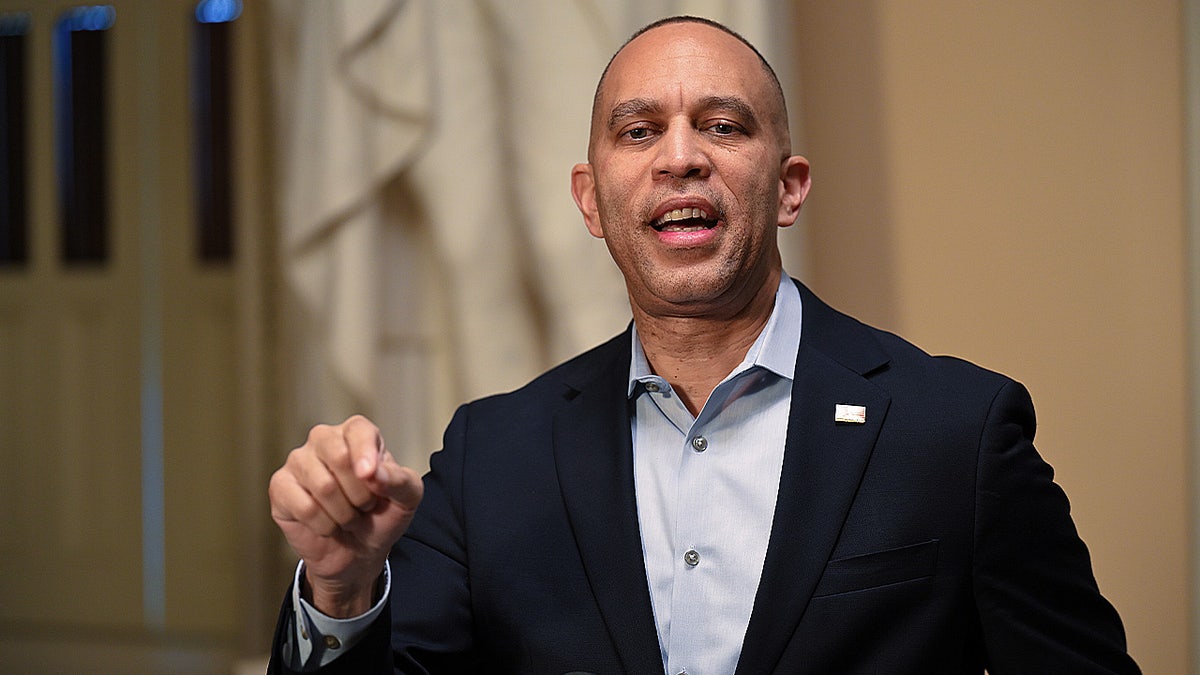
“It’s our expectation that we will respond to the unserious offer that Republicans have made that clearly omits things that need to happen,” House Minority Leader Hakeem Jeffries, D-N.Y., said during a press conference.
“There are a variety of different areas where clearly the administration has fallen short of doing things that make things better for the American people. Until that happens, unfortunately, it appears that Donald Trump and the Republicans have decided to shut down other parts of the Department of Homeland Security.”
Democrats blew up bipartisan negotiations over DHS funding last month after federal law enforcement agents killed two U.S. citizens in Minneapolis during anti-ICE demonstrations there.
House Minority Leader Hakeem Jeffries speaks during a press conference on Capitol Hill on Nov. 3, 2025, in Washington, D.C. (Roberto Schmidt/Getty Images)
They are now demanding significant reforms to rein in ICE and CBP, many of which Republicans in Congress have long panned as non-starters, including banning ICE agents from wearing masks and requiring them to obtain judicial warrants before pursuing suspected illegal immigrants.
What happens next will be up to Senate Democrats and the White House, who are expected to continue negotiating through the weekend and into next week if need be.
Both sides have traded proposals and legislative text on a compromise DHS funding bill, but Senate Minority Leader Chuck Schumer, D-N.Y., and his caucus remained steadfast in their position that the GOP’s offer didn’t go far enough.
Meanwhile, the majority of House and Senate lawmakers left Washington on Thursday and are not currently expected to return until Feb. 23.
Senate Majority Leader John Thune, R-S.D., said that he would give lawmakers 24 hours’ notice to return to Washington, D.C., should there be a breakthrough, and remained optimistic that there was a path forward despite Democrats’ blockade.
Senate Minority Leader Chuck Schumer, D-N.Y., turns to an aide during a news conference at the Capitol in Washington, June 3, 2025. (J. Scott Applewhite/AP Photo)
“Every iteration of this gets a step closer, because I think the White House is giving more and more ground on some of these key issues,” Thune said. “But so far, they’re not getting any kind of response to Democrats, even allowing us to continue this, allowing [the] government to stay open.”
But Democrats have reiterated several times that they believe their demands are simple.
“Again, the only — the fundamental ask is that ICE abide by the same principles and policies of every other police force in the country, and if we can get there, then we can resolve the problem,” Sen. Angus King, I-Maine, said.
Meanwhile, Speaker Mike Johnson, R-La., gave House lawmakers his blessing to leave Washington with a 48 hours’ notice to return pending Senate action, two sources told Fox News Digital.
Elizabeth Elkind is a politics reporter for Fox News Digital leading coverage of the House of Representatives. Previous digital bylines seen at Daily Mail and CBS News.
Follow on Twitter at @liz_elkind and send tips to elizabeth.elkind@fox.com
Donald Trump says regime change in Iran “would be the best thing that could happen” as a second US aircraft carrier is deployed to the Middle East.
The US president made the remarks after visiting troops at Fort Bragg in North Carolina on Friday, where he was pressed by reporters on whether he wanted to see a change in government in Iran.
“It seems like that would be the best thing that could happen,” Mr Trumpsaid.
“For 47 years, they’ve been talking and talking and talking.
“In the meantime, we’ve lost a lot of lives while they talk. Legs blown off, arms blown off, faces blown off. We’ve been going on for a long time.”
Mr Trump declined to name who he hoped would assume control from the clerical regime, saying only “there are people”.
Image:Mr Trump and first lady Melania Trump arrive at Palm Beach International Airport on Friday. Pic: PA
He said the world’s largest aircraft carrier, the USS Gerald R Ford, was being sent to the Middle East in case talks between the US and Iran fail to produce an agreement.
“In case we don’t make a deal, we’ll need it,” he said.
“It’ll be leaving very soon.”
The USS Gerald R Ford reallocation forms part of a build-up of US military assets in the Middle East amid deepening tensions between Washington and Tehran.
The USS Abraham Lincoln and accompanying guided-missile destroyers were deployed last month.
Image:Mr Trump speaks to reporters at Fort Bragg. Pic: PA
Last week, US forces shot down an Iranian drone that approached the USS Abraham Lincoln on the same day that Iran tried to stop a US-flagged ship in the Strait of Hormuz.
Iranian and American officials met in Oman last week for talks, but an agreement has not been reached.
Mr Trump has repeatedly threatened to take military action against Iran if the government uses force to suppress anti-regime protests.
Onboard USS Abraham Lincoln in Arabian Sea
On Friday, Mr Trump suggested that a deal could still be struck with Iran to avoid US military action.
“Give us the deal that they should have given us the first time,” he said. “If they give us the right deal, we won’t do that.”
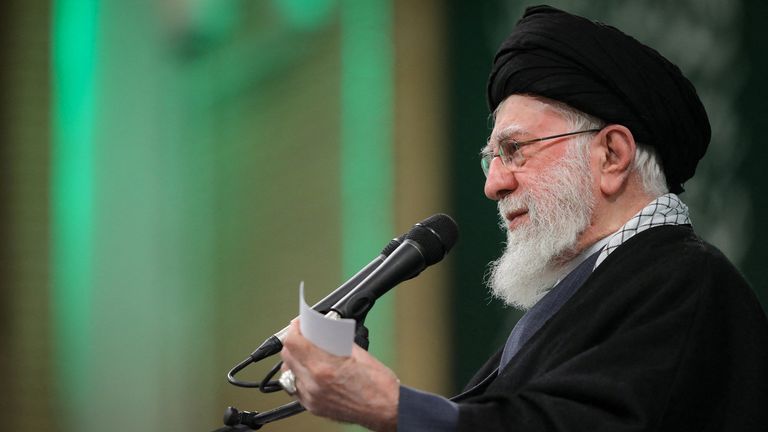
Supreme Leader Ayatollah Ali Khamenei has said that any US military action against the country would plunge the entire region into war.
Image:Iran’s Supreme Leader Ayatollah Ali Khamenei speaks in Tehran. Pic: Reuters
More talks between Washington and Tehran are anticipated, with a US delegation including Middle East envoy Steve Witkoff and Jared Kushner due to meet with the Iranians on Tuesday, sources have told Reuters.
Iran’s nuclear programme has also been a repeated source of tension, with Mr Trump suggesting that one of his top priorities was for Tehran to scale back its atomic programme.
Spotify
This content is provided by Spotify, which may be using cookies and other technologies.
To show you this content, we need your permission to use cookies.
You can use the buttons below to amend your preferences to enable Spotify cookies or to allow those cookies just once.
You can change your settings at any time via the Privacy Options.
Unfortunately we have been unable to verify if you have consented to Spotify cookies.
To view this content you can use the button below to allow Spotify cookies for this session only.
But on Friday he suggested that was only one aspect of the concessions the US expected from Iran.
“If we do it, that would be the least of the mission,” Mr Trump said about targeting Tehran’s nuclear programme.
Israeli Prime Minister Benjamin Netanyahu, who met with Mr Trump in Washington this week for talks, has pushed for any deal to include steps to neutralise Iran’s ballistic missile programme.
The US targeted Iran’s nuclear facilities in strikes in June in the culmination of the 12-day war between Iran and Israel.
There was a dispute after finding out about nephew’s love affair with aunt and the husband refused to keep his wife with him citing fear of blue drum. After this, after getting the marriage of aunt and nephew done at Doghat police station, they were sent together. The whole matter has become a topic of discussion among the people.
Trending Videos
2 of 5
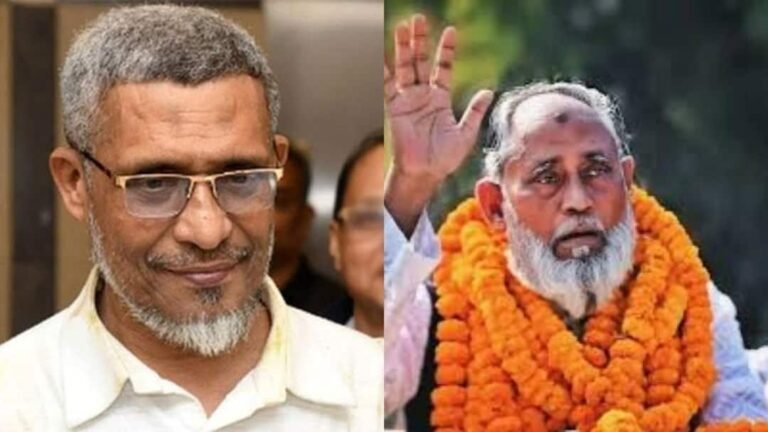
Nephew garlanding his aunt – Photo: Amar Ujala
The love affair was going on for five years A woman resident of a town in Doghat area of Baghpat, UP, was having an affair with her brother-in-law’s son for the last five years. It was told that on Friday, the woman’s husband came to know about the love affair going on between the two. After this, there was a fight between the husband and wife and the husband refused to keep his wife with him while keeping both the sons with him.
3 of 5
Husband – Photo: Amar Ujala
Husband afraid of blue drum incident After this, he threw his wife out of the house, telling her to stay with her nephew. After coming to know about this, the dignitaries of the town tried to convince the husband, but he did not agree. The husband says that the Blue Drum incident has taken place in Meerut and at many places husbands have been murdered in love affairs.
4 of 5
The villagers got both of them married – Photo: Amar Ujala
Villagers got aunt and nephew married He said he did not want to take his wife with him because of his fear of blue drums. After this, the woman, her husband and lover nephew along with their father reached Doghat police station on Friday evening, where they told the whole story to the policemen. The woman and her lover nephew told that they are going out of the town of their own free will and will earn their living by working as laborers there. Then some people of the town also came there and in front of them, the husband got married to his wife and his lover nephew by putting garlands around the neck of both of them.
5 of 5
Villagers present at the spot – Photo: Amar Ujala
police statement On the other hand, the woman’s maternal family refused to come to the police station. In this case, investigating officer Suryadeep Singh says that such a case had come to light, but no one gave a written complaint. Outside the police station, both of them garlanded each other. After this both the parties left from there.
Bangladesh Politics: This time there has been a big and shocking turn in the politics of Bangladesh. After the general elections, three such leaders have suddenly become lucky, who till some time back were facing serious charges and some of whom had even received death sentence. Among these, two leaders are from Bangladesh Nationalist Party, which is led by Tariq Rahman, and one leader is associated with Jamaat-e-Islami.
These three leaders were involved in big matters at the time when Sheikh Hasina left the country and went to India. After this, Nobel laureate Muhammad Yunus returned and took over the power of Bangladesh. After his arrival, all the cases pending against these three leaders were closed.
Who are these three leaders?
The first two leaders are Lutfozzaman Babar and Abdus Salam Pintu, who are from Bangladesh Nationalist Party. The third leader is ATM Azharul Islam, who is associated with Jamaat-e-Islami. Now all three are going to be part of the new Parliament. This is the same Bangladesh, whose relations with India have been tense for some time.
In December 2024, a Bangladesh court acquitted Tariq Rahman, Lutfozzaman Babar and some others in cases related to the grenade attack of 21 August 2004. This attack was targeted at Sheikh Hasina. She was saved, but 24 people lost their lives in this attack. In this election, Lutfozzaman Babar defeated his nearest rival by about one lakh sixty thousand votes.
Pintu is a name of concern for India
India is said to be more concerned about Babar’s companion Abdus Salam Pintu. About a year after Babar’s acquittal, Pintu also got relief and the charges against him were dropped. Pintu was accused of supporting a terrorist organization of Pakistan, which is accused of many attacks in India. These include the blast in Varanasi court complex, blast in Ajmer Sharif Dargah and blasts in Delhi. This time Pintu has won by about two lakh votes.
story of azhar ul islam
The third “lucky” leader is Azhar ul Islam, an old leader of Jamaat. He has been in politics since 1998 and was also the General Secretary of the organization till 2012. He was accused of being responsible for the death of more than twelve hundred people during the liberation war of 1971. Apart from this, thirteen rape cases were also registered against him. In all these cases, he was sentenced to death in 2014, but later during the Yunus regime, he was pardoned and acquitted of all charges. The names of these three leaders were once associated with the death penalty, but now in a few days, when Tariq Rahman will take oath, all three of them will sit in the Parliament of Bangladesh.
Delhi’s vision and future politics
From New Delhi’s perspective, this election result shows a completely different path from the era of the Yunus-led interim government. According to Indian officials, that time was full of turmoil. Now everyone’s eyes are on Tariq Rehman. Indian officials are expressing “cautious optimism” about them. He believes that even though there may have been differences with his party’s governments earlier, now Tariq Rehman can adopt a more practical policy considering the economic needs of the country and the peace of the region.
Canadian prime minister Mark Carney has told residents of Tumbler Ridge that the country is “with you, and we will always be with you”, during a candlelight vigil for the eight victims of a mass shooting that has shattered the small mining town.
The prime minister, holding hands with opposition leader Pierre Poilievre while flanked by First Nations chiefs and local officials, paid tribute to the families enduring the loss of loved ones, after the shooting at a local school that has become one of the most deadly attacks in Canadian history.
“I know that nothing I can say will bring your children home,” the prime minister told nearly 2,000 people huddled in the cold and holding candles. “I know that no words from me or anyone can fill the silence in your homes tonight, and I won’t pretend otherwise.”
On Tuesday, an 18-year-old transgender woman opened fire at the Tumbler Ridge Secondary School, killing five students and a teacher, after earlier killing her mother and stepbrother at home. The attacker then took her own life.
Police recently released the names of the victims from the school, and at the vigil, leaders remembered Kylie Smith, Abel Mwansa, Zoey Benoit, Ticaria Lampert, Ezekiel Schofield and educator Shannda Aviugana-Durand.
Mark Carney speaks to community members during the vigil. Photograph: Paige Taylor White/AFP/Getty Images
Maya Gebala, 12, who was wounded in the head and neck, and Paige Hoekstra, 19, who also suffered bullet wounds, remain hospitalized in Vancouver.
“When we leave here tonight and some of you go back to quiet houses, some of you go back to empty rooms, please know that you’re not alone,” Carney said. “Canada is a community that relies on each other’s grace, and may that grace bless us all.”
Earlier in the day, federal leaders walked to the memorial outside the school, meeting for the first time with victims’ families. Both Carney and Poilievre fought back tears as they spoke with victims’ families for the first time.
The two, who have clashed politically in recent weeks, have set aside partisan differences in order to show a unified front – a move welcomed by residents of the town.
“Today, there are no Conservatives. There are no Liberals, New Democrats, Greens or Bloc Quebecois” said Poilivre. “We are all just mothers and fathers. We all watch our kids going to school, expecting them to come back to us”.
Poilievre commended Carney for his “tremendous grace” and the two leaders joined hands as an Indigenous leader sang a prayer outside the town hall.
Prime minister Mark Carney and Conservative leader Pierre Poilievre join hands while attending the vigil. Photograph: Canadian Press/Shutterstock
Leaders praised the acts of heroism and courage they said defined the town and its residents. British Columbia premier David Eby singled out one teacher who “did everything right” by barricading students in a classroom, even though his own son had left the class to use the bathroom. Eby credited older students for comforting and protecting younger students.
Eby also promisedthe students that, under no circumstances, would any be forced to return to the school. “We will provide a safe place for you to go back to school.”
Dwayne McDonald, the deputy commissioner of the Royal Canadian Mounted Police in British Columbia, said earlier Friday that the alleged shooter did not appear to be searching for a specific target at the school.
“This suspect was, for lack of a better term, hunting,” McDonald said. “They were prepared and engaging anybody and everybody they could come in contact with.”
McDonald described a “chaotic” scene at the school when police arrived, with fire alarms sounding and a person yelling out a window that the suspect was upstairs.
“They entered the school, proceeded to go up the stairwell, and were met with gunfire,” he said. “It was a matter of seconds after that there was more gunfire, not as we know now, having reviewed video, directed at any persons. Then the suspect took their life.”
Mayor Darryl Krakowka told the community to “make space” for each other, warning that the coming days would reveal the immense difficulty of returning to the routine of daily life. But he praised their resilience.
Access Denied
You don’t have permission to access “http://hindi.gadgets360.com/science/asteroid-162882-name-2001-fd58-biggest-asteroid-2026-coming-near-earth-today-nasa-update-news-11002088” on this server.
Nablus, occupied West Bank – Before he was killed by an Israeli drone 18 months ago at the young age of 17, Wael Mesheh was an aspiring university student who was wanted to be a successful computer programmer.
But having seen five of his relatives and friends cut down by Israeli forces during almost daily raids of his northern West Bank refugee camp of Balata, the Palestinian teenager came to believe that life and death were the same, engendering a desire to sacrifice himself for the cause of Palestinian freedom, and therefore turning himself – in his belief – into a “martyr”.
Recommended Stories
list of 3 itemsend of list
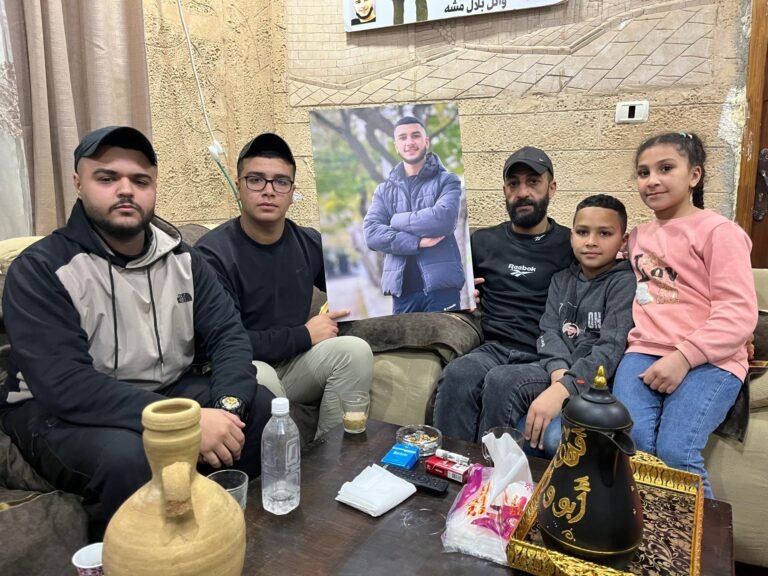
“What our family was suffering planted this desire inside him: He always knew he wanted to fight and see his country without occupation,” Wael’s 47-year-old father, Belal, told Al Jazeera.
“And it was not just Wael, but many of his generation in the camp.”
Before he turned 17, Wael had been imprisoned for throwing stones at Israeli soldiers, assaulted in jail, and then freed in a prisoner exchange deal.
He joined the Qassam Brigades – the armed wing of Hamas – once he got out of prison, and was eventually killed in August 2024 while fighting Israeli troops near his home in Balata, southeast of Nablus.
Wael’s story is typical of many young Palestinians in the West Bank’s refugee camps. Children learn from an early age that trauma will define their lives in ways even other Palestinians are spared.
Psychologists from the West Bank told Al Jazeera young people in the camps face “incessant traumatisation”, and most are deprived of “safety, places to play, opportunities, and a chance to escape”.
Instead, as the offspring of refugees denied the right to return to their homeland, they face a life surrounded by poverty, death, and Israeli military violence.
They are part of Palestinian society, yet remain marginalised within it – without the sense of belonging others take for granted.
The conditions endured by those in the camps make them a breeding ground for armed resistance to Israel.
Belal says that it was Wael’s time in prison that eventually pushed him to fight. He says that Wael was tortured by guards for being defiant, and was kept in solitary confinement. He was eventually released as part of the November 2023 prisoner exchange deal, at the start of Israel’s genocidal war on Gaza.
The Balata refugee camp in the occupied West Bank has been repeatedly attacked by Israeli forces [Al Jazeera]
Defenders of the camps
The West Bank’s 19 refugee camps, once makeshift tented communities when they were established in 1948 after Israel’s founding and intended to be temporary, are now densely populated built-up areas housing the descendants of hundreds of thousands of refugees.
The older generations remember being forcibly expelled from their homes in historical Palestine by Zionist militias in the 1948 Nakba to pave the way for the creation of an Israeli state.
The United Nations Relief and Works Agency (UNRWA) describes the camps as dominated by poverty, severe overcrowding, and joblessness. The camps are also the primary targets of Israeli military operations in the West Bank.
Without the prospect of a normal childhood for their occupants, the lure of fighting Israel can often prove irresistible.
Nablus-based psychologist, Nisreen Bsharat, said “martyrdom”, particularly for those in the camps, is viewed as the ultimate demonstration of faith and resilience.
Bsharat, who works with young people and grieving mothers from Balata, said martyrdom is seen as a “’heroic’ contribution to Palestine”, and that martyrs and their families are celebrated as such.
Those who fight against Israel are seen as “role models” when so few opportunities exist in refugee camps, Bsharat added.
“Historically, martyrdom is tied to our national identity,” she said. “It’s seen as the least we can offer our homeland, and part of our duty.”
Though far from an exclusively Islamic concept, Palestinians often refer to those who are killed by Israeli forces as martyrs, believing they sacrifice their lives fighting for their nation, Islam, and the Holy Land – and believe that God promises them their place in paradise.
Bethlehem-based clinical psychologist and academic, Amanda Manasra, who was born in Aida refugee camp, and focuses on trauma in Palestine, told Al Jazeera the vast majority of camp residents live with untreated complex post-traumatic stress disorder (CPTSD), which is significantly more difficult to cure.
The harsh environment of the camps creates a revolutionary fervour that is far less common in wealthier areas, Manasra added.
“The idea of martyrdom is related to how Palestinians find meaning to deal with hardship, individually and collectively,” she said.
“Many of my cases are adolescent men from the camps – many former prisoners – who have lost so many friends and family members.
“Joining the resistance is about taking control – it can feel like a reward for experiencing hardship, and can satisfy feelings of retribution.
“The fighters feel they have survived, persisted, and beaten the occupation war machine.”
Camps in the northern West Bank came under even more relentless attack since Israel launched “Operation Iron Wall” in January 2025, which has displaced tens of thousands of refugees in nearby Jenin and Tulkarem, and killed hundreds.
Tributes to Palestinians killed fighting Israel are visible across Balata [Al Jazeera]
Psychological toll
Belal, who spent eight years in Palestinian Authority (PA) prison during Wael’s childhood, feels the pain of his son’s loss deeply.
They both had only ever known the narrow, labyrinthine streets and decrepit buildings of Balata, the most populous refugee camp in the West Bank. But Belal feels that he wasn’t able to be there to guide Wael through them.
“I didn’t get the chance to see Wael growing up, or spend time with him as all other fathers do,” he said, unable to fight back his tears.
“I envy his mother and brother because at least they lived with him. They have beautiful and plentiful memories with him, shared moments.
“Do you know what it feels like to carry your son on your shoulders, place him in his grave, and bury him with your own hands? It is the hardest thing in the world.”
Belal, whose brother was also killed by Israel when he was younger, said he and his son had so many plans for when he would be released from prison.
In the end, Belal was freed only on compassionate grounds so he could see Wael for the final time before he was buried.
Israel’s actions breed hatred
For those in Nablus’s refugee camps, violent incidents like Wael’s killing are nearly a weekly reality – and a doom-laden reminder that death lurks around every corner.
Belal recalled Wael becoming deeply affected as a child by the 20-year imprisonment of his closest uncle, after whom he was named. Later, he became preoccupied with avenging those close to him whose lives he says Israel had stolen. Four of Wael’s cousins had been killed in the 12 months preceding his death.
“Of course, it was also the constant invasions and the violence he grew up around, and the barbaric way the soldiers treat us,” Belal told Al Jazeera.
“Every night, we experience the atmosphere of Israel’s raids. We’re forced to accept this life – we have no choice but to adjust.”
Belal said that when Wael was growing up, there were no youth clubs or even parks that could take his mind off the harsh life in the camp. He added that soldiers had once raided the family’s house and destroyed “literally everything”.
“It’s actions like these that breed hatred toward them.”
Belal specifically remembered Wael, who had just begun high school, being enraged by footage of Israeli soldiers beating women in Al-Aqsa Mosque in occupied East Jerusalem, one of Islam’s holiest sites.
“Wael couldn’t accept that soldiers would beat women and girls,” he said. “It was intolerable for him.”
Wael’s surviving family live in a crowded second-floor apartment near the centre of the camp, and his father, two of his brothers, his little sister, and his grieving mother took turns tearfully eulogising him.
His mother, Hanadi, was beaten, and his brother, Ibrahim, was also detained as soldiers broke into their apartment late at night to arrest Wael.
Hanadi was shocked by Wael’s condition once he was released from prison.
“The marks of torture remained on his body even after his release,” she said. “Burn scars from extinguished cigarettes were visible on his back and hands.”
Refugee camps under siege
Balata has often been a target for the Israeli military, and, according to the UN, 30 people have been killed in the camp since Israel intensified its attacks on the West Bank following Hamas’s October 7 attacks.
The pictures of Palestinians killed fighting Israel are emblazoned, like shrines, on the camp’s walls.
About 33,000 people are crammed into Balata’s narrow streets. It spans an area of 0.25 square kilometres (0.1sq miles), and has one of the highest rates of unemployment and food insecurity anywhere in the territory, according to UNRWA.
On August 15, Wael and two other fighters rushed to confront an incursion of Israeli soldiers when they were struck by a drone on the camp’s main street. Wael and fellow fighter Ahmad Khalil were killed instantly, while four others, including children, were injured.
Hanadi described the camp being surrounded by soldiers while gunshots rang close by, as she comforted her younger children.
“The moment I heard the sound of the missile, I knew he had been martyred,” she said.
“I started praying for God to accept him and to give me strength to bear this calamity.
“I also prayed that his face would remain unharmed because he always wished his face wouldn’t be disfigured so we could say our goodbyes to him properly.”
Tsunami of trauma
Manasra said there is a tsunami of untreated mental health problems across the West Bank, while services remain hopelessly stretched, underfunded, and inaccessible for most.
She says the glorification surrounding resistance to Israel and martyrdom also obscures a more difficult reality of unprocessed grief and trauma that lingers with individuals and families forever.
Supporting families in the camps like Belal’s is nearly impossible when services are so costly and restricted, she says.
Without any such mental health support, Belal spoke of his suffering and told Al Jazeera that, since his son’s death, “joy has not entered our house”.
“We may smile or laugh at each other to show politeness, but inside, it’s different,” he added.
“Inside, there’s only fire – and pain.”
Too often, the burden of resistance falls on the poorest residents of the West Bank’s refugee camps.
In each case, the reason for resisting is different. But there are nearly always similarities: Hardship, piety, retribution, and a sense of duty to one’s country.
The pride found in resisting only briefly distracts from the deep scars left by Israel’s occupation, which is tightening its grip over the West Bank – particularly in the refugee camps.
The surviving families of those killed are left somewhere between terrible grief and hopeful adulation.
“When I sit alone, I imagine Wael beside me,” Belal added.
“Sometimes, I feel like hugging his picture tightly to my chest as I cry my heart out.
“He was a role model even for me. I bid him farewell with complete serenity – I know God will accept him as a martyr.”
Wagner Moura and Kleber Mendonca Filho, star and director of political thriller The Secret Agent, have been delayed, slightly, I’m told.
A few minutes turn into quite a few more minutes, which is not usually a promising sign when it comes to interviewing film stars and filmmakers, but it turns out there’s a good reason – an unexpected phone call from the president of Brazil. Not the kind of caller you send to voicemail.
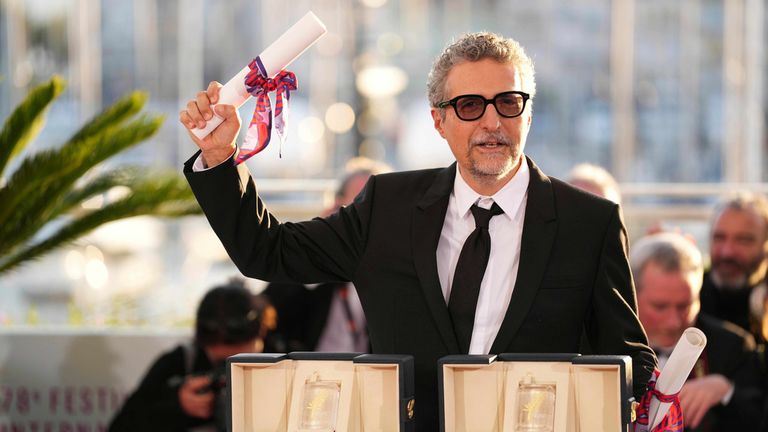
Luiz Inacio Lula da Silva, known as Lula, wanted to congratulate them on the film’s success: a string of honours starting with major wins at the Cannes Film Festival back in May, which now includes a Critics Choice award, Golden Globe wins for best actor and best non-English language film, plus two BAFTA and four Oscar nominations.
Image:Moura celebrating his win at the Golden Globes. Pic: Chris Pizzello/ AP
As the first Brazilian ever to be nominated for best actor, Moura has made Academy Awards history.
“I think it’s meaning a lot to Brazilians, especially because we went through a very bad moment in our history where artists and culture were seen in a very negative way,” says Moura. “It’s a huge transformation, you know, and it’s a big change.”
Veteran leftist Da Silva returned as Brazil’s president after beating the far-right incumbent Jair Bolsonaro in 2022. In November last year, Bolsonaro began a 27-year prison sentence for plotting a coup after his election loss.
The former leader’s three-year tenure was marked by misogynistic and homophobic rhetoric, and a hostility towards culture and the arts; things have changed dramatically under Da Silva.
Image:Kleber Mendonca Filho was named best director at Cannes, where The Secret Agent was the most awarded film. Pic: Scott A Garfitt/Invision/AP 2025
“We went from living in a country where we were seen, perceived by the power as enemies of the people to a moment where the president himself is calling us to say that, hey, we are proud of you,” says Moura. “The president saying that ‘I see the culture, I see films, I see books, I see this as an important tool to the development of the country’. It’s a reconnection.”
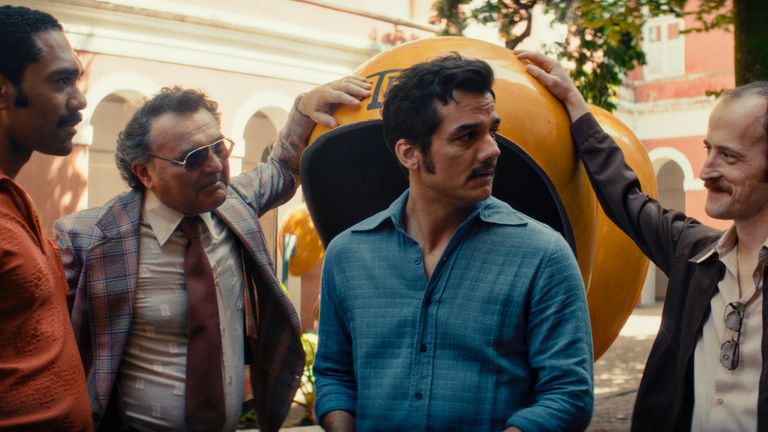
The Secret Agent is set in 1977, during the brutal military dictatorship in Brazil that lasted for more than 20 years, and Moura plays Armando, a professor forced into hiding after clashing with a regime official. While it started as a period thriller, the echoes of recent history are there.
Image:Wagner Moura in The Secret Agent. Pic: MUBI/ CinemaSco’pio/ MK Production
Image:Pic: MUBI/ CinemaSco’pio/ MK Production
‘It requires courage to stick to your values’
The Portuguese-language film is up there among the most celebrated of Hollywood’s awards season, particularly following Moura’s best actor win at the Globes, over favourite Michael B Jordan for his portrayal of twin brothers in Sinners.
Mendonca Filho says the part of Armando was “tailor-made” for Moura. After years of talk about making something together, “it only worked when I finally sat down to write a script thinking specifically about working with him”.
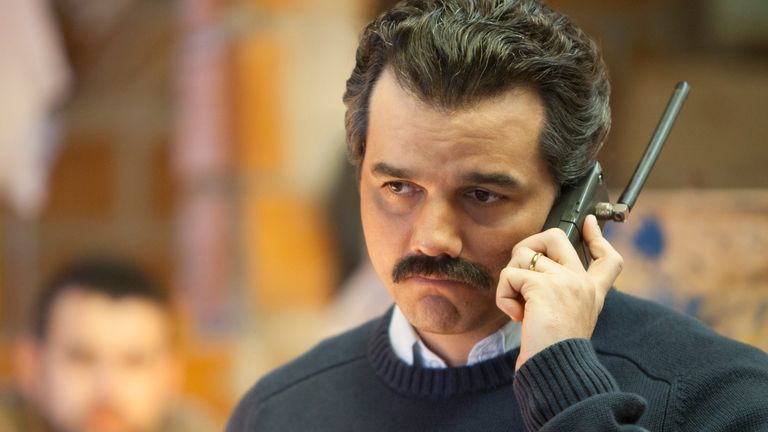
Moura, who is better known globally for his portrayal of notorious Colombian drug lord Pablo Escobar in the hit series Narcos, says the film is about generational trauma and values, and he was able to draw from his own experiences.
Image:Wagner Moura in Narcos. Pic: Juan Pablo Gutierrez/Netflix
“This film is about a man who is sticking with the values he has, during the dictatorship, which are obviously values that are opposite to [his],” he says.
“What Kleber and I went through during the Bolsonaro time in Brazil is a big example of that. It requires a lot of… courage to stick with your values when what’s established around you says the opposite, especially in this polarised world.
“I think that it’s getting harder and harder because the idea of truth is disappearing, you know… facts, they don’t matter anymore.”
There was once a time when the right and the left “would discuss and we would even fight over something, but we were both seeing the same thing”, he continues. “Nowadays, it’s not about facts anymore, it’s about versions, so we are not living in the same mental space, which is a very dangerous thing.”
Red carpet award controversy
But people are connecting with The Secret Agent. Since Cannes, Moura says, “this film has been receiving so much attention, steadily – it hasn’t dropped – which is very rare and kind of amazing, especially for a Brazilian film”.
Which is why a move to hand out the Critics Choice award for best international feature film on the red carpet, rather than during the ceremony itself, proved particularly controversial.
The awards hierarchy is nothing new, with the Oscars criticised in recent years over plans not to televise certain technical (read: not enough star-power) awards to tighten the broadcast time.
But Filho, who was clearly caught by surprise as he was unceremoniously handed his Critics Choice prize, says now – as Donald Trump’s controversial immigration crackdown continues in the US – is a particularly troubling time to make such a decision around international films.
“I think politically, whoever made that decision doesn’t seem to have a pulse on what is taking place in the world now and in the United States,” he says. “I think once you invite someone to your party, just give him or her all the drink that he or she deserves, you know, don’t say, oh I don’t have the right to drink this like everybody else.”
Moura highlights the many brilliant non-English language films in the awards conversation this year, including Sentimental Value, submitted by Norway, Sirat (Spain) and It was Just An Accident (France).
“In a year where the international films are great… politically, it doesn’t feel right at all.”
Now is an important time for filmmakers, says Filho. “It does feel like the world is sliding back into a moment of conflict. And it’s happening in many different areas and authoritarians are also back in a big way.
“So as much as it feels so bad and we worry to death about what is taking place, it’s also a very fertile moment to develop stories and tell stories, because the irony of present-day use of power is something that is part of our lives.”
A major administrative reshuffle was made in Bhopal at midnight, in which 11 IAS and 4 State Administrative Service officers were transferred. These orders were issued by the state government and major changes were made in the responsibilities of many departments. Some officers were also given additional charges.
In this reshuffle, Manish Singh has once again been given the responsibility of Public Relations Department. He has also been given the additional charge of Commissioner Public Relations, Transport Secretary and many other institutions. Changes have been made in the public relations department within four months.
Their names also included in transfers
Deepak Kumar Saxena, who was the Public Relations Commissioner, has now been made the Excise Commissioner, Gwalior. Abhijeet Aggarwal, who was Excise Commissioner, has been appointed Managing Director, Madhya Pradesh State Cooperative Marketing Federation, Bhopal. Ajay Gupta has been removed from Farmer Welfare and Agricultural Development and made the Managing Director of East Region Electricity Distribution Company, Jabalpur.
Umashankar Bhargava has returned from Raj Bhavan after eight months and has been made Director, Farmers Welfare and Agricultural Development. Sunil Dubey has been appointed Deputy Secretary, Raj Bhavan, Bhopal. Sanghamitra Gautam has been made the Chief Executive Officer of District Panchayat, Alirajpur.
Important responsibility to senior officers
Additional Chief Secretary Ashok Baranwal has been given additional charge of Public Health and Medical Education Department, Bhopal Gas Tragedy Relief and Rehabilitation Department, Agricultural Production Commissioner, Environment Department, Environment Commissioner, Director General APCO and Commissioner Food Safety. Principal Secretary Sandeep Yadav has been given the additional charge of Principal Secretary of Forest Department and Overseas Indian Department.
other transfers
Nanda Bhalave Kushere has been made Additional Project Director, National Secondary Education Campaign, Bhopal and Deputy Secretary. Kamal Solanki has been given the responsibility of Chief Executive Officer, District Panchayat Raisen. Shivshekhar Shukla has been given the responsibility of Additional Chief Secretary, Home Department, Culture Department, Religious Trust and Endowment Department along with Swaraj Sansthan and Bharat Bhavan.
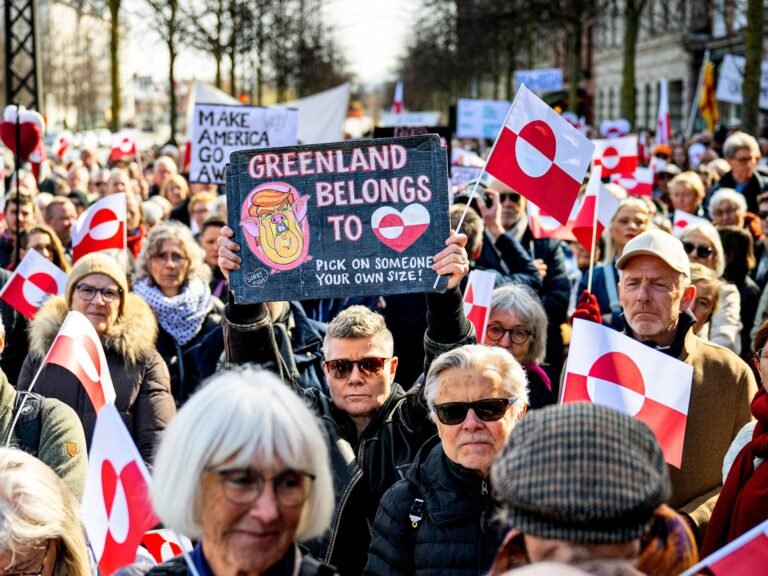
New opinion poll finds seven in 10 US adults disapprove of President Donald Trump’s handling of Greenland issue.
Denmark’s prime minister and Greenland’s premier met with United States Secretary of State Marco Rubio and agreed that talks would be pursued on the running of Greenland, the semi-autonomous Danish territory that President Donald Trump has threatened to take over.
Rubio held a 15-minute meeting with Danish Prime Minister Mette Frederiksen and Greenland’s Premier Jens-Frederik Nielsen on the sidelines of the Munich Security Conference on Friday.
Recommended Stories
list of 4 itemsend of list
Greenland’s leader Nielsen said in a post on social media that during the meeting with Rubio, “it was emphasised that the conversations being made are the right way forward and the interests of Greenland were once again clearly highlighted”.
Prime Minister Frederiksen said on X after the meeting: “Constructive talk with Secretary of State Marco Rubio together with Jens-Frederik Nielsen, Chairman of Naalakkersuisut, at the Munich Security Conference.”
“Work will continue as agreed in the high-level working group,” she said.
The meeting between the Danish and Greenlandic leaders and the US state secretary comes amid severely strained ties between Europe and Washington, and NATO allies, amid President Trump’s repeated threats to take over Greenland and criticism of European nations as “decaying” and “weak”.
Speaking to reporters on Friday, Trump said, “We’re negotiating right now for Greenland.”
“I think Greenland’s going to want us, but we get along very well with Europe. We’ll see how it all works out,” he said.
After months of bellicose language regarding the US’s necessity to acquire Greenland, Trump abruptly stepped back from his threats last month, saying that he had reached an understanding with NATO Secretary-General Mark Rutte that would give the US greater influence in the mineral-rich Arctic territory.
Late last month, the US, Denmark and Greenland also launched talks to find a diplomatic path out of the crisis.
Poll finds most US adults disapprove of Trump’s Greenland plan
The US administration has cited key national security concerns related to Russia and China to justify its demand to take control over Greenland and has accused Denmark, and Europe more broadly, of being unable to defend the strategic territory.
But, according to a new opinion poll conducted by The Associated Press and NORC Center for Public Affairs Research, Trump’s push to seize control of Greenland has gone down badly with the US public and members of his own party.
The survey, conducted between February 5-8, found that about seven in 10 US adults disapprove of how Trump is handling the Greenland issue – a higher disapproval rating than the share of those who dislike how he is handling foreign policy generally.
Even among Republican supporters, about half disapprove of his attempt to turn Greenland into US territory, according to the poll.
Sweden said on Thursday that it would send fighter jets to patrol Greenland as part of a newly launched NATO mission in the Arctic aimed at placating Trump’s concerns over the threats posed by Moscow and Beijing.
The government said in a statement that Swedish-made Gripen fighter jets would patrol Greenland as part of the newly-launched NATO mission, Arctic Sentry.
“As a NATO ally, Sweden has a responsibility to contribute to the security of the entire territory of the Alliance. The Arctic region is becoming increasingly important from a strategic perspective,” Sweden’s Prime Minister Ulf Kristersson said.
In a separate statement, the Swedish Armed Forces said the fighter jets would be based out of Iceland, where six aircraft have been stationed since early February as part of the rotating incident response force, NATO Air Policing.
Swedish special forces would also be sent to Greenland to take part in training exercises for a couple of weeks, the military said.