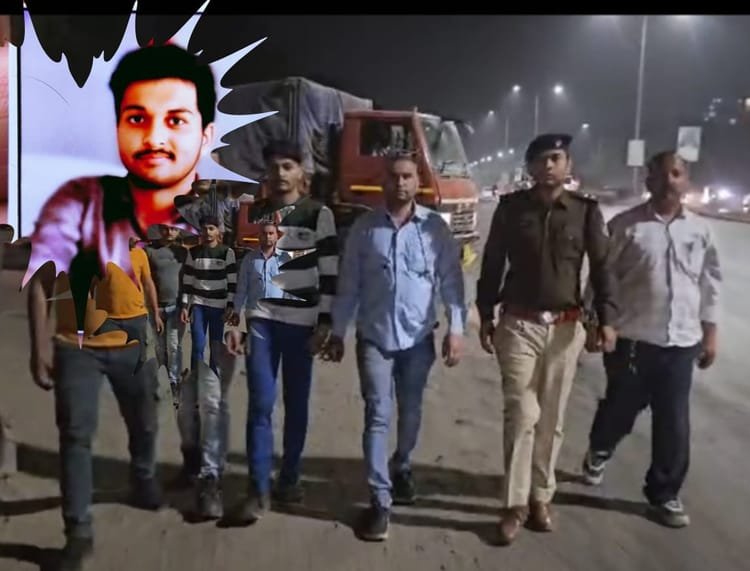
Police interrogation of Piyush, the accused who murdered an MBA student in Indore, is going on. He had told the police that he was drunk and had taken power enhancing pills before the murder. After coming to the room, he had a dispute with the student.
After this, he got so bleeding that he killed the student. The accused was unhappy with the student’s refusal to have physical relations after coming to the room.
drank alcohol after murder
The accused had tied the student’s hands and legs and strangled her by stuffing a cloth in her mouth. After the murder, he did not run away immediately, but remained sitting in the room. He then drank alcohol and misbehaved with the dead body. Later he closed the windows and doors and ran away after locking the door. He knew that he could be caught due to the location of his mobile, hence he bought a new SIM before going to the railway station. It was also revealed that he himself wanted to commit suicide by jumping from the train.
It has also come to light that he had performed Tantra Kriya by placing flowers and kumkum in front of the photo of the student in Mumbai. He felt that by doing this the student’s soul would talk to him. He kept traveling in Mumbai railway stations and trains for three days. During this time he had contacted his family members on phone. Then Indore Police came to know that he was in Mumbai. Police arrested him with the help of Andheri police and brought him to Indore. On the other hand, his family members were also made to confront the accused.
There could be a death sentence
No old criminal record of the accused student has been found. According to legal experts, the circumstances under which he committed the murder could get him the death penalty. If the police proves the rape before and after the murder in the court and the court considers it to be the rarest of the rare, then it can award death sentence or even life imprisonment.
Shares of IT major Infosys rose more than 3 per cent on Tuesday after the company said it has entered into a strategic collaboration with Anthropic to develop and deliver advanced enterprise artificial intelligence (AI) solutions.
On the BSEthe scrip of company increased 3.27 per cent to ₹1,410.95 per piece.
BSE-focussed IT index gained 1.45 per cent, with Infosys emerging as the top performer.
Markets are trading in the positive territory, with the 30-share BSE Sensex rising 126.19 points, or 0.15 per cent, to 83,403.34.
Infosys on Tuesday announced a strategic collaboration with Anthropic, an AI safety and research company, to develop and deliver advanced enterprise AI solutions to companies across telecommunications, financial services, manufacturing, and software development.
The Bengaluru-based Infosys said the collaboration with Anthropic will focus initially on the telecommunications sector through a dedicated Anthropic Center of Excellence to build and deploy AI agents tailored to industry-specific operations.
The partnership will further expanded across industries, including financial services, manufacturing, and software development, the company said in a regulatory filing.
At its core, the strategic alliance integrates Anthropic’s Claude models, including Claude Code, with Infosys Topaz AI offerings to help enterprises automate workflows, accelerate software delivery, and adopt AI with governance and transparency for regulated industries.
The collaboration will also help organizations modernize legacy systems, combining Infosys Topaz and Claude to accelerate migration and reduce the cost of updating aging infrastructure, it added.
“Our collaboration with Anthropic marks a strategic leap toward advancing enterprise AI, enabling organizations to unlock value and become more intelligent, resilient, and responsible,” Salil Parekh, Chief Executive Officer, Infosys said.
Anthropic Co-Founder and CEO Dario Amodei said, “Infosys has exactly that kind of expertise across important industries: telecom, financial services, and manufacturing. Their developers are already using Claude Code to accelerate their work and to create AI agents for industries that demand precision, compliance, and deep domain knowledge.”
Barca miss a chance to move above Real Madrid in the Spanish league as Catalan neighbours Girona climb to 12th.
Published On 17 Feb 202617 Feb 2026
Share
Lamine Yamal missed a penalty as Barcelona lost to Girona 2-1, passing up a chance to overtake Real Madrid at the top of La Liga. The defeat was the second in less than a week for Barca and left them second in the table, two points behind Madrid.
A win on Monday would have taken the defending champions above their archrivals, but, instead, a crisis brewed for coach Hansi Flick, whose side lost to Atletico Madrid 4-0 in the Copa del Rey last week.
The second loss came even though Barcelona took the lead early in the second half.
Yamal hit the post with his spot kick on the stroke of half-time, but 14 minutes into the second period, Pau Cubarsi met Jules Kounde’s cross from the right and placed his header perfectly into the top corner.
The goal was Barcelona’s 100th in all competitions this season, making them the second club in Europe’s big five domestic leagues to hit the century mark after Bayern Munich.
However, Girona roared back into the game just three minutes later.
Barcelona’s Joan Garcia was already the busier of the two goalkeepers, but he could not stop Thomas Lemar side-footing home from close range after nice work from Vladyslav Vanat on the left wing.
Both sides pushed for a decisive second, and it was Girona who executed with three minutes remaining, substitute Fran Beltran scoring with a low shot from just inside the box.
Girona’s Joel Roca was sent off in the dying seconds, but there were no more goals.
The victory ended a three-game winless streak for Girona and lifted them by three places into 12th, equal on points with Getafe.
Only seven points separate the 11 clubs from eighth to 18th in La Liga.
Named after Yuvraj, Strongman of Canada, Who is Shatakveer Yuvraj Samra?
Last Updated:
Chennai: Canada’s Yuvraj Samra created history by scoring a century against New Zealand in the T20 World Cup 2026. Yuvraj Samra, just 19 years old, beat New Zealand’s brilliant bowlers like children. This left-handed opening batsman scored a century in 58 balls. He completed the first century of his career by hitting Jameson for a four on the last ball of the 17th over. In this way, he became the youngest player to score a century in the T20 World Cup. Not only this, now he has also made the highest score of any associate player in the T20 World Cup.
Anshul Talmale is captaining the sports desk of Network18 Group from February 2025, wearing the jersey of Deputy News Editor. His unbeaten innings continues for the last decade with a tremendous strike rate. With his all-round ability…read more
Home affairs minister Tony Burke is “taking advice” from security agencies on whether Australian women and children in a Syrian detention camp should be temporarily banned from returning, but it is unclear how many in the cohort such an order would apply to.
On Monday night, 34 Australian women and children – the wives, widows and children of dead or jailed Islamic State fighters – left from the al-Roj camp, in north-eastern Syria, after being released by Kurdish authorities for their expected repatriation to Australia.
But they were forced to return due to “poor coordination between their relatives and the Damascus government”, a camp official told Agence France-Presse. The Guardian understands their repatriation had not been organised by the Australian government and it was unclear if the group was in possession of their travel documents.
Anthony Albanese has repeatedly pledged there would be no help from the Australian government in repatriating the group, but conceded government officials had “obligations” to issue passports to citizens and has previously said citizens had the right to return.
But on Tuesday, a spokesperson for Burke said the government was “constantly receiving advice from our agencies about whether the threshold for Temporary Exclusion Orders has been met”.
“We will always act in accordance with advice from our law enforcement, security and intelligence agencies,” the spokesperson said.
Temporary exclusion orders are provided for under counter-terror legislation, allowing the home affairs minister to make an order to prevent someone outside Australia from entering the country for a period up to two years.
There is a high bar for such an order to be made; a TEO can only be made if the minister “suspects on reasonable grounds” that such an order would prevent a terrorist act, prevent training being provided to or received from a listed terror group, the supporting of a terrorist act or terror group, or if the person has been assessed by the Australian Security Intelligence Organisation to be “a risk to security” related to politically motivated violence.
A TEO can only apply to someone over the age of 14, with an order placed on someone aged 14 to 17 requiring additional safeguards.
It is unclear how many of the 34 cohort that these conditions would apply to.
Speaking about a separate cohort of Australians who’d returned from Syria in October 2025, Albanese said the government also did not assist that group, but added: “The Australian citizens, of course, have the right to enter Australia.”
Liberal senator and former home affairs shadow minister under Sussan Ley, Jonno Duniam, demanded the government do “everything to prevent these people from re-entering Australia while they present a risk”, suggesting TEOs be applied because the cohort had followed their Islamic State fighter husbands to Syria.
“These are people who have been part of a group that want to attack our way of life and are a very serious risk to our society,” Duniam said.
“Issuing TEOs while every possible measure is activated to protect law-abiding Australians from any risk of harm that this group of people may pose to the community is the very least that this government must do. Anything less will be a failure.”
Greens senator David Shoebridge urged the government to help the women and children, noting some of them were as young as six and many were victims of Islamic State.
“The fundamental responsibility of the government is to protect Australian citizens, and children most of all. The fact that Albanese is instead using this moment to put kids in danger and doing his best One Nation impression is disgusting. Children should not be held responsible for their parents’ actions,” he said.
Albanese on Tuesday defended the government’s stance of not assisting the current group of 34 women and children to return to Australia.
“My mother would have said if you make your bed, you lie in it. These are people who went overseas supporting Islamic State and went there to provide support for people who basically want a caliphate,” he told the ABC.
“We won’t repatriate them. And indeed the government was taken to court by one of the non-government organisations saying that we had a responsibility and they weren’t successful in that.”
Asked whether it was “unfortunate” for children caught in the situation, Albanese said yes – but did not back down from his position.
“We have a very firm view that we won’t be providing assistance or repatriation. Of course, Australian law applies and there are obligations that Australian officials have, but we want to make it clear as well, as we have to the people involved, that if there are any breaches of the law then they will face the full force of the Australian law,” he said.
“Our security agencies have been monitoring – and continue to monitor – the situation in Syria to ensure they are prepared for any Australians seeking to return to Australia.”
The families of women turned back said they had no knowledge of the plan, and were unclear as to why it had not succeeded.
One father told Guardian Australia he only knew about the issue because of reporting from Syria that emerged late on Monday night.
Shares of DCM Shriram Fine Chemicals Ltd and DCM Shriram International Ltd, the two demerged entities from DCM Shriram Industries Ltd, began trading on stock exchanges on Tuesday, delivering a mixed debut that reflected cautious investor sentiment.
DCM Shriram Fine Chemicals opened at ₹50 on the National Stock Exchange of Indiamarking a decline of ₹10.58 or 17.46 per cent compared with its demerger price of ₹60.58. On the BSE, the stock started on a weak note at ₹50, down ₹8.50 or 14.53 per cent from the issue price of ₹58.50. The muted listing indicates subdued early demand for the chemicals-focused business as investors assessed valuation and outlook following the corporate restructuring.
DCM Shriram International shares likewise began trading in the red on the NSE, slipping ₹11.08 or 18.29 per cent to ₹49.50 against the same demerger benchmark price of ₹60.58. However, the counter showed resilience on the BSE, opening at ₹59, up ₹0.50 or 0.85 per cent from the issue price of ₹58.50. The contrasting performance across exchanges highlighted uneven sentiment toward the newly carved-out international business.
Meanwhile, DCM Shriram Industries opened flat at 39.40 on the NSE.
The market debut marks the formal completion of the demerger that split operations of DCM Shriram Industries into two separately listed companies aimed at sharpening business focus and unlocking shareholder value. Early trading trends suggest investors are still calibrating expectations for the independent entities, with pricing likely to stabilize as liquidity improves and clarity emerges on their standalone strategies.
Bangladesh’s incoming prime minister Tarique Rahman and other politicians were sworn into parliament on Tuesday, becoming the first elected representatives since a deadly 2024 uprising.
Rahman is set to take over from an interim government that has led the country of 170 million people for 18 months since the autocratic government of Sheikh Hasina was overthrown.
The lawmakers, who promised loyalty to Bangladesh, were sworn in by the chief election commissioner, A M M Nasir Uddin.
Bangladesh Nationalist party (BNP) politicians were expected to formally elect Rahman as their leader, and the president, Mohammed Shahabuddin, was set to administer the oath of office to the prime minister and his ministers later on Tuesday afternoon.
“This victory belongs to Bangladesh, belongs to democracy,” he said in his victory speech on Saturday. “This victory belongs to people who aspire to and have sacrificed for democracy.”
But he has also spoke of the challenges ahead, including tackling the economic woes of the country.
“We are about to begin our journey in a situation marked by a fragile economy left behind by the authoritarian regime, weakened constitutional and statutory institutions, and a deteriorating law and order situation”, he added.
The new leader has pledged to restore stability and revive growth after months of turmoil that rattled investor confidence in Bangladesh, the world’s second-largest garment exporter.
He has also called for all parties to “remain united” in a country polarised by years of bitter rivalry.
Rahman only returned to Bangladesh in December after 17 years in exile in Britain.
The BNP coalition won 212 seats, compared with 77 for the Jamaat-e-Islami-led alliance.
Jamaat, which secured more than a quarter of seats in parliament – a four-fold increase on its previous best – have challenged results in 32 constituencies. But its leader, Shafiqur Rahman, 67, has also said the Islamist party would “serve as a vigilant, principled, and peaceful opposition”.
Hasina’s Awami League party was barred from taking part in the elections.
Hasina, 78, who was sentenced to death in absentia for crimes against humanity, issued a statement from hiding in India decrying an “illegal” election.
But India praised the BNP’s “decisive win” – a notable shift after deeply strained ties.
Only seven women were directly elected, although a further 50 seats reserved for women will be allocated to parties according to their share of the vote.
Four members of minority communities won seats, including two Hindus – a population that makes up roughly 7% of the population in Muslim-majority Bangladesh.
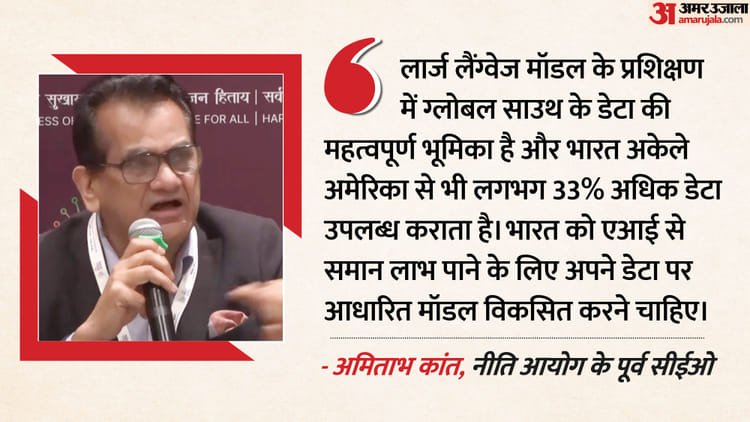
During the India AI Impact Summit 2026, former G20 Sherpa Amitabh Kant said that big tech companies are using data from Global South countries to train their Large Language Models (LLM). He stressed that India and other developing countries should develop models based on their own data to get similar benefits from AI.
During a panel discussion at the India AI Impact Summit 2026, Kant said that data from the Global South plays an important role in LLM training and India alone provides about 33 percent more data than the US. He warned that global tech companies can create their own commercial products based on this data and later sell them in the market at a higher price.
He also said that India’s demographic strength and technological ambition give it a unique position in the global AI race. He said that the country’s young population and increasing interest towards AI shows the transformative potential of this technology.
The Reina Sofía’s new rehang opens, quite pointedly, with a painting of a detained man sitting, head bowed and wrists shackled, as he waits for the arbitrary hand of institutional bureaucracy to decide his fate.
The picture, Document No …, was painted by Juan Genovés in 1975, the year Francisco Franco died and Spain began its transition to democracy after four decades of dictatorship. Genovés’s faceless, everyman victim of the Franco regime’s control and repression is the natural starting point for the Madrid museum’s exploration of the past 50 years of contemporary art in Spain.
Through the 403 selected works, the museum’s curators examine how artists from Spain and beyond have chronicled and reacted to socio-historical changes, from the hedonistic explosion of creativity that followed the dictator’s demise to the Aids epidemic, from second-wave feminism to growing environmental awareness, and from decolonisation to global terrorism.
According to Ángeles González-Sinde, the president of the Reina Sofía’s board, the rehang – an exercise museums undertake to re-evaluate and reinvigorate their collections – is much more than a simple rejigging. Almost two-thirds of the works on display in the new Contemporary Art: 1975 to the Present collection, which occupies the museum’s fourth floor, have never been exhibited as part of the permanent collection.
“More than an exhibition reorganisation, it’s a critical reinterpretation that seeks to contextualise artistic practices in dialogue with the social, political and cultural processes that have marked these five decades,” she told a press conference on Monday.
‘More than an exhibition reorganisation, it’s a critical reinterpretation.’ Photograph: Roberto Ruiz/Museo Reina Sofía
Alongside works by internationally known artists such as Nan Goldin, Hal Fischer, Peter Hujar, Belkis Ayón and Robert Mapplethorpe are pieces that chart a rapidly changing Spanish society. The exiled Argentinian photographer Carlos Bosch used his camera to document key moments of the Transition – the process by which post-Franco Spain returned to democracy – among them Spain’s first gay pride march in 1977. The artist and queer activist José Pérez Ocaña employed altar installations to appropriate and subvert the popular rituals of Andalucían Catholicism.
The collection also features items of jewellery by the designer Chus Burés, who has created pieces for two films by Pedro Almodóvar, perhaps the most famous figures of the wild and wildly creative post-Franco underground scene known as the Movida madrileña.
The dark and destructive side of the movida is also apparent in Iván Zulueta’s 1979 arthouse horror film Arrebato (Rapture) and in the photographs of Alberto García-Alix. One of the many poignant works on show is García-Alix’s 1988 image En ausencia de Willy (Willy’s Absence), a black and white shot of a western shirt that belonged to the artist’s brother, who died of an overdose in the heroin epidemic that ravaged Spain in the 1980s. The shirt, which sits alongside a pencil sketch of Willy, serves as a potent reminder of the years when, in García-Alix’s words, “nothing was enough”.
Willy’s Absence, 1988, by Alberto García-Alix. Photograph: Museo Reina Sofía
The advent of another epidemic is memorialised in several pieces, not least in Hujar’s photographs of mummified bodies in the catacombs of Palermo, which unknowingly foreshadow the physical ravages that Aids would inflict on the artist and so many of his friends decades later.
Ajuares (Funerary Offerings), an installation by the artist, teacher and researcher Pepe Miralles, offers another musing on the epidemic by collecting together everyday objects linked to the illness and treatment of his friend Juan Guillermo. The items gathered together in a huge glass cabinet include antiretroviral medication, Prozac, gauzes, syringes, pyjamas and soft toys.
Manuel Segade, the director of the Reina Sofía, said the 403 works were intended to create a constant dialogue between the past, the present and the future.
“The Reina Sofía’s intention isn’t to create a single, unequivocal, closed narrative, but rather to open it up, to socialise these narratives as a possibility and as a way to consider this work for future presentations, so that the Reina Sofía’s collections are permanently open to revision,” he told reporters.
The fundamental aim of the three-year-long reorganisation, Segade added, was to ensure that each and every visitor could “grasp the diversity, quality and discursive potential of contemporary Spanish art and the contributions of our artists to culture in general”.
Spain’s culture minister, Ernest Urtasun, said the idea was to reflect on the “turning point” year of 1975 but also on wider questions of society, art and democracy.
Given the current state of things, he added, such reflections were as vital today as they were 50 years ago. “Just as this floor begins with Juan Genovés – with the aspirations of Spain at that time, with its social aspirations and the role that contemporary art played in shaping perspectives on the various democratic social achievements of recent years – so I believe we must also be aware of the importance that contemporary art will play in the fight for democracy and in the defence of our fundamental values, the values of the Enlightenment,” Urtasun said.
Police are “determined to do more” to hold to account domestic abusers who drive victims to kill themselves, the National Police Chiefs’ Council has said.
Assistant Commissioner Louisa Rolfe, the NPCC lead for domestic abuse, has said that “more posthumous investigations are taking place”, but that officers struggle with a lack of resources, adding that 20% of all crime relates to domestic abuse in most forces.
National guidance had been changed, she said, with the NPCC’s research team going into forces to look at how it was being applied. That guidance, she said, had been adapted based on feedback from families, who had consistently raised concerns about police response.
This included, Rolfe said, “officers too quick to assume, ‘well, it’s a suicide and therefore a case for the coroner, not an investigation to be had by policing’, too often assuming that the domestic abuse perpetrator was the primary next of kin, and therefore risking evidence being lost by, for example, returning personal property like phones to those individuals.
“Not being sufficiently curious in speaking to family, wider family members about what might be going on. So we changed the guidance and we have seen some improvements.”
Rolfe made the comments after the Guardian revealed analysis suggesting that the number of women driven to suicide by domestic abusers was being seriously under-reported, with their cases often overlooked by the police. To illustrate the scale of the crisis, the Guardian is publishing a series of articles about some of those who have died by suicide after domestic abuse.
Rolfe said police forces had been urged to introduce a local review system, similar to that introduced by the Met after the case of Stephen Port, who killed young gay men in east London. Despite similarities in the deaths of four men, the Met failed to recognise that they might be connected.
Scotland Yard, she said, had introduced “a daily review process for all unexpected deaths to just ensure that there was a second opinion on each of those cases”. As a result of the recommendations in relation to domestic abuse suicides, “we’re certainly seeing more posthumous investigations”, Rolfe said.
Katie Madden took her own life hours after her partner Jonathon Russell told her to kill herself. Photograph: Handout
She pointed to the case of Kiena Dawes, who was subjected to repeated assaults, bullying and belittling from her partner Ryan Wellings before she took her own life, as an example of the difficulty in securing prosecutions. Dawes left a note on her phone saying “Ryan Wellings killed me”. He was found guilty of assault and coercive and controlling behaviour and sentenced to six and a half years, but found not guilty of manslaughter.
“We know from that case how difficult it can be to secure a prosecution that makes a causal link between the abuse and the death, so a manslaughter charge or homicide charge, but we want to pursue more of those,” she said.
Rolfe added: “But also for many families, ensuring that we’re investigating the coercive controlling behaviour that happened in an abusive relationship. So we are seeing more posthumous investigations, which is heartening.”
One of the biggest barriers to progressing investigations, Rolfe said, was diminishing resources, coupled with long delays in the criminal justice system. “The scale of this is challenging, policing has a finite resource,” she said. But she added: “The one really good thing I’ve seen in policing in my 35 years is that the focus on this work has really increased.”
Another challenge, Rolfe said, was the huge amount of digital data that police investigations now involved. “The more data that technology [such as mobile phones] includes, the more work there is for policing,” she said, “but we probably have less resources now than we had 20 years ago when people didn’t really use smartphones.”
Some families whose loved ones killed themselves after domestic abuse have complained that ongoing investigations into that abuse were dropped after a victim took their own life.
Katie Madden, whose case was revealed by the Guardian on Monday, took her own life hours after her partner Jonathon Russell told her to kill herself. At an inquest, Russell said he then ‘went back on’ himself and told her not to. He also admitted to giving her a black eye weeks before she died.
No criminal investigation was ever launched. Madden’s mother was told by police that officers only had the capacity to examine one month’s worth of messages, and dropped an investigation into alleged coercive and controlling behaviour.
In relation to posthumous investigations being dropped, Rolfe said: “There is a reality that we have more work than we can cope with and we have to cut our cloth and make really tough decisions about the prioritisation of cases. And for domestic abuse investigators, sometimes that might mean the cases where they are seeking to protect a victim who needs protection right now might take precedence over a case where sadly the victim is no longer around to be protected.”
However, she said that while she could understand see why officers might choose to discontinue cases, “that doesn’t mean they should stop”. “The most serious cases we deal with are deaths, and therefore we should not be not investigating,” she said.
Another issue, Rolfe said, was “poor communication by investigators overwhelmed with cases, and particularly with the impact of the crisis in the wider justice system”.
While a police investigator should have a caseload of about 15 cases, she said, some now would have more than double that, with the corresponding number of families to keep in touch with. “Ten years ago most of those cases will be in court over the next six months and then move out of their caseload,. For the last five years, those have not been going through the court process, so the list of victims that they’re keeping updated and supporting is just growing, so that’s really tough for policing.”
Rolfe added: “We’re were determined to do more. We’re seeing green shoots of improvement in our response. There’s still a huge amount more to do.”