Reference #18.6e560e17.1777959907.105ddbb
https://errors.edgesuite.net/18.6e560e17.1777959907.105ddbb
Reference #18.6e560e17.1777959907.105ddbb
https://errors.edgesuite.net/18.6e560e17.1777959907.105ddbb
Reference #18.490dde17.1778199569.258e4f0d
https://errors.edgesuite.net/18.490dde17.1778199569.258e4f0d
Reference #18.490dde17.1778202204.25b64fcb
https://errors.edgesuite.net/18.490dde17.1778202204.25b64fcb

The situation in West Asia has not yet become normal. Three Indians were injured on Monday (May 4) in a fire that broke out in UAE’s Fujairah Petroleum Industries Zone (FOIZ) following a drone attack. Indian Foreign Ministry spokesperson Randhir Jaiswal has condemned the attack on Indians.
Tension increased between US-Iran
Tension between America and Iran seems to be increasing once again. Breaking the ceasefire, Iran attacked the United Arab Emirates (UAE) with drones and missiles on Monday (May 4). This is considered to be Iran’s first major military action after the ceasefire announcement on April 8. UAE officials confirmed the air threat and said that emergency alerts were issued by the Ministry of Foreign Affairs and Defense and the air defense system was activated.
India has demanded to stop these war-like situations immediately. In the statement issued by MEA, it was said that targeting innocent civilians and residential areas is wrong. India believes that the solution to this problem can be found only through dialogue and diplomacy, so that peace can be established again in West Asia.
A fire broke out in the Fujairah Petroleum Industries Zone on Monday (May 4) after a drone attack by Iran, in which three Indian citizens were injured. In the statement, the Foreign Ministry appealed for an immediate end to the tension and strongly condemned the targeting of civilian infrastructure and civilians.
Iran breaks ceasefire and attacks UAE, first attack since April 8, 3 Indians injured
India has demanded the continuation of international trade through the ‘Strait of Hormuz’ without any hindrance. India stressed that maritime trade should be safe under international laws. The ministry made it clear that India is ready to support every effort to resolve this dispute peacefully.
Our statement on the attack on Fujairah ⬇️
🔗 https://t.co/01Nz7g06FR pic.twitter.com/KQAr8R9ciQ
— Randhir Jaiswal (@MEAIndia) May 5, 2026
PM Modi also condemned the attack
PM Modi also condemned the attack on Indians in UAE. Posting on X, he wrote, We strongly condemn the attacks on UAE, in which three Indian citizens have been injured. Targeting civilians and infrastructure is unacceptable. India stands in full solidarity with the UAE and reiterates its support for the peaceful resolution of all issues through dialogue and diplomacy. Ensuring safe movement through the Strait of Hormuz is extremely important for regional peace, stability and global energy security.
Pakistan also praised PM Modi on his bumper victory in Bengal elections, know what Bangladesh said?
Reference #18.50200117.1777959488.3c6add2
https://errors.edgesuite.net/18.50200117.1777959488.3c6add2

Shares of Quess Corp surged more than 12 per cent in early trade following its March quarter results, as investors reacted to a sharp turnaround in profitability and attractive dividend announcements.
The stock was trading at ₹227.68, up 7.5 per cent as of 10.31 am, touching a high of ₹238 on the NSE compared with the previous close of ₹211.63.
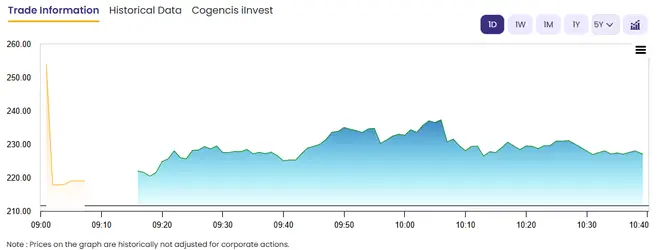
Quess Corp shares
The rally was driven by the company’s return to profit in Q4FY26 after reporting a loss in the year-ago period, along with improved full-year earnings and shareholder payouts.
It reported a standalone net profit of ₹58.7 crore for the quarter ended March 2026, compared with a net loss of ₹81.26 crore in the same quarter last year, marking a strong yoy recovery.
For the full year FY26, profit after tax rose 57.4 per cent to ₹189.12 crore from ₹120.12 crore in the previous fiscal, reflecting sustained improvement in earnings performance.
The company also announced shareholder-friendly measures, declaring a special interim dividend of ₹3 per share along with a final dividend of ₹3 per share, which further supported investor sentiment around the stock.
Overall, the combination of a turnaround in quarterly profitability, solid full-year growth and higher dividend payouts has driven the sharp upmove in Quess Corp shares.
Published on May 5, 2026

A small plane carrying five people crashed into a residential building in Belo Horizonte, Brazil, shortly after takeoff, killing three and leaving two others hospitalised. The aircraft went down minutes after departing Pampulha Airport, with no injuries reported among residents on the ground.
Published On 5 May 2026

Gold prices edged higher on Tuesday from a five-week low hit in the previous session, although gains were limited as elevated crude oil prices kept inflation fears alive and clouded the US interest rate outlook.
Spot gold rose 0.3 per cent to $4,533.40 per ounce by 0417 GMT, after a more than 2 per cent drop on Monday. US gold futures for June delivery inched 0.2 per cent higher to $4,542.50.
“Prices seem to be digesting a bit after the return of the ‘war trade’ across markets sent gold lower Monday,” said Ilya Spivak, head of global macro at Tastylive.
However, gains were capped as Treasury “yields and the dollar pushed higher as a rebound in crude oil stoked inflation fears. That weighed against non-interest-bearing and anti-fiat gold,” Spivak said.
The dollar rose and Brent crude hovered above $113 a barrel as the US and Iran continued to work towards a truce while trading blows over the Strait of Hormuz.
The US military said on Monday it destroyed six Iranian small boats and intercepted Iranian cruise missiles and drones as Tehran sought to thwart a new US naval effort to open shipping through the Strait of Hormuz.
A stronger US currency makes dollar-priced metals more expensive for holders of other currencies.
Meanwhile, higher crude oil prices can stoke inflation, increasing the likelihood of higher interest rates. While gold is considered an inflation hedge, high interest rates make yield-bearing assets more attractive, weighing on its appeal.
Traders have largely priced out US interest rate cuts for this year, with markets now seeing a 37 per cent chance of a hike by March 2027, compared with 27 per cent of a reduction a week earlier.
Investors now await a slew of key US data this week, including job openings, the ADP employment report, and the April payrolls report.
Spot silver was steady at $72.73 per ounce, platinum gained 1 per cent to $1,964, and palladium was up 0.8 per cent at $1,492.27.
Published on May 5, 2026
Reference #18.6e560e17.1777964665.1110652
https://errors.edgesuite.net/18.6e560e17.1777964665.1110652

Microsoft will stop offering long-term rentals for 17 Azure instance types – most of them powered by CPUs Intel released in the 2010s – again showing that cloud computing isn’t always a seamless and easy choice.
The fun starts on July 1st when Microsoft will stop taking orders for one-year reservations for 13 instance types – Av2, Amv2, Bv1, D, Ds, Dv2, Dsv2, F, Fs, Fsv2, G, Gs, Ls, Lsv2 – meaning it won’t be possible to book a server for a year. Microsoft will retire these instance types in May and November 2028.
For another four instance types – Dv3, Dsv3, Ev3, Esv3 – Microsoft won’t allow any more reservations for one or three years, however they’ll remain operational beyond 2028. Redmond’s Retired VM Sizes Migration Guide lists all the details.
Microsoft launched these instance types in the mid-to-late 2010s, so the machines it is retiring are no spring chickens. The newest of the retirees are third-gen VMs and Redmond is now offering seventh-gen machines.
The software giant has published several pages offering advice on what to do, but none of them explain why it’s decided to retire these instance types.
The Register thinks it’s because they run old Xeon CPUs from Intel’s Haswell, Skylake and Cascade Lake generations – which debuted in 2013, 2015, and 2019.
More recent processors outperform these oldies and few Xeons have major backward-compatibility roadblocks, so very few cloudy workloads won’t be able to move. Users should therefore quite enjoy the move to newer Azure instances. Microsoft’s guidance of course recommends different Azure instance types as the ideal migration target.
Microsoft will certainly like the move because newer CPUs offer more cores and almost certainly consume less energy than Intel’s oldies, meaning Redmond can pack more VMs into fewer servers while incurring lower operating costs.
Perhaps Redmond will even free up some datacenter space it can use to host some AI hardware.
Some Azure customers, however, face a job they could probably see coming but which will still be unpleasant.
Organizations with applications running on Haswell, Skylake and Cascade Lake processors, and servers that can host them, are probably finding spare parts hard to come by and therefore must endure heightened risk. But they can choose to address that risk whenever they want to, unlike users of the 13 Azure instance types that will go away in 2028. ®