‘Could be the making of him’: Starmer’s allies praise stance on Trump and Iran | Keir Starmer

0

It is not often that Keir Starmer’s allies believe he has Nigel Farage and Kemi Badenoch on the run – but on Iran, they think he is on the right side of history and public opinion.

“It could be the making of him,” said Emily Thornberry, the Labour chair of the foreign affairs committee, who was first out of the blocks to say she thought Donald Trump’s strikes on Iran were illegal. “You’ve not had a British prime minister say no to an American president since Vietnam. This is a big deal.”

Since the drawn-out disasters of Iraq and Afghanistan, the prospect of helping the US attempt to facilitate regime change in another foreign country has been deeply unpopular with the public.

Starmer has sought a middle ground – refusing to let the US operate from British bases for the initial strikes but later giving it permission to use them for defensive action to destroy Iranian missiles. It has earned him the ire of Trump and public approval in the UK, and has given heart to many within the Labour party who believe he is acting more according to his own political instincts.

A US B-1B Lancer bomber takes off from RAF Fairford, Gloucestershire, on 13 March. Photograph: Christopher Furlong/Getty Images

One Labour MP said Starmer’s decision after several days to become even more critical of the US strikes on Iran had made them feel they “recognise this person as the real Starmer – closer to Robin Cook than Tony Blair” on these matters.

In contrast, Farage and Badenoch were quick to say Starmer was not doing enough to support the US and Israel’s joint strikes. The Reform UK leader said when the conflict began: “We should do all we can to support the operation.”

However, as petrol prices rose and public opinion hardened against the war over the past week, both adjusted their positions. A YouGov survey found this week that six in 10 Britons are opposed to the military action, while a quarter are in favour of it.

Badenoch now denies she wanted the UK to join the war and says she wanted Britain only to help take out Iranian missiles. Meanwhile, Farage held a stunt at a petrol station promising 25p off a litre of fuel and claiming: “If we can’t even defend Cyprus, let’s not get ourselves involved in another foreign war.”

One senior Tory said: “We have just looked confused and the messaging has been terrible. But most of us on the right do actually believe Starmer was completely wrong not to support Trump at the beginning, so the right thing to do would be to stick to our guns, whatever the public say.”

Andrew Mitchell, a veteran Conservative and former deputy foreign secretary, said refusing Trump’s request was a “very big mistake” and that Starmer would be proven not to have acted in the UK’s national interest in the long run.

“The US is our closest ally and friend, and when the president asked for our help with the use of joint bases – essentially what he wanted them for was refuelling – the answer should have been yes,” he said. “It’s embarrassing, really, that Starmer said no on the basis of questionable legal advice, thus demonstrating that Starmer is a lawyer, not a political leader.”

Although the majority of the public are anti-war, opinion polls suggest Conservative voters are almost equally split. Reform voters are more likely than other party supporters to back the Iran war, but there is still an isolationist flank on the hard right drawn to the message of Rupert Lowe – a former Reform MP who now sits as an independent – that it is “not our fight”. The risks of appearing too pro-war and pro-Trump appear to have forced both parties on the right to have moderated their initial messaging.

But Alan Mendoza, Reform’s chief adviser on global affairs and executive director of the rightwing Henry Jackson Society thinktank, said the party still believed that Starmer was wrong to have refused Trump’s request and maintained that Farage had been consistent throughout.

“He’d have said yes when America asked that question on day one. And he, of course, would have also firstly ensured the British bases were defended,” Mendoza said, adding that no one in the UK was ever suggesting or in favour of joining in offensive bombing action or a ground invasion.

He also questioned whether polls were asking the right questions about support for the Iranian military action, and suggested that framing questions around whether it was in Britain’s strategic interests to back an ally would generate a more positive response.

However, those within Downing Street are confident they have got the strategy right on this one, with internal polling showing support for Starmer’s approach. One senior Downing Street figure said: “[Reform mayor] Andrea Jenkyns not ruling out boots on the ground is exactly the wrong side.”

Labour’s position is also helpful in explaining any potential hit to the cost of living. “Obviously how people attribute blame is a multifaceted thing, but we can turn around and say, this is exactly why we don’t think we should be involved in the Middle East,” they said.

The Iran conflict has led to a rise in petrol prices, further squeezing Britons struggling with the cost of living. Photograph: Tolga Akmen/EPA

Other senior MPs within Labour have been reflecting on whether Starmer would have made the same decision to block the US using the military bases if Peter Mandelson were still ambassador to the US and his ally Morgan McSweeney were still chief of staff.

Ben Judah, a former adviser to David Lammy when he was foreign secretary, said the rightwing parties had got into difficulties because they “basically took a decision on the first day to try and use that old card of ‘have you failed the special relationship?’ to try and bash the prime minister”.

He added: “I think, out of their own leadership’s foreign policy inexperience and lack of curiosity about the world beyond Westminster, that they were sort of anticipating that this would be a Venezuela-style one-night story. And it’s turned out, actually, this is kind of a weeks-long, deeply disruptive event in the world economy, which voters are really concerned about, and at the petrol pump. And you see them changing position.”

He said that for the Tories it had come from the party “losing that kind of foreign policy muscle now they’re in opposition”, and that Farage “has an America problem”.

“Trump 2.0 is not governing in the same [way] as he campaigned,” Judah said. “He campaigned on an isolationist platform, he literally campaigned to bring world peace.

“We’ve seen Reform in its attempt to professionalise and become the real competitive conservative party, from the old sort of Ukip isolationists to a more kind of neocon, pro-American stance.

“That sort of neocon tradition in the UK is one thing when America is behaving in a way that’s good for your politician, shining praise on him, or when America is perceived to [be] booming, or charging ahead, but now it’s become a problem for him.”

However, not everyone within the cabinet is on the same page on whether the UK’s strategy will ultimately prove to be the right one. While an unprecedented leak to the Spectator of a national security council meeting showed Ed Miliband, Rachel Reeves and Yvette Cooper had strongly supported blocking the US from using Britain’s military bases, at least one senior cabinet minister is worried that the longer-term impact on the transatlantic relationship will be disastrous for the UK’s standing and security.

Thornberry is more confident that the relationship will recover. “We will always be close to America,” she said. “They are our closest ally. But there are times when you can disagree. We survived Vietnam, we will survive this. And it’s not like we haven’t been led by them into some pretty disastrous decisions in the near past.

“People get – well, men particularly get – particularly excited about wars, and it’s quite popular to start with. And then, as they begin to think through what it means and what the ramifications are, then the war starts to affect daily life, war starts to kind of lose popularity. You don’t have to have been around that long to have experience of Middle East wars. You know, we know how this goes.”


Source link
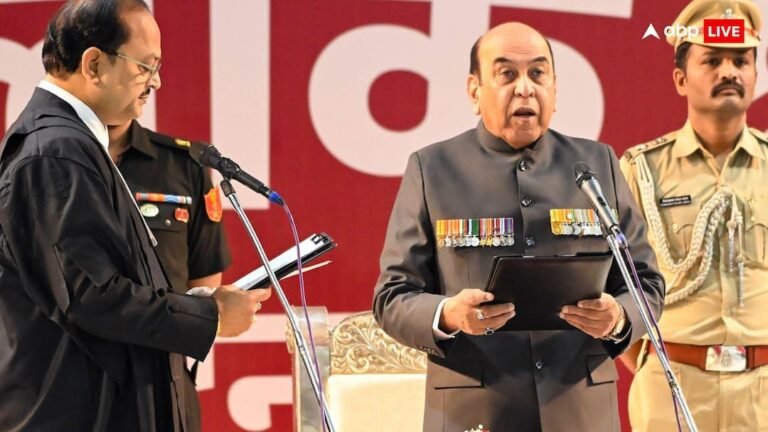
Bihar News: Retired Lieutenant General Syed Ata Hasnain became the 43rd Governor of Bihar, Justice Sangam Sahu administered the oath.

0

Lieutenant General Syed Ata Hasnain was sworn in as the 43rd Governor of Bihar today (March 14). Patna High Court Chief Justice Justice Sangam Kumar Sahu administered the oath of office to him at Lok Bhavan. Before this, Arif Mohammad Khan was on this post. During the swearing in, Chief Minister Nitish Kumar, Deputy Chief Minister Samrat Chaudhary, Vijay Sinha, Minister Vijay Kumar Chaudhary and Bijendra Prasad Yadav and many of his cabinet members were present there. Syed Ata Hasnain took oath in Hindi. After this, Chief Secretary Pratyaya Amrit informed the President regarding the appointment of the Governor. Draupadi Murmu Read out the letter.

General Syed Ata Hasnain’s last posting was as Military Secretary

Lieutenant General (retd) Syed Ata Hasnain was sworn in as the Governor of Bihar on Saturday (March 14). Patna High Court Chief Justice Sangam Kumar Sahu administered the oath of office and secrecy to Hasnain at a ceremony held at Lok Bhawan. Hasnain has replaced Arif Mohammad Khan. Many dignitaries including Chief Minister Nitish Kumar, his cabinet colleagues and senior officials were present at the ceremony. Hasnain’s last posting in the army was as Military Secretary, an important post responsible for senior level personnel management. Earlier, he had commanded 15 Corps of the Army in Jammu and Kashmir. Even after retirement, Hasnain remained active in national and academic roles. He was appointed Chancellor of Central Kashmir University in 2018. He joined as a member of the National Disaster Management Authority (NDMA) in 2020.

General Syed has also been the former Commanding in Chief of Chinar Corps based in Srinagar.

Lieutenant General Syed Ata Hasnain has also been the former Commanding-in-Chief of the Srinagar-based Chinar Corps of the Indian Army. He was the Vice Chancellor of Central University of Kashmir. Even while in the army, he ran many social campaigns, in which he ran many programs for the youth regarding education, employment and sports so that they could inspire people to become good citizens. Even after retirement, he remained active in his public life and ran many campaigns to link national security and employment. In which mainly an attempt was made to connect the youth of Kashmir. For this reason, he is seen as a military officer as well as a strategic thinker.

US attacks military sites on Iran’s Kharg Island, home to vast oil facility | US-Israel war on Iran News

0

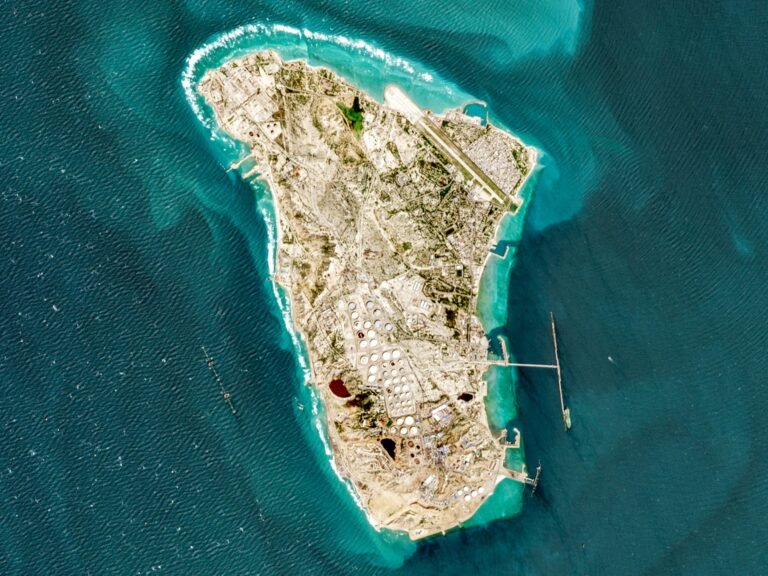
United States President Donald Trump has said the country’s military bombed military installations on Iran’s Kharg Island, warning the area’s critical oil facilities could be next if Iran continues to block the Strait of Hormuz.

Iran, in turn, threatened on Saturday to reduce US-linked oil facilities to “a pile of ashes” if oil structures on the island were targeted as the US-Israel war on Iran, now in its punishing third week, spilled over into a global oil price crisis already in the making.

Recommended Stories

list of 3 itemsend of list

Kharg Island is where more than 90 percent of Iran’s oil is exported. Crude oil prices have surged more than 40 percent since the war began.

Trump said on Friday US forces had “totally obliterated” all military targets on Iran’s Kharg Island oil export hub, describing it in a social media post as “one of the most powerful bombing raids in the History of the Middle East.” He provided no evidence of that.

The US president said he had chosen not to “wipe out” oil infrastructure on the Iranian island, for now.

“However, should Iran, or anyone else, do anything to interfere with the Free and Safe Passage of Ships through the Strait of Hormuz, I will immediately reconsider this decision,” he added.

Iran’s semi-official Fars news agency reported, citing sources, that more than 15 explosions were heard on Kharg Island during the US attacks.

The sources said the attacks targeted air defences, a naval base, and airport facilities, but caused no damage to oil infrastructure. Iran’s Fars news agency reported thick smoke was seen rising from the island.

Al Jazeera’s Mohamed Vall, reporting from Tehran, said Iran’s potential retaliatory attacks on Gulf oil facilities would be a “catastrophic scenario” for the region, and for the “entire industry of oil and gas”.

“The Iranians are keeping this, apparently, as a card to use,” he said. “They’ve been talking about restraint and the possibility of that restraint ending if the Iranian oil facilities are attacked, as the Americans are hinting and threatening.”

US ground operation in the works?

Meanwhile, 2,500 more Marines and an amphibious assault ship are being sent to the Middle East, a US official told AP news agency.

Elements from the 31st Marine Expeditionary Unit and the amphibious assault ship USS Tripoli have been ordered to the region, according to the source, who spoke on condition of anonymity to discuss sensitive military plans.

INTERACTIVE - Strait of Hormuz - March 2, 2026-1772714221
(Al Jazeera)

Marine Expeditionary Units are able to conduct amphibious landings, but they also specialise in bolstering security at embassies, evacuating civilians, and disaster relief.

“What we’re to make of this is that the US is very slowly increasing its military posture in terms of prosecuting the war, and that it is not intending to wrap things up any time soon,” Al Jazeera’s Rosalind Jordan reported from Washington.

The deployment does not necessarily indicate that a ground operation is imminent or will take place.

Trump dismisses prospect of deal

Following the attack on Kharg Island, Trump said Iran would be “wise to lay down their arms, and save what’s left of their country”. Trump wrote on his Truth Social platform.

“The Fake News Media hates to report how well the United States Military has done against Iran, which is totally defeated and wants a deal – but not a deal that I would accept!” he posted separately, providing no evidence Tehran was seeking any sort of deal.

At least 1,444 people have been killed and 18,551 injured by US-Israeli attacks on Iran since 28 February, Iran’s Health Ministry says.

Al Jazeera’s Tohid Asadi, reporting from Tehran, said US-Israeli air strikes hit targets across the country, including in the capital, Karaj, Isfahan and Tabriz. He said this was a sign that “we are not close to de-escalation”.

“Iranian officials are talking about retaliatory strikes, with the Islamic Revolutionary Guard Corps talking about using what they call their most advanced weaponry, including Heidar missiles, to target Israeli territories and US bases in the region,” he said.


Source link

Pm Modi In Wb: Enthusiasm in Bengal for PM Modi’s rally, supporters arrive in Kolkata by boat and bus – Enthusiasm In Bengal For Pm Modi’s Rally, Supporters Arrive In Kolkata By Boat And Bus

0

Prime Minister Narendra Modi is on West Bengal tour today. During this period, there is tremendous enthusiasm among BJP workers. A large number of workers from different parts of the state have left for Kolkata. He said that Prime Minister Modi is coming to the Brigade Rally. We’re going there to hear them. Pictures emerged from Basirhat, Kanthi, Durgapur and Sundarban areas of West Bengal. Holding banners and party flags, they came out to join the BJP workers rally. BJP workers and supporters from Kanthi and Durgapur left for the Brigade Parade Ground to attend Prime Minister Modi’s rally. At the same time, BJP workers and supporters from remote areas of Sundarban, including Sagar, Namkhana and Patharpratima, have started reaching Kolkata by crossing the rivers in boats.

Trending Videos


Also read- PM: ‘Where the minds of Congress people are locked, our work begins there’, PM Modi said in Silchar

Reached Kolkata by bus and boats
BJP workers from different parts of Basirhat are reaching Kolkata in buses and boats to listen to Prime Minister Modi. Speaking to IANS, a BJP worker in Basirhat said, “We are going by boat through Sundarbans because PM Modi is coming to the brigade rally. We are going there to listen to him.” Another BJP supporter said, “People from different areas and communities are coming together to join the rally.”

Also read- Sonam Wangchuk Detention Revoked: Sonam Wangchuk will be released from custody, Home Ministry took the decision; Know the matter

Will inaugurate crores of projects
Regarding Prime Minister Modi’s visit to Kolkata, BJP leader Dilip Ghosh said, “The Prime Minister visits before every major election. The BJP often, when possible, forms alliances with other parties and if no suitable alliance is available, it contests the elections alone.” Prime Minister Narendra Modi will inaugurate and lay the foundation stone of development projects worth about Rs 18,680 crore in Kolkata on Saturday. These projects cover multiple sectors including road infrastructure, railways, ports and shipping. He will also inaugurate six redeveloped railway stations in West Bengal under the Amrit Bharat Station Scheme. PM Modi will reach Kolkata at around 2 pm.

Crude Oil: Crude oil prices increased by 40% after the start of Iran war, what are the predictions for the coming days? – Crude Oil Prices Increased By 40% After The Iran War Started, What Are The Predictions For The Coming Days?

0

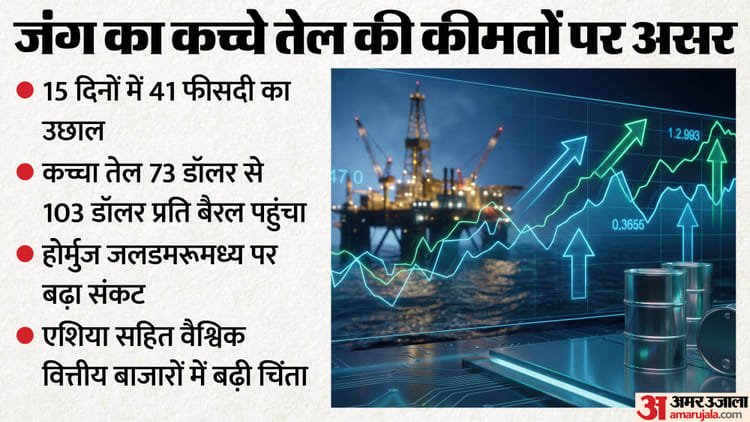
There has been a sharp increase of more than 40 percent in the prices of crude oil in the international market within the last 15 days. Due to the ongoing war between America, Israel and Iran, serious concerns regarding energy supply in West Asia have increased. In particular, the impact of the Strait of Hormuz has increased the pressure on the global energy market, especially on Asian countries.

What do the figures say?

  • Before the war started, on February 27, crude oil was trading at around $73 per barrel in the international market.
  • By Saturday its price had increased to around $103 per barrel.
  • In this way, in just 15 days, the price of oil increased by $ 30 per barrel, which is equivalent to a jump of about 41.1 percent.

Tension continues since February 28

The current military confrontation between the US and Iran is said to have intensified since February 28, when US and Israeli forces carried out widespread attacks targeting Iran’s military bases and top leadership. This conflict has further increased the markets’ concerns about global energy supply.

What is the opinion of experts regarding the market?

Experts say that the impact of increasing tension in West Asia will be clearly visible on global markets in the coming days. Ponmudi R, CEO of Enrich Money, said that the coming week could be very volatile, because the eyes of investors will be completely focused on the developments related to this conflict.

He said that the direction of the market in the coming week will largely depend on the developments related to the ongoing conflict in West Asia. Investors will keep a close eye on what government officials of the respective countries and global stakeholders indicate in the direction of escalating tensions or a diplomatic solution.

According to Ponmudi R, the impact of this conflict will not be limited only to crude oil prices, but will also affect global bond yields, currency markets and the risk appetite of investors. He said that special focus will remain on the Strait of Hormuz, as it is counted among the most important energy supply routes in the world.

Experts believe that if the movement of oil and gas through the Strait of Hormuz remains disrupted for a long time, it could lead to further tightening of global oil supply. This will impact inflation expectations in Asia and there may remain an environment of uncertainty and pressure in global markets.


Kuldeep Yadav Wedding: Royal wedding in Mussoorie, star spinner will take seven rounds with childhood friend Vanshika today – Kuldeep Yadav Wedding In Mussoorie: Kuldeep To Marry Childhood Friend Vanshika Today News In Hindi

0

Team India’s star spinner Kuldeep Yadav is going to tie the knot with his friend Vanshika today. Many celebrities including former cricketers Suresh Raina, Yuzvendra Chahal have arrived to attend the wedding ceremony being organized in Mussoorie. Former Indian cricketer Mohammad Kaif has also reached Mussoorie today.


The main functions of the wedding will be held today, Saturday 14th March. Arrangements have been made for breakfast from 8 am in the morning and a grand meal from 12 noon. There will be a program of tying the turban along with high tea from 4 pm onwards.


The wedding procession will start from the Premium Valley View Wing from 5 pm onwards, while the Jaymala ceremony will take place at the Central Lodge at 6:30 pm. After this, the ritual of seven rounds will be completed in the Royal Ballroom.

Also, arrangements have been made for farewell and check-out for the guests after breakfast at 8 am on March 15. Overall, this royal wedding has included a special combination of traditional and modern programs along with delicious dishes for the guests.

Invisible datacentres and capricious chips: is UK’s AI bubble about to burst? | AI (artificial intelligence)

0

Stargate was to be the world’s biggest AI investment: a $500bn infrastructure project to “secure American leadership in AI”. Never shy of hyperbole, its key backer, the ChatGPT-maker OpenAI, promised “massive economic benefit for the entire world” with facilities to help people “use AI to elevate humanity”.

Now, OpenAI appears to be dropping out of a part of the deal – the expansion of a flagship datacentre stretching across a swathe of land in Abilene, Texas, which has become one of the most visible manifestations of a frenzy of investment in the chips and power plants required to build and run AI. There has been a breakdown in negotiations over project financing, as well as the timeline of when the expanded capacity might come online.

This may be fine for OpenAI; it can presumably find other datacentres. It is less fine for OpenAI’s partner on the project, Oracle, which has already spent billions on hardware for the site. It is one of a number of cracks appearing in the capital side of the AI economy that are making investors rather nervous.

Both companies have said the development will not derail their AI plans. They also said that a month ago, when a different $100bn deal melted down between OpenAI and Nvidia, the world’s biggest maker of the chips that train AI models and respond to the billions of questions people ask them daily.

The fate of such deals for the global economy is only increasing in importance. Future datacentre leases agreed by the largest cloud computing companies (including Amazon, Oracle and Microsoft) are up nearly 340% in two years and now top $700bn, according to Bloomberg. It is a lot of money if the technology does not start delivering on its promise to supercharge economic productivity. On Friday, more than three years since the launch of ChatGPT unleashed the AI hype, the UK reported zero GDP growth for January.

Sam Altman, the chief executive of OpenAI, the maker of ChatGPT. Photograph: Bloomberg/Getty Images

On Monday, the Guardian exposed another fissure in the AI edifice. An investigation found the UK’s flagship AI deals, many announced with great fanfare during Donald Trump’s state visit last September, are not as they were described in government and corporate press releases. Key projects are delayed or improbable, crucial “investments” are in fact vague agreements between mostly US tech companies, desperately being spun by ministers as an engine for economic growth.

If the cracks in this datacentre boom widen, consequences range from Britain ending up without the AI infrastructure it needs to keep up in the global economy to the more grave risk that the entire AI bubble bursts in a replay of the 2001 dotcom crash that could knock the world economy sideways.

“There has been a lot of blind optimism around the buildout of AI infrastructure,” said Andy Lawrence, the executive director of research at the Uptime Institute, which inspects and rates datacentres. “While there is an incredible boom under way, with construction at a scale that’s never been seen before – it has also been apparent for quite a while that many projects would either not go ahead, or would take a lot longer to build and begin operating than many of the claims suggested. Because of the high stakes and high rewards in AI, it has attracted speculators who promise investment but have little experience in the sector.”

Most emblematically, the Guardian’s investigation featured a site in Loughton, Essex, that the government said would host “the largest UK sovereign AI datacentre” by the end of 2026. The then technology secretary, Peter Kyle, called it “a fresh start for our economy and for working people”. A year later it was still being used as a scaffolding yard with almost zero chance of being open when billed. After the Guardian’s investigation, Nscale confirmed it had bought the land on which the computer is to be built – eight months after it said it did in January 2025. It still does not have planning permission but said on Friday it was planning to start construction before July and would switch on the datacentre between April and July 2027.

The site of the proposed datacentre in Essex, pictured in February. Photograph: Martin Godwin/The Guardian

The rickety AI deals have come amid a tightening embrace between US tech corporations and senior politicians in the US and UK. Donald Trump’s top AI advisers include David Sacks and Sriram Krishnan, both with recent histories as tech investors. In London, OpenAI hired the former chancellor George Osborne; Anthropic and Microsoft employed the former prime minister Rishi Sunak; Peter Mandelson was an owner of a consultancy that lobbied for Palantir; and the Tony Blair Institute has received funding from the foundation of Oracle’s billionaire owner Larry Ellison.

These figures have helped create an AI policy in which the UK has essentially agreed to be a staging ground for US-designed hardware being rented mostly to US tech companies. The UK government says it is creating “sovereign AI infrastructure”, which has a contested definition ranging from hardware and data owned by the UK so it retains control of a piece of critical national infrastructure in a world of unstable international alliances, to the AI minister Kanishka Narayan’s more flexible definition as “strategic leverage” so the UK “can ensure ongoing access to critical inputs”.

In the UK that means relying on the US. As Jensen Huang, the chief executive of Nvidia, said during Trump’s state visit last September: “America must lead across the entire AI technology stack.”

The former deputy prime minister Nick Clegg put it more bluntly that week, calling the UK a “vassal state technologically”. Clegg this week became a board director at Nscale, the UK company involved in the Loughton AI deal, where its client is Microsoft – part of the US tech hegemony whose power he lamented six months ago.

On BBC Radio 4’s Today programme this week, Nscale’s senior vice-president, Imran Shafi, was asked if its Essex datacentre would be live by “Q4 of 2026” as promised. He replied: “The time that it will be live will be the time we have approved with our customer.”

Narayan, meanwhile, defended the broader pace of progress. “What we are saying is that we’re making concerted progress,” the minister told CityAM. “We have live datacentres in Lanarkshire already. We have spades in the ground in parts of the north-east.”

Kanishka Narayan, the UK’s minister for AI and online safety. Photograph: Maja Smiejkowska/Reuters

Narayan might consider the example of the current meltdown in Texas. Billions were promised, construction began, billions of dollars worth of equipment were bought, and then OpenAI walked out, leaving its partners in the unenviable position of having to find another giant AI company to work with.

OpenAI, it was reported, wanted a newer chip model: and by the time construction in Texas finishes, the hardware that Oracle bought may no longer be cutting-edge. It was like buying a job lot of iPhones just before a far more powerful model was about to be launched. The pace with which chips go out of date casts a further shadow over the UK government’s claims of massive AI investment. It is describing in cash terms “investments” that are mostly computer chips. Chips are not money – they depreciate, possibly even faster than most tech companies say they will.

This means it matters when a datacentre in Essex or an AI hub in Lanarkshire is meant to be online. By the time they are ready and the extra electricity has been sourced, will leaps in the design of AI systems mean that running 2025 chips is like owning a propeller plane in the jet age? Or if the deals announced relate to future chips, will they be available? Iranian drone strikes have already affected supplies of helium from Qatar, which chip manufacturers need. What happens if China disrupts supplies from Taiwan?

“Datacentres, especially the big high-density AI ones, are very complex engineering projects,” said Lawrence at the Uptime Institute. “Few go live in less than two years, and usually it takes much longer. It is not uncommon for some projects to be delayed for years or be indefinitely postponed.”

The final component here is the banks. Nscale’s chips, and those of other datacentre companies, are leveraged. These operators have secured billions of dollars in loans on the basis of their graphics processing units (GPUs). At least in Nscale’s case, this debt will go to financing its UK buildout, but when does that debt come due? If it cannot be paid, what happens to Nscale or to the financial institutions that are left looking to find a buyer for potentially out of date chips?

A spokesperson for Nscale said it “works with established financial counterparties and maintains disciplined governance around financing decisions. We take a conservative approach to our financing, aligned to long-term infrastructure buildouts.”

Alvin Nguyen, an analyst at Forrester, said: “The people who are loaning the money, the financial institutions, they’re taking on so much more risk because there is a lifespan to the chips.”

The datacentre investment boom represents one of the biggest infrastructure gambles of this or any era. Whether that scaffolding yard in Loughton ends up becoming a real AI factory could tell us a lot about who will win and who will lose.


Source link

Pm:’Where the minds of Congress people are locked, our work begins there’, PM Modi said in Silchar – Pm Modi In Assam Silchar Target Congress Inaugurate Thousand Crore Development Project

0

PM Modi on Saturday laid the foundation stone of development projects worth Rs 24 thousand crore in Silchar, Assam. During this, in his address, PM Modi talked about the importance of Barak Valley of Assam and said, ‘Silchar is called the gateway of Barak Valley. This is a place which has created a special identity by combining language and culture. The fertile plains of the Barak River, its tea gardens have always inspired farmers, trade routes and educational institutions. This region connects not only to Assam but also to the entire North East and West Bengal. I have come among you to further strengthen this area of ​​Barak Valley in the 21st century.


Barak Valley will become a big logistics and trade hub of North East
PM Modi performed Bhoomi Pujan of Shillong-Silchar Corridor. The cost of this 166 km long corridor will be around Rs 22,860 crore. This will improve connectivity between Assam and Meghalaya. With the help of this corridor, the travel time between Guwahati and Silchar will be reduced from eight and a half hours to just five hours. PM Modi said in his address, ‘Some time ago, the foundation stone of a project worth thousands of crores of rupees was laid and inaugurated here. With every such project like Rail, Agriculture Forest, Barak Valley is going to become a big logistics and trade hub of North East. This is going to create countless employment opportunities for the youth here. I congratulate all of you very much for all these development projects.

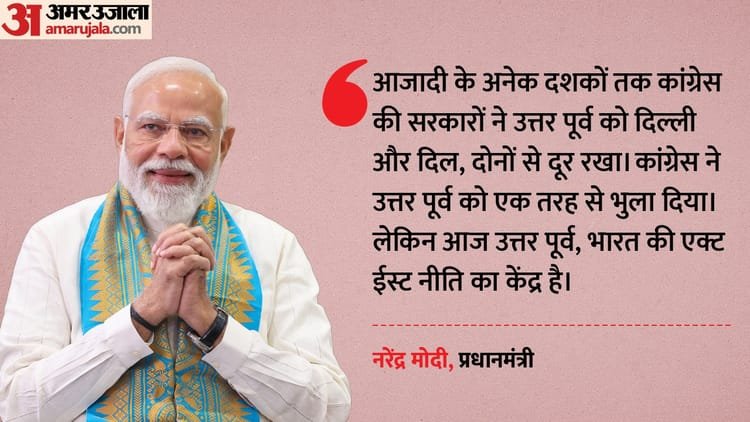
He said, ‘For many decades after independence, Congress governments kept the North East away from both Delhi and the heart. Congress, in a way, forgot the North East. But the double engine government of BJP and NDA has connected the North East like this. Today the North East is the center of India’s Act East policy. But Congress had left the North East to itself. Similarly, Congress has played a big role in making Barak Valley also miserable. When the country became independent, Congress set such boundaries that the Barak Valley lost its connection with the sea. The Barak Valley, which was once known as a trade centre, was stripped of its power. Now the double engine government of BJP is continuously working to make Barak Valley a big center of business.

Barak Valley will open the way to the big market of South East Asia
The Prime Minister said, ‘Today the bhoomi pujan of the Silchar-Shillong corridor worth about Rs 24 thousand crore has been done. Where the minds of Congress people are locked, our work begins there. This will be the first access controlled high speed corridor of the North East. Silchar, Manipur, Mizoram, Tripura, all the states are going to be connected through this corridor. Ahead of these three states are Bangladesh and Myanmar and ahead of them is the huge market of South East Asia. Today this valley is laying the foundation stone to connect with a bright future. This will benefit the farmers of the entire North East including Assam. The youth here will. This will strengthen connectivity in the entire region, tourism will benefit and every corner of India will be easily connected to the North East.

Congress made Assam a laboratory for the policy of ‘divide and rule’
PM Modi said, ‘BJP’s mantra is to give priority to those who were left behind in the race of development. Congress governments considered the border areas as the last villages of the country. But we consider border villages as the first villages of the country. For the development of border areas, the next phase of Vibrant Village Program was started from Cachar district itself. Due to this, many villages of Barak Valley are also certain to improve. Congress had only kept the youth of Assam entangled in the vicious cycle of violence and terrorism. Congress made Assam a laboratory of ‘divide and rule’ policy. Today, there is an open sky of opportunities before the youth of Assam. Today every state of the country is teaching a lesson to Congress. Now in the near future, Congress is going to complete its own century of defeat.


‘America is pleading with India to buy Russian oil’, know why Iran’s Foreign Minister Araghchi said this amid war

0

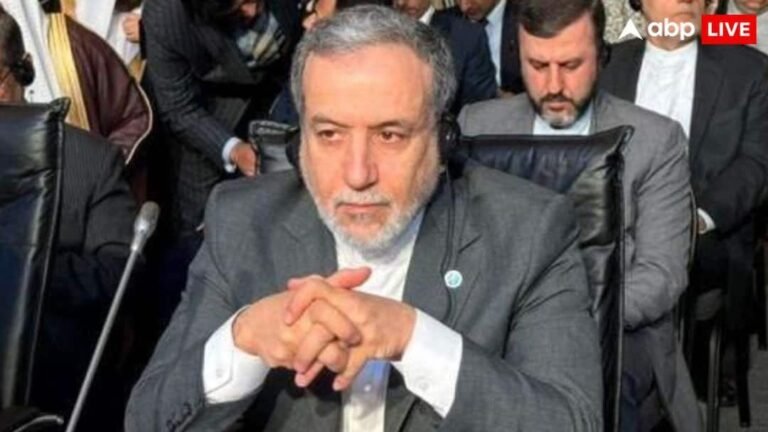
Amidst the American attacks, Iran’s Foreign Minister Seyyed Abbas Araghchi has cornered Washington regarding Russian oil. He said that the Trump administration is begging countries around the world including India to buy Russian oil. He further said that earlier America had put pressure on Russia to stop oil imports.

Iranian Foreign Minister targeted America by sharing a report of Financial Times on social media platform X. It has been said in this report that the Iran war has come as a lifeline for Russia’s oil industry.

What did the Iranian Foreign Minister say?
Araghchi said that America spent several months threatening India to stop importing oil from Russia. After a 2-week war with Iran, the White House is now begging countries around the world, including India, to buy Russian crude oil. He further said that Europe thought that by supporting the illegal war against Iran they would get America’s support against Russia.

This comment of the Iranian Foreign Minister has come at a time when just a day before America informed about temporarily lifting the ban on buying Russian oil. US Finance Minister Scott Besant said that the Finance Department has decided to give 30 days approval to buy Russian oil. He had said that this approval would be only for that Russian oil, which is already present in the sea. America has recently given similar relaxation to India also.

what did america say
The US Treasury Secretary said that its purpose is to increase the reach of existing oil supply and the US President is taking decisive steps to promote stability in the global energy market. He further said that Russia will not get much benefit from this, because the Russian oil which has been approved is already present in the sea.

According to the report shared by the Financial Times, Russia is earning an additional amount of 150 million dollars i.e. approximately Rs 1389 crore every day due to the oil crisis due to the Iran war. This is because Iran has closed the Strait of Hormuz.

read this also

Russian Crude Oil Price: Russia’s bumper earnings in Iran-America war, oil being sold at premium price, profit of 150 million dollars every day

Confidential health records from UK BioBank project exposed online | Genetics

0

Confidential health data has been exposed online on dozens of occasions, a Guardian investigation can reveal, raising questions about the safeguarding of patient records by one of the UK’s flagship medical research projects.

UK Biobank, which holds the medical records of 500,000 British volunteers, is one of the world’s most comprehensive stores of health information and is credited with driving breakthroughs in cancer, dementia and diabetes research. But scientists approved to access Biobank’s sensitive data appear to have sometimes been cavalier about its security.

The files, which seem to have been inadvertently posted online by researchers using the data, do not include names or addresses, but they may still pose privacy concerns. One dataset found by the Guardian contained millions of hospital diagnoses and associated dates for more than 400,000 participants.

With the consent of a Biobank volunteer, the Guardian was able to pinpoint what appeared to be extensive hospital diagnosis records for the volunteer, using only their month and year of birth and details of a major surgery they had undergone.

One data expert said the scale and persistence of the problem was “shocking” at a time when AI and social media were making it ever easier to cross-reference information online.

UK Biobank rejected the concerns, saying that no identifying data, such as names and addresses, were provided to researchers.

In a statement, Prof Sir Rory Collins, the chief executive of UK Biobank, said: “We have never seen any evidence of any UK Biobank participant being re-identified by others.”

’They said they would hold our data securely’

Founded in 2003 by the Department of Health and medical research charities, UK Biobank holds genome sequences, scans, blood samples and lifestyle information of 500,000 volunteers. Last month, the government extended Biobank’s access to volunteers’ GP records.

Scientists at universities and private companies across the world apply for access and, until late 2024, were free to download data directly on to their own computer systems.

Before this point, data had been inadvertently published online and Biobank appears to still be grappling with the problem.

The issue emerged because journals and funders increasingly require researchers to publish the code they have used to analyse large datasets. When intending to upload code, some researchers have also accidentally published partial or entire Biobank datasets to GitHub, a popular online code-sharing platform. UK Biobank prohibits researchers from sharing data outside their systems and says it has introduced further training for all researchers.

In the past year, the data leaks appear to have become a more urgent concern to UK Biobank. Between July and December 2025, it issued 80 legal notices to GitHub, which has complied with requests to remove data from the internet. Yet much still remains available.

Some of the data files contain just patient IDs, or test results for small numbers, others are more extensive. One dataset found online by the Guardian in January contained hospital diagnoses and associated diagnosis dates for about 413,000 participants, along with their sex and month and year of birth.

A data expert, who reviewed the file said: “It sent shivers down my spine to even open. I deleted the file immediately. It was very detailed and felt like a gross invasion of privacy even to glance at.”

To test the risk of re-identification, the Guardian approached several Biobank volunteers, two of whom had undergone medical procedures in the timeframe within the data and agreed to share these details with an external data scientist.

One volunteer, who provided treatment dates for a fracture and seizure, could not be located in the dataset. A second volunteer, a woman in her 70s, shared her month and year of birth and the month and year she had a hysterectomy. Only one person in the dataset matched these details. The apparent match was corroborated by five other diagnoses from the records that the volunteer had not initially disclosed.

“Effectively you were rehearsing the main parts of my medical history to me without me having given you any information at all. I didn’t expect that,” the volunteer said.

The woman said she was not too concerned about her own data being exposed and intended to remain a participant, saying that she viewed UK Biobank’s work as “extremely important”. But, she added: “I’m more concerned about whether Biobank has broken its agreement with people. They said they would hold our data securely … I just feel as though that has to come into the equation.”

UK Biobank said the re-identification scenario tested by the Guardian did not highlight a privacy risk because without additional information it would be impossible to identify individuals.

A Biobank spokesperson said: “As we have communicated to our participants, including on our website: ‘If a participant puts information that reveals something about their health and identity, such as genealogy data, on a public website, this could make it possible for their identity to be discovered by cross-referencing UK Biobank research data.’

“You have simply demonstrated why we tell participants not to do this.”

The spokesperson added that Biobank had taken extensive measures to protect participants’ privacy, including proactively searching GitHub, contacting researchers directly and issuing legal takedown notices, actions which they said had led to about 500 repositories being removed. Many of these, it said, contained only patient IDs, not health data.

‘There are tensions between driving research with data and protecting privacy’

Privacy experts said UK Biobank’s approach appeared at odds with the reality that many people, reasonably, shared some health information online and that in an age of AI this could readily be identified and cross-referenced.

“Are these people aware that the internet exists?” asked Prof Felix Ritchie, an economist at the University of the West of England. “The idea that they can rely on their volunteers never putting any other information out there about themselves is an entirely unreasonable thing to expect.”

Dr Luc Rocher, associate professor at the Oxford Internet Institute, who reviewed several Biobank datasets found online, said that removing identifiers often did not guarantee anonymity and that simply knowing a person’s birthday and, say, the date they broke a leg might be enough to pinpoint their record with high confidence.

“Once identified, that record could reveal sensitive information such as a psychiatric diagnosis, an HIV test result, or a history of drug abuse,” they said.

Prof Niels Peek, professor of data science and healthcare improvement at the University of Cambridge, said the scale of the problem was “shocking”. “If it had happened once or 10 times I’d probably say: ‘It’s not great that it’s happened but at the same time zero risk is impossible,’” he said. “Hundreds. That’s a little bit too much.”

In Peek’s view, Biobank’s actions show it has taken the issue seriously and “done everything that one can reasonably expect”. But, he added: “The scale and persistence with which this has happened demonstrates that there are huge tensions between the ambition to drive health research with data at scale and the legal and ethical imperative to protect people’s privacy.”

Experts questioned whether Biobank will be able to fully regain control of the data released online. Despite researchers and GitHub having taken down most of the offending repositories in response to Biobank’s requests, many of the relevant files remained available on a code archive website.

Additional reporting by Luke Hoyland


Source link