Data breach at fintech firm Figure affects nearly 1 million accounts

0

Figure

Hackers have stolen the personal and contact information of nearly 1 million accounts after breaching the systems of Figure Technology Solutions, a self-described blockchain-native financial technology company.

Founded in 2018, Figure uses the Provenance blockchain for lending, borrowing, and securities trading, and has unlocked over $22 billion in home equity with over 250 partners, including banks, credit unions, fintechs, and home improvement companies.

While the blockchain lender didn’t publicly disclose the incident, a Figure spokesperson told TechCrunch on Friday that the attackers stole “a limited number of files” in a social engineering attack.

Wiz

BleepingComputer has also reached out to Figure with further questions about the breach, but a response was not immediately available.

Although the company has yet to share how many individuals were affected by the data breach, notification service Have I Been Pwned has now revealed the extent of the incident, reporting that data from 967,200 accounts was stolen in the attack.

“In February 2026, data obtained from the fintech lending platform Figure was publicly posted online,” Have I Been Pwned said on Wednesday.

“The exposed data, dating back to January 2026, contained over 900k unique email addresses along with names, phone numbers, physical addresses and dates of birth. Figure confirmed the incident and attributed it to a social engineering attack in which an employee was tricked into providing access.”

The ShinyHunters extortion group claimed responsibility for the breach and added the company to its dark web leak site, leaking 2.5GB of data allegedly stolen from thousands of loan applicants.

Figure Technology on ShinyHunters leak site
CaptionFigure Technology on ShinyHunters leak site (BleepingComputer)

In recent weeks, ShinyHunters claimed similar breaches at Canada Goose, Panera Bread, Betterment, SoundCloud, PornHub, and CrowdStrike.

While not all of them are part of the same campaign, some of these victims were breached in a voice phishing (vishing) campaign targeting single sign-on (SSO) accounts at Okta, Microsoft, and Google across more than 100 high-profile organizations.

The attackers are impersonating IT support, calling their targets’ employees and tricking them into entering credentials and multi-factor authentication (MFA) codes on phishing sites that impersonate their companies’ login portals.

Once in, they gain access to the victim’s SSO account, which provides them with access to other connected enterprise applications and services, including Salesforce, Microsoft 365, Google Workspace, SAP, Slack, Zendesk, Dropbox, Adobe, Atlassian, and many others.

As part of this campaign, ShinyHunters also breached online dating giant Match Group, which owns multiple popular dating services, including Tinder, Hinge, Meetic, Match.com, and OkCupid.

Modern IT infrastructure moves faster than manual workflows can handle.

In this new Tines guide, learn how your team can reduce hidden manual delays, improve reliability through automated response, and build and scale intelligent workflows on top of tools you already use.


Source link

Mikaela Shiffrin wins slalom Olympic gold medal at Winter Games 2026 | Winter Olympics News

0

American ski great clinches her fourth career Olympic medal, and her first since 2018, in the women’s slalom at Tofane.

Mikaela Shiffrin won Olympic slalom gold on Wednesday to end her eight-year Winter Games medal drought and bring some solace to the US ski team.

Shiffrin claimed the third Olympic title of her career, and her first since giant slalom gold at the 2018 Pyeongchang Games, with a rapid combined time of 1min 39.10sec.

Recommended Stories

list of 4 itemsend of list

The 30-year-old already had a lead of 0.82sec after a first run she said she “nailed” in glorious conditions, and that handy cushion enabled her to cruise to victory.

She finished a whopping 1.50sec ahead of world champion Camille Rast, who took the first medal of these games for the Swiss women’s ski team.

Sweden’s Anna Swenn Larsson rounded out the podium to claim the first Olympic medal of her career.

Mikaela Shiffrin reacts.
Shiffrin, centre, celebrates winning gold in the slalom event alongside silver medalist Camille Rast of Team Switzerland, left, and bronze medalist Anna Swenn Larsson of Team Sweden [Mattia Ozbot/Getty Images]

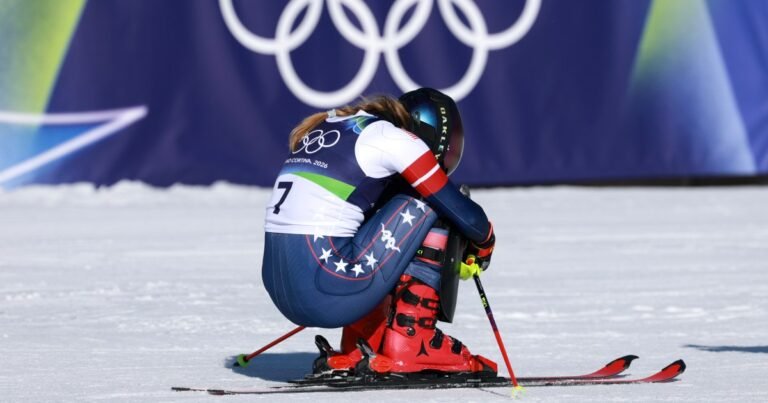
Shiffrin has banished memories of both her last Olympics in Beijing – where she failed to pick up a single medal from six races and did not even finish three – and her disappointing displays in the team combined and giant slalom in northern Italy.

She came to Cortina as a red-hot favourite to claim at least one gold due to her sensational form this season, which has taken her all-time record of World Cup wins to 108.

Shiffrin has already won the slalom title in the World Cup after coming out on top in seven of this season’s races, finishing just 0.14sec behind Rast in Kranjska Gora, the one time she did not win.

Gold is a happy ending to a difficult Olympics for both Shiffrin and the US ski team, whose games were dominated by Lindsey Vonn’s horror crash and leg break in the downhill race, which opened proceedings in Cortina.

Shiffrin’s victory is her second Olympic gold medal in the slalom and comes 12 years after she became the youngest winner of that Olympic event at the Sochi Games.

Mikaela Shiffrin in action.
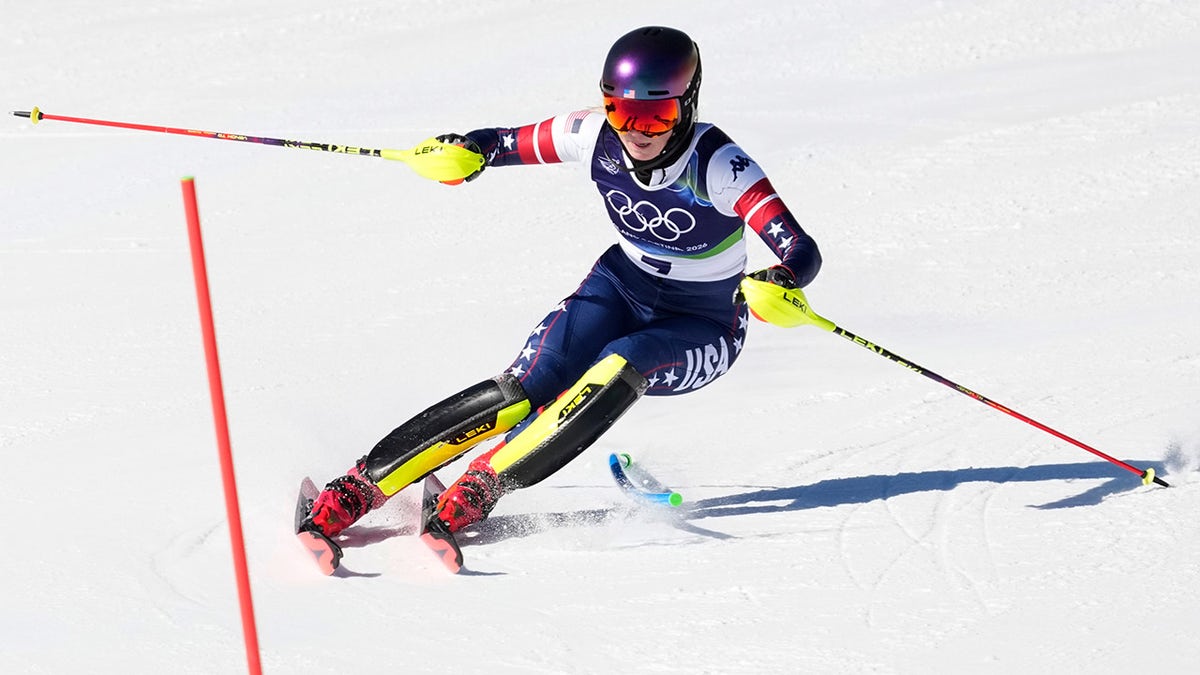
Shiffrin competes during the Women’s Slalom final [Julian Finney/Getty Images]


Source link

t20 wc super 8 schedule: T20 World Cup 2026: The battle of Super 8 is ready, which team is the biggest contender for victory?

0

New Delhi. The ICC Men’s T20 World Cup 2026, which started with 20 teams, has reached its most exciting stage. After the hustle and bustle of the group stage, now the top 8 teams of the world are ready to enter the field for ‘Super 8’. This tournament, being played on the soil of co-hosts India and Sri Lanka, has already seen many major upsets, in which the exit of a great team like Australia was the most shocking. Now the fight is for four tickets to the semi-finals, where the teams of Group 1 and Group 2 will challenge each other.

Super 8 teams and group divisions

The teams have been divided into two groups for the Super 8 stage. The interesting thing is that the groups were already decided on the basis of seeding, due to which the picture of the great matches is now clear.
Group 1: India, South Africa, West Indies and Zimbabwe.
Group 2: Pakistan, Sri Lanka, England and New Zealand

Who has the upper hand and which group is the ‘Group of Death’?

This time Group 2 is being considered as the ‘Group of Death’ because it has balanced teams like Pakistan, defending champions England, New Zealand and Sri Lanka taking advantage of home conditions. Making it to the top two from here will be a big challenge for any team. Whereas in Group 1, Team India seems to have the heaviest advantage. India has proved its dominance by defeating Pakistan in the group stage. According to experts, India and South Africa are strong contenders for the semi-finals from this group, although West Indies has the power to surprise any team on its day.

Complete schedule: When, where and between whom will the clash take place?

The battle of Super 8 will start from 21st February and continue till 1st March. Each team will play one match each with the other three teams of its group. The top 2 teams from both the pools will secure their place for the semi-finals.

21st February New Zealand vs Pakistan 7:00 PM Colombo
22 February England vs Sri Lanka 3:00 PM Kandy
22 February India vs South Africa 7:00 pm Ahmedabad
23 February Zimbabwe vs West Indies 7:00 pm Mumbai
24th February England vs Pakistan 7:00 PM Kandy
25 February New Zealand vs Sri Lanka 7:00 pm Colombo
26 February South Africa vs West Indies 3:00 pm Ahmedabad
26 February India vs Zimbabwe 7:00 pm Chennai
27 February England vs New Zealand 7:00 pm Colombo
28th February Pakistan vs Sri Lanka 7:00 PM Kandy
March 1 Zimbabwe vs South Africa 3:00 pm Delhi
March 1 India vs West Indies 7:00 pm Kolkata

This round of Super 8 will be a test of not only skills but also mental strength. India will have the advantage of its home grounds, but Sri Lanka can also prove to be a big threat in Group 2. The coming ten days are going to be full of high-voltage drama and thrill for cricket lovers.

Masseuse charged with multiple sexual offences | UK News

0


A masseuse has been charged with multiple sexual offences following an investigation in Northumberland.

Terence McBrien, 72, of the Alnwick area, is due to appear at Berwick Magistrates’ Court on March 19. He is currently on bail.

He has been charged with 55 offences, including one count of attempted rape, seven counts of sexual assault by penetration, 34 counts of sexual assault by touching and 13 counts of voyeurism.

These charges are in relation to 14 women.

Detective Sergeant Michael Rainbow, the officer in charge of the case, said: “Following a complex and lengthy investigation, an individual has now been charged with attempted rape and more than 50 other serious sexual offences.

“We recognise the nature and number of the charges may raise concern and anxiety within our communities.

“We would encourage anyone who does have concerns or believes they have information which is relevant to this case to come forward.

“We would also like to remind people that with criminal proceedings now active, it is important to avoid speculation both online and in the communities which could impact the case.”

This breaking news story is being updated and more details will be published shortly.

Please refresh the page for the fullest version.

You can receive breaking news alerts on a smartphone or tablet via the Sky News app. You can also follow us on WhatsApp and subscribe to our YouTube channel to keep up with the latest news.


Source link

Mikaela Shiffrin secures gold medal in Winter Olympcis

0

NEWYou can now listen to Fox News articles!

Mikaela Shiffrin returned to the top of the podium in the alpine skiing women’s slalom event on Wednesday at the Winter Olympics.

As she awaited her moment, her coach told her to “rip this thing.” She certainly did.

CLICK HERE FOR MORE SPORTS COVERAGE ON FOXNEWS.COM

Mikaela Shiffrin skis down

United States’ Mikaela Shiffrin arrives at the finish area of an alpine ski, women’s slalom race, at the 2026 Winter Olympics, in Cortina d’Ampezzo, Italy, Wednesday, Feb. 18, 2026.  (AP Photo/Andy Wong)

Shiffrin recorded a total time of 1:39.10 after going down the hill with a time of 47.13 on her first run and 51.97 on her second. She catapulted herself to gold medal position and added to Team USA’s medal total.

After a disastrous run in the 2022 Beijing Games, Shiffrin was able to keep her composure and deliver an incredible run to grab the gold. But she had to wait a few agonizing seconds as the two competitors ahead of her failed to make it through the course.

AMERICAN JAKE CANTER TAKES HOME BRONZE MEDAL IN OLYMPIC MEN’S SNOWBOARD SLOPESTYLE

Mikaela Shiffrin looks on

United States’ Mikaela Shiffrin at the finish area of an alpine ski, women’s slalom race, at the 2026 Winter Olympics, in Cortina d’Ampezzo, Italy, Wednesday, Feb. 18, 2026.  (AP Photo/Andy Wong)

Shiffrin locked in and even gained time on her competitors in portions of the course. She bent down in almost disbelief realizing the incredible moment she made.

It wasn’t that long ago when Shiffrin had a shocking outing in the 2022 Games where she didn’t make the podium in any of the alpine skiing events despite being considered one of the greatest of all time in her sport. Now, she can call herself a three-time gold medalist.

She’s the second Olympic skier to win gold twice in the event.

Mikaela Shiffrin celebrates

United States’ Mikaela Shiffrin, center, winner of an alpine ski, women’s slalom race, celebrates with second-placed Switzerland’s Camille Rast, left, and third-placed Sweden’s Anna Swenn Larsson, at the 2026 Winter Olympics, in Cortina d’Ampezzo, Italy, Wednesday, Feb. 18, 2026.  (AP Photo/Andy Wong)

CLICK HERE TO DOWNLOAD THE FOX NEWS APP

Switzerland’s Camille Rast was second with a silver and Sweden’s Anna Larsson Swenn secured the bronze medal.

Follow Fox News Digital’s sports coverage on X and subscribe to the Fox News Sports Huddle newsletter.


Source link

Child stole mobile before going to school, did a cute dance on “Main Tere Ishq Mein” in the balcony

0

homeVideostrange-wonderful

Child stole mobile before going to school, did a cute dance on “Main Tere Ishq Mein” in the balcony

X
title=

Child stole mobile before going to school, did a cute dance on “Main Tere Ishq Mein” in the balcony

arw img

A cute dance video of a child is going viral on social media. The child has made a reel on a trending song in school dress. In the video, you can see that the child kept the mobile in the balcony of the house and danced on the song Main Tere Ishq Mein Mar Na Jaoin Kahin. The child’s steps and his expression won people’s hearts. Many people wrote in the comments that he will become a great dancer. Let us tell you that these days this song is trending a lot on social media. In such a situation, many people are making reels and sharing it.

To add News18 as your favorite news source on Google click here Do it.

Operating in a World of Permanent Instability

0

In 2025, navigating the digital seas still felt like a matter of direction. Organizations charted routes, watched the horizon, and adjusted course to reach safe harbors of resilience, trust, and compliance.

In 2026, the seas are no longer calm between storms. Cybersecurity now unfolds in a state of continuous atmospheric instability: AI-driven threats that adapt in real time, expanding digital ecosystems, fragile trust relationships, persistent regulatory pressure, and accelerating technological change. This is not turbulence on the way to stability; it is the climate.

In this environment, cybersecurity technologies are no longer merely navigational aids. They are structural reinforcements. They determine whether an organization endures volatility or learns to function normally within it. That is why security investments in 2026 are increasingly made not for coverage, but for operational continuity: sustained operations, decision-grade visibility and controlled adaptation as conditions shift.

This article is less about what’s “next-gen” and more about what becomes non-negotiable when conditions keep changing. The shifts that will steer cybersecurity priorities and determine which investments hold when conditions turn.

Regulation and geopolitics become architectural constraints

Regulation is no longer something security reacts to. It is something systems are built to withstand continuously.

Cybersecurity is now firmly anchored at the intersection of technology, regulation and geopolitics. Privacy laws, digital sovereignty requirements, AI governance frameworks and sector-specific regulations no longer sit on the side as periodic compliance work; they operate as permanent design parameters, shaping where data can live, how it can be processed and what security controls are acceptable by default.

At the same time, geopolitical tensions increasingly translate into cyber pressure: supply-chain exposure, jurisdictional risk, sanctions regimes and state-aligned cyber activity all shape the threat landscape as much as vulnerabilities do.

As a result, cybersecurity strategies must integrate regulatory and geopolitical considerations directly into architecture and technology decisions, rather than treating them as parallel governance concerns.

Changing the conditions: Making the attack surface unreliable

Traditional cybersecurity often tried to forecast specific events: the next exploit, the next malware campaign, the next breach. But in an environment where signals multiply, timelines compress and AI blurs intent and scale, those forecasts decay quickly. The problem isn’t that prediction is useless. It’s that it expires faster than defenders can operationalize it.

So the advantage shifts. Instead of trying to guess the next move, the stronger strategy is to shape the conditions attackers need to succeed.

Attackers depend on stability: time to map systems, test assumptions, gather intelligence and establish persistence. The modern counter-move is to make that intelligence unreliable and short-lived. By using tools like Automated Moving Target Defense (AMTD) to dynamically alter system and network parameters, Advanced Cyber Deception that diverts adversaries away from critical systems, or Continuous Threat Exposure Management (CTEM) to map exposure and reduce exploitability, defenders shrink the window in which an intrusion chain can be assembled.

This is where security becomes less about “detect and respond” and more about deny, deceive and disrupt before an attacker’s plan becomes momentum.

The goal is simple: shorten the shelf-life of attacker knowledge until planning becomes fragile, persistence becomes expensive and “low-and-slow” stops paying off.

AI becomes the acceleration layer of the cyber control plane

AI is no longer a feature layered on top of security tools. It is increasingly infused inside them across prevention, detection, response, posture management and governance.

The practical shift is not “more alerts,” but less friction: faster correlation, better prioritization and shorter paths from raw telemetry to usable decisions.

The SOC becomes less of an alert factory and more of a decision engine, with AI accelerating triage, enrichment, correlation and the translation of scattered signals into a coherent narrative. Investigation time compresses because context arrives faster and response becomes more orchestrated because routine steps can be drafted, sequenced and executed with far less manual stitching.

But the bigger story is what happens outside the SOC. AI is increasingly used to improve the efficiency and quality of cybersecurity controls: asset and data discovery become faster and more accurate; posture management becomes more continuous and less audit-driven; policy and governance work becomes easier to standardize and maintain. Identity operations, in particular, benefit from AI-assisted workflows that improve provisioning hygiene, strengthen recertification by focusing reviews on meaningful risk and reduce audit burden by accelerating evidence collection and anomaly detection.

This is the shift that matters. Security programs stop spending energy assembling complexity and start spending it steering outcomes.

Security becomes a lifecycle discipline across digital ecosystems

Most breaches do not start with a vulnerability. They start with an architectural decision made months earlier.

Cloud platforms, SaaS ecosystems, APIs, identity federation and AI services continue to expand digital environments at a faster rate than traditional security models can absorb. The key shift is not merely that the attack surface grows, but that interconnectedness changes what “risk” means.

Security is therefore becoming a lifecycle discipline: integrated throughout the entire system lifecycle, not just development. It starts at architecture and procurement, continues through integration and configuration, extends into operations and change management and is proven during incidents and recovery.

In practice, that means the lifecycle now includes what modern ecosystems are actually made of: secure-by-design delivery through the SDLC and digital supply chain security to manage the risks inherited from third-party software, cloud services and dependencies.

Leading organizations move away from security models focused on isolated components or single phases. Instead, security is increasingly designed as an end-to-end capability that evolves with the system, rather than trying to bolt on controls after the fact.

Zero Trust as a continuous decisioning and adaptive control

In a world where the perimeter dissolved long ago, Zero Trust stops being a strategy and becomes the default infrastructure. Especially as trust itself becomes dynamic.

The key shift is that access is no longer treated as a one-time gate. Zero Trust increasingly means continuous decisioning: permission is evaluated repeatedly, not granted once. Identity, device posture, session risk, behavior and context become live inputs into decisions that can tighten, step up, or revoke access as conditions change.

With identity designed as a dynamic control plane, Zero Trust expands beyond users to include non-human identities such as service accounts, workload identities, API tokens and OAuth grants. This is why identity threat detection and response becomes essential: detecting token abuse, suspicious session behavior and privilege path anomalies early, then containing them fast. Continuous authorization makes stolen credentials less durable, limits how far compromise can travel and reduces the Time-To-Detection dependency by increasing the Time-To-Usefulness friction for attackers. Segmentation then does the other half of the job by keeping local compromise from turning into systemic spread by containing the blast radius by design.

The most mature Zero Trust programs stop measuring success by deployment milestones and start measuring it by operational outcomes: how quickly access can be constrained when risk rises, how fast sessions can be invalidated, how small the blast radius remains when an identity is compromised and how reliably sensitive actions require stronger proof than routine access.

Data security and privacy engineering unlock scalable AI

Data is the foundation of digital value and simultaneously the fastest path to regulatory, ethical and reputational damage. That tension is why data security and privacy engineering are becoming non-negotiable foundations, not governance add-ons. When organizations can’t answer basic questions such as what data exists, where it lives, who can access it, what is it used for and how it moves, every initiative built on data becomes fragile. This is what ultimately determines whether AI projects can scale without turning into a liability.

Data security programs must evolve from “protect what we can see” to govern how the business actually uses data. That means building durable foundations around visibility (discovery, classification, lineage), ownership, enforceable access and retention rules and protections that follow data across cloud, SaaS, platforms and partners. A practical way to build this capability is through a Data Security Maturity Model to identify gaps across the core building blocks, prioritize what to strengthen first and initiate a maturity journey toward consistent, measurable and continuous data protection throughout its lifecycle.

Privacy engineering becomes also the discipline that makes those foundations usable and scalable. It shifts privacy from documentation to design through purpose-based access, minimization by default and privacy-by-design patterns embedded in delivery teams. The result is data that can move quickly with guardrails, without turning growth into hidden liability.

Post-Quantum Risk makes crypto agility a design requirement

Quantum computing is still emerging, but its security impact is already tangible because adversaries plan around time. “Harvest now, decrypt later” turns encrypted traffic collected now into future leverage. “Trust now, forge later” carries the same logic into trust systems: certificates, signed code and long-lived signatures that anchor security decisions today could become vulnerable later.

Governments have understood this timing problem and started to put dates on it, with first milestones as early as 2026 for EU governments and critical infrastructure operators to develop national post-quantum roadmaps and cryptographic inventories. Even if the rules start in the public sector, they travel fast through the supply chain and into the private sector.

This is why crypto agility becomes a design requirement rather than a future upgrade project. Cryptography is not a single control in one place. It is embedded across protocols, applications, identity systems, certificates, hardware, third-party products and cloud services. If an organization cannot rapidly locate where cryptography lives, understand what it protects and change it without breaking operations, it is not “waiting for PQC.” It is accumulating cryptographic debt under a regulatory clock.

Post-quantum preparedness therefore becomes less about picking replacement algorithms and more about building the ability to evolve: cryptographic asset visibility, disciplined key and certificate lifecycle management, upgradable trust anchors where possible and architectures that can rotate algorithms and parameters without disruption.

Cryptographic risk is no longer a future problem. It is a present design decision with long-term consequences.

Taken together, these shifts change what “good” looks like.

Security stops being judged by how much it covers and starts being judged by what it enables: resilience, clarity and controlled adaptation when conditions refuse to cooperate.

The strongest security programs are not the most rigid ones. They are the ones that adapt without losing control.

The digital environment does not promise stability, but it does reward preparation. Organizations that integrate security across the system lifecycle, treat data as a strategic asset, engineer for cryptographic evolution and reduce human friction are better positioned to operate with confidence in a world that keeps shifting.

Turbulence is no longer exceptional. It’s the baseline. The organizations that succeed are the ones designed to operate anyway.

Read Digital Security Magazine – 18th Edition.

Found this article interesting? This article is a contributed piece from one of our valued partners. Follow us on Google News, Twitter and LinkedIn to read more exclusive content we post.

Source link

Why is the US targeting Cuba’s global medical missions? | Government News

0

Guatemala announced last week that it will begin phasing out its three-decade-old programme, under which Cuban doctors work in its country to fill the gap in the country’s healthcare system.

Communist-ruled Cuba, under heavy United States sanctions, has been earning billions of dollars each year by leasing thousands of members of its “white coat army” to countries around the world, especially in Latin America. Havana has used its medical missions worldwide as a tool for international diplomacy.

Recommended Stories

list of 4 itemsend of list

So why are some countries withdrawing from the programme that helps the host countries?

Why is Guatemala phasing out Cuban doctors?

Guatemala’s health ministry said in a statement that it would begin a “gradual termination” over this year.

“The phased withdrawal of the Cuban Medical Brigade stems from an analysis of the mission’s completion of its cycles,” the statement, originally in Spanish, said on February 13.

The statement added that the Cuban medical mission was meant to support Guatemala through the 1998 Hurricane Mitch, which devastated parts of Central America, overwhelmed local hospitals and left rural communities with almost no access to medical care.

“The Ministry of Health is developing a phased strategic replacement plan that includes hiring national personnel, strengthening incentives for hard-to-reach positions, strategic redistribution of human resources, and specialized technical support,” the statement said.

The Cuban mission in Guatemala comprises 412 medical workers, including 333 doctors.

The Central American country’s decision comes amid growing pressure from the United States, which wants to stop Cuban doctors from serving abroad.

The move aims to starve Cuba of much-needed revenue as a major share of the incomes earned by doctors goes to government coffers. Cuba has been facing severe power, food and medical shortages amid an oil blockade imposed by the Trump administration since January.

Guatemala is just one country which benefits from Cuban medical missions.

Over the past decades, Cuba has sent medical missions around the world, from Latin America to Africa and beyond. It began sending these missions shortly after the 1959 Cuban revolution brought Fidel Castro to power.

Castro’s communist government reversed many of the pro-business policies of Fulgencio Batista, the dictator backed by the US. The revolution ruptured ties between the two countries, with the US spy agency CIA trying several times unsuccessfully to topple Castro’s government.

Guatemala has moved closer to the US since the election of Bernardo Arevalo as the president in January 2024. He has cooperated with US President Donald Trump’s administration. Last year, Guatemala agreed to ramp up the number of deportation flights it receives from the US. The US has deported thousands of immigrants without following due process to third countries such as Guatemala and El Salvador, which are headed by pro-Trump leaders.

In November 2018, shortly after Brazil elected Jair Bolsonaro as president, Cuba announced its withdrawal from the country’s Cuba “Mais Medicos” (More Doctors) programme. Bolsonaro, who is known as Brazil’s Trump, had criticised the medical mission, deeming it “slave labour”. Bolsonaro is serving a 27-year prison sentence after he was convicted in September 2025 of plotting to stage a coup in order to retain power after his defeat in the 2022 presidential election.

Why is the US targeting Cuba’s global medical missions?

The US has deemed Cuba’s foreign medical missions a form of “forced labour” and human trafficking, without any evidence, and has a goal of restricting the Cuban government’s access to its largest source of foreign income.

US efforts to curb Cuba’s medical missions are not new. Just last year, Washington imposed visa restrictions aimed at discouraging foreign governments from entering into medical cooperation agreements with Cuba.

In February last year, US Secretary of State Marco Rubio announced that the US would restrict visas targeting “forced labor linked to the Cuban labor export program”.

“This expanded policy applies to current or former Cuban government officials, and other individuals, including foreign government officials, who are believed to be responsible for, or involved in, the Cuban labor export program, particularly Cuba’s overseas medical missions,” a statement on the US State Department’s website said.

Rubio, who is of Cuban origin, has been a vocal critic of Havana, and has pushed US policies in Latin America, including the military operation to abduct Venezuelan President Nicolas Maduro on January 3. Under Trump, Washington has pushed its focus on Latin America as part of its Western Hemisphere pivot, which seeks to restore Washington’s preeminence in the region.

Since Maduro’s abduction, the US focus has turned towards Cuba. Senior US officials, particularly Rubio, hinted that Havana could be the next target of Washington’s pressure campaign.

The US, in effect, cut off Venezuelan oil shipments to Cuba as part of a new oil blockade. Havana has faced sweeping US sanctions for decades, and Cuba has since 2000 increasingly relied on Venezuelan oil provided as part of a deal struck with Maduro’s predecessor, Hugo Chavez.

The blockade has caused a fuel shortage and, in turn, a severe energy crisis in Cuba. President Miguel Diaz-Canel has imposed harsh emergency restrictions as a response.

This has renewed US pressure on countries to phase out Cuban medical missions.

How many Cuban doctors are on missions abroad?

More than 24,000 Cuban doctors are working in 56 countries worldwide. This includes Latin American countries such as Venezuela, Nicaragua and Mexico; Africa, including Angola, Mozambique, Algeria; and the Middle East, including Qatar.

There have been occasional deployments in other countries. For instance, Italy received Cuban doctors during the COVID-19 pandemic to help overwhelmed hospitals in some of its hardest-hit regions.

Cuban doctors are crucial for Caribbean countries. They fill a significant gap in medical care amid a lack of trained medical professionals.

Have countries resisted US pressure in the past?

Caribbean countries hit back in March 2025 against the US threats to restrict visas. “We could not get through the pandemic without the Cuban nurses and the Cuban doctors,” Barbados’s Prime Minister Mia Mottley said in a speech to the parliament.

“Out of the blue now, we have been called human traffickers because we hire technical people who we pay top dollar,” Trinidad and Tobago’s Prime Minister Keith Rowley said back then, adding that he was prepared to lose his US visa.

“If the Cubans are not there, we may not be able to run the service,” Saint Vincent and the Grenadines then-Prime Minister Ralph Gonsalves said. “I will prefer to lose my visa than to have 60 poor and working people die.”

In August 2025, the US announced that it was revoking the visas of Brazilian, African and Caribbean officials over their ties to Cuba’s programme that sends doctors abroad.

It named Brazilian Ministry of Health officials, Mozart Julio Tabosa Sales and Alberto Kleiman, who had their visas revoked for working on Brazil’s Mais Medicos, or “More Doctors” programme, which was created in 2013.

Some countries are now finding ways around the pressure from Washington. For instance, this month Guyana announced that it would start paying doctors directly, rather than through the Cuban government.


Source link

Norah O’Donnell calls CBS News leadership ‘challenging’ amid departures

0

NEWYou can now listen to Fox News articles!

Longtime CBS News correspondent Norah O’Donnell remarked on how “challenging” the network’s new leadership has been in a podcast interview Tuesday.

While appearing on “The Jamie Kern Lima Show,” O’Donnell was asked to comment on the changes at CBS since the network and its parent company, Paramount Global, came under new leadership.

“You know, I have worked at CBS now for, oh my goodness, probably almost 14 years and have had a great career,” O’Donnell said. “Whether it was covering the White House anchoring the morning show, anchoring the evening news, and working for ‘60 Minutes,’ we have had a lot of leadership changes at CBS, and that has been challenging, not only for me, but I know for my colleagues. And I think with so many leadership changes, people are fearful about what the future means.”

POLARIZING CBS NEWS CHIEF CALLS ALL-HANDS MEETING ABOUT ORGANIZATION’S FUTURE, WILL DIRECTLY ADDRESS STAFFERS

Margaret Brennan Norah O'Donnell

Norah O’Donnell (right) spoke to “The Jamie Kern Lima Show” about CBS News leadership. (Mary Kouw/CBS via Getty Images)

During the podcast, she still spoke highly of CBS News for helping facilitate major interviews, such as her “60 Minutes” interview with President Donald Trump.

“I’m very fortunate to work for CBS News and work with the very best producers and, you know, sometimes we all take a lot of heat, you know, but I happen to work with some really incredible, incredible people who make our job not only interesting and successful, but also we care deeply about each other,” O’Donnell said.

Fox News Digital reached out to CBS News for comment.

CONNIE CHUNG CONDEMNS CBS NEWS, SAYS ‘GREEDY’ LEADERSHIP CAUSED HER FORMER NETWORK TO ‘CRASH INTO CRUMBLES’

CBS News has come under scrutiny since The Free Press founder Bari Weiss took over as editor-in-chief in October, a move that was seen as controversial by many people inside and outside the network.

Bari Weiss

Bari Weiss, who was handpicked by Paramount CEO David Ellison, was formally named editor-in-chief of CBS News in October. (Michele Crowe/CBS News via Getty Images)

Shortly after Weiss’ new position was announced, John Dickerson, who replaced O’Donnell as anchor of “CBS Evening News,” announced that he would be leaving the network after 16 years.

Last week, “CBS Evening News” producer Alicia Hastey abruptly resigned from the network and accused leadership of wanting to conform stories to “ideological expectations.”

CBS DENIES IT BLOCKED COLBERT FROM BROADCASTING TALARICO INTERVIEW AFTER HOST CLAIMED NETWORK LAWYERS HALTED

“The truth is that commitment to those people and the stories they have to sell is increasingly becoming impossible,” Hastey said. “Stories may instead be evaluated not just on their journalistic merit but on whether they conform to a shifting set of ideological expectations — a dynamic that pressures producers and reporters to self-censor or avoid challenging narratives that might trigger backlash or unfavorable headlines.” 

CBS News

CBS News anchors such as John Dickerson and Anderson Cooper have left the network since Weiss took over leadership. (Getty Images)

CLICK HERE TO DOWNLOAD THE FOX NEWS APP

It was later announced on Monday that “60 Minutes” correspondent Anderson Cooper would be leaving the network after almost 20 years.


Source link

War fixed between America and Iran? Trump prepares to eliminate Khamenei, sends ammunition from 150 cargo planes in 24 hours

0

An atmosphere of tension has once again arisen in the Middle East regarding the possibility of an American military attack on Iran. On one hand, there were talks regarding nuclear talks between the delegations of the two countries in Geneva on Tuesday (17 February 2026), while on the other hand, America is increasing the presence of its Air Force and Navy power in the Middle East. Within the last 24 hours, America has sent more than 50 fighter jets near Iran’s territory, due to which sounds of another war are being heard.

Trump is preparing for a big war in the Middle East

Before the start of the second round of nuclear talks, US President Donald Trump had warned Iran of facing the consequences. After this, Iran’s supreme leader Ayatollah Ali Khamenei also talked about giving a befitting reply to America. According to the report of American news website Axios, the Trump administration is preparing for a major war in the Middle East. This war will be bigger than most Americans can even imagine.

The report quoted sources and claimed that the US military operation in Iran could last for several weeks. America and Israel will jointly carry out this operation, which will create a more dangerous situation for the Iranian government. Last year, America had attacked to destroy Iran’s underground nuclear facilities, but this time the attack will have a deep impact on the entire region. There is no significant public discussion on American military intervention in the Middle East between the US Parliament and the people there.

Trump wants compromise: JD Vance

By using so much military power in the Middle East, Trump has increased the fear that if a nuclear deal is not reached, America will carry out a major operation in the region. At present, there seems to be little possibility of an agreement between the two countries. Trump advisers Jared Kushner and Steve Witkoff met with Iranian Foreign Minister Abbas Araghchi in Geneva on Tuesday for three hours. Although both sides said that progress was made in the talks, differences still run deep.

US Vice President JD Vance told Fox News that in some ways there were good talks between the two countries, but on many issues it was clear that President Trump had set some limits on which Iran would never be ready to talk. However, JD Vance also said that Trump wants a compromise.

The war will start in the next few weeks

According to sources, war between Iran and America may start soon. More than 150 US military cargo planes have delivered weapons and ammunition to the Middle East. About 50 fighter jets have also been sent to the Middle East, which includes F-35, F-22 and F-16. Senator Lindsey Graham said that the attack could still take several weeks, but other experts say that the attack could happen even earlier. A Trump advisor said, ‘I think there is a 90 percent chance of military action against Iran in the next few weeks.