Country music singer Brantley Gilbert was tapped to perform at Turning Point USA’s “All-American Halftime Show” on Sunday to counter against Bad Bunny’s spectacle at Super Bowl LX.
Gilbert will be one of four singers at the Turning Point USA event. Kid Rock is the headliner along with Lee Brice and Gabby Barrett. Gilbert has been singing professionally since 2007 and released his debut album in 2009.
Brantley Gilbert performs for fans before the start of the NASCAR Toyota – Save Mart 350 race at Sonoma Raceway on June 12, 2022.(Stan Szeto/USA TODAY Sports)
He may not be a household name for some Americans and football fans. He addressed those who were asking who he was and why he was performing at the event.
“I’m a songwriter who grew up, and still lives in Jackson County, GA, whose goal in the music business was to sell out the local theater a few miles from my house and somehow make my living writing songs,” he said in a statement. “I’m a recovering addict with the history of all the bad choices that come with it. I’m not proud of those choices, but I am proud of the choice I’ve made to live in another direction.
“I share my story through my music, in hopes that it may help and inspire others in their darkest hour. I’m a Christian, and I love our country, despite its flaws. I’ve dedicated part of my life to the men and women who fight for it, and the families of those who gave their life for it. Above all, I’m a proud husband and father of three.”
Brantley Gilbert arrives on the red carpet for the 59th Annual CMA Awards at Music City Center in Nashville, Tennessee, Wednesday, Nov. 19, 2025.(Andrew Nelles/USA TODAY NETWORK via Imagn Images)
Gilbert added that he wanted to perform for his children and that it’s been more than 20 years since a country music singer had been asked to sing at halftime of the Super Bowl.
“We’re celebrating 250 years as a country, and it’s been more than 20 years since a country artist has been asked to play the Super Bowl halftime show. I respect that some people may see this differently, but I’m not playing this show to be divisive. I was offered this opportunity and imagined my kids watching their daddy perform at halftime during the biggest game in American football. Everything I do, I do for them.
“The way I treat people isn’t conditional based on what our differences may be. I believe “united we stand, divided we fall,” and my prayer for our country is that we stand united.”
He said he was looking forward to putting on an epic show Sunday.
Turning Point USA said the show will air live on YouTube, X and Rumble in addition to other conservative news outlets.
The event — titled “The All-American Halftime Show” — is scheduled to air around 8 p.m. ET on Feb. 8 and will feature performances from artists including Kid Rock, Brantley Gilbert, Lee Brice and Gabby Barrett, according to the nonprofit organization.(Turning Point USA)
Andrew Kolvet, TPUSA’s spokesman, previously told Fox News Digital that the broadcast will be meant to provide families a different viewing option that will give the viewer an immersive and high-energy experience.
“‘The All-American Halftime Show’ is an opportunity for all Americans to enjoy a halftime show with no agenda other than to celebrate faith, family, and freedom,” Kolvet said. “… We can’t wait to watch the incredible show they’re about to put on. We know millions around the country will be watching too.”
Authorities investigating killing of Saif al-Islam Gaddafi, once seen as de-facto PM under father’s iron-fisted rule.
Published On 6 Feb 20266 Feb 2026
Share
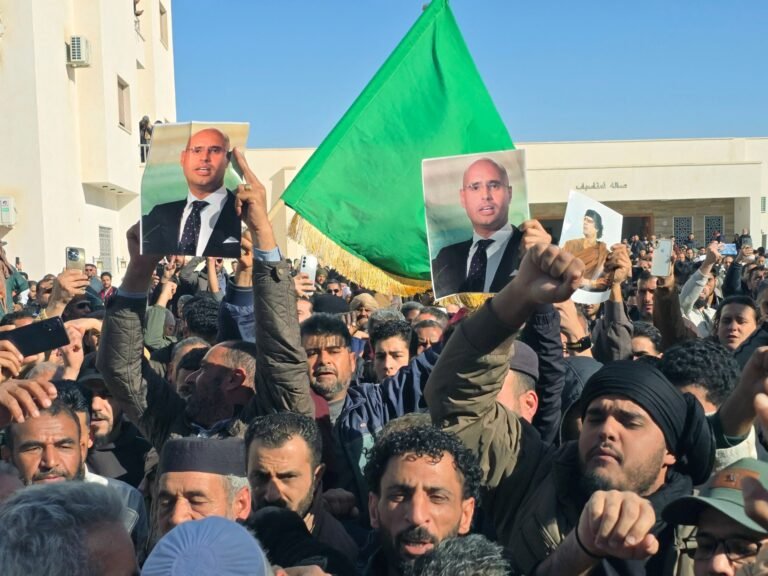
Thousands of people have attended the funeral of Saif al-Islam Gaddafi, the late Libyan leader Muammar Gaddafi’s most prominent son, who was shot dead this week.
The burial took place on Friday in the town of Bani Walid, some 175 kilometres (110 miles) south of Tripoli.
Recommended Stories
list of 3 itemsend of list
Nearly 15 years after the elder Gaddafi was toppled and killed in a 2011 NATO-backed uprising, thousands of loyalists turned up to mourn his son, who was once seen as the former leader’s heir apparent.
Saif al-Islam Gaddafi was killed on Tuesday in his home in the northwestern city of Zintan. His office said in a statement that he had been killed during a “direct confrontation” with four unknown gunmen who broke into his home.
The office of Libya’s attorney general said investigators and forensic doctors examined the 53-year-old’s body and determined that he died from gunshot wounds and that the office was working to identify suspects.
“We are here to accompany our beloved one, the son of our leader in whom we placed our hope and our future,” said Waad Ibrahim, a 33-year-old woman from Sirte, nearly 300km (186 miles) away from Bani Walid.
Divided country
Saif al-Islam Gaddafi was once described as the de facto prime minister under his father’s iron-fisted 40-year rule, cultivating an image of moderation and reform despite holding no official position.
Championing himself as a reformer, he led talks on Libya abandoning its weapons of mass destruction and negotiated compensation for the families of those killed in the bombing of Pan Am Flight 103 over Lockerbie, Scotland, in 1988.
But that reputation soon collapsed when he promised “rivers of blood” in response to the 2011 uprising, which led to his arrest that year on a warrant issued by the International Criminal Court for alleged crimes against humanity.
In 2021, he announced he would run for president, but the elections aiming to unify the divided country under a United Nations agreement were indefinitely postponed.
Today, Libya remains split between Prime Minister Abdul Hamid Dbeibah’s UN-backed government based in Tripoli and an eastern administration backed by Khalifa Haftar.
The killing of Gaddafi, seen by many as an alternative to the country’s power duopoly, occurred less than a week after a reported January 28 meeting in France’s Elysee Palace, which brought together Haftar’s son and advisers to Dbeibah.
Speaking of the parasite, Foy said, “I kept losing weight and I didn’t know what was going on. I was just like, ‘I’m eating everything.’ I was so hungry.”
“The Crown” star Claire Foy contracted a parasite that lived in her body for five years.(Getty Images)
Jesse Ware asked Foy if she was diagnosed with the parasite through a blood test or a stool test. “Yeah, the gross stuff,” Foy replied.
According to the Cleveland Clinic, parasitic infections are “diseases caused by organisms that live off of another living thing.” Side effects can include fever, fatigue, intestinal symptoms, skin rashes or neurological symptoms.
Claire Foy in season one of Netflix’s “The Crown.”(Netflix)
Claire Foy cut out caffeine and made other diet changes to get rid of the parasite.(Getty Images)
“You can get them from contaminated food, water or surfaces, bug bites and eating undercooked meat,” according to the Cleveland Clinic.
Foy told the podcast host that she learned more information on her parasite infection after consulting with a doctor and believes she had been living with it in her body for “at least five years.”
“They travel as a pair. I got told by the doctor, gross, absolutely rank. It’s disgusting.”
— Claire Foy
“They travel as a pair. I got told by the doctor, gross, absolutely rank. It’s disgusting,” Foy said.
It took sacrificing caffeine to get rid of the parasite, according to the actress.
Claire Foy originated the role of Queen Elizabeth in Netflix’s “The Crown.”(Getty Images)
Foy said giving up caffeine and changing her diet wasn’t easy since she consumed “at least 15 cups of tea a day” and two coffees. Even after the parasite was treated, Foy decided to stick to a caffeine-free life.
“Real Housewives of Beverly Hills” alum Brandi Glanville previously shared that she believed she picked up a parasite after visiting Morocco in 2023. She suffered from facial paralysis and initially was diagnosed with stress-induced angioedema.
Brandi Glanville debuted her face after illness.(Fox News Digital)
After the initial diagnosis, she suspected she contracted a parasite in Morocco and could feel it moving within her face.
“We had food sitting out for hours on end and some of it was meat. Six months after I got back from Morocco, I started having this speaking thing and the swelling up thing. It started in July and we’re still here trying to figure it out,” she told Entertainment Tonight.
“I feel like it’s s—ing or having babies in my face,” Glanville added.
AI-pocalypse Britain’s welfare system is experimenting with AI to manage Universal Credit claimants – even as evidence piles up that artificial intelligence may soon be pushing more people onto benefits in the first place.
The Department for Work and Pensions is exploring chatbot-style digital assistants to support Universal Credit claimants, with Permanent Secretary Sir Peter Schofield telling MPs the technology could eventually become part of frontline welfare support.
UK names Barnsley as first Tech Town to see whether AI can fix… well, anything
Officials believe automated tools could help claimants navigate applications, training options, and employment support while easing pressure on human work coaches stretched by rising caseloads.
“We want to be able to focus our work in a more tailored way so that the people who don’t need the interaction with a work coach potentially, in due course, could be able to have an interaction with a digital tool that prompts them, freeing up our work coaches for the people who most need it,” Schofield said.
Universal Credit isn’t just for unemployed people; it also covers low-income workers, disabled people, and those who can’t work full-time. Dragging AI into that ecosystem suggests automation may end up doing double duty by reshaping employment, then helping government handle the fallout.
Meanwhile, the government is expanding its AI partnerships to help citizens navigate the changing labor market. Officials recently announced that the government will work with model developer Anthropic on AI-powered tools to provide career advice and job search guidance, part of a broader effort to position automation as both the cause of disruption and its solution.
Inside government, officials are already weighing more radical responses. Investment minister Lord Jason Stockwood recently told The Financial Times that universal basic income (UBI) is being discussed as a possible safety net for workers displaced by AI, warning that automation is likely to create socially “bumpy” transitions.
UBI is not official policy, but its consideration suggests ministers are questioning whether retraining programs and digital job matching tools alone will be sufficient.
If the idea ever makes it off the Whitehall whiteboard, the welfare journey risks becoming oddly circular: lose your job to AI, explain that problem to AI, get career guidance from AI, and, if ministers’ quieter contingency planning ever becomes reality, potentially receive income support designed to soften the blow from AI in the first place. ®
Bangkok, Thailand – The orange campaign buses of Thailand’s opposition People’s Party have been hard to miss in recent weeks, winding through cities and villages carrying reformist politicians on what they call the “Choose the Future” tour.
At rally stops, thousands have gathered to hear promises of change.
Recommended Stories
list of 4 itemsend of list
On social media, videos of the candidates have drawn millions of views.
For many, the support for the party before Sunday’s general election has stirred hope that the democratic future it promises may finally be within reach.
But in Thailand, winning an election does not guarantee the right to govern.
Known simply as the Orange party for its signature colour, the People’s Party is the latest incarnation of a progressive movement that has repeatedly clashed with Thailand’s royalist conservative establishment. Its predecessor won the last election in 2023, taking 151 seats in the 500-member House. Yet it was blocked from power by a military-appointed Senate and later dissolved by the Constitutional Court over its calls to curb the powers of the monarchy.
“Our ‘soldiers’ might have grown in number, but the conservative side’s arsenal is still devastatingly strong,” said Thankrit Duangmaneeporn, co-director of Breaking the Cycle, a documentary about the “Orange Movement”. But he said he hoped the party could still force the entrenched establishment into a compromise by demonstrating overwhelming support at the polls.
“We will fight at the ballot box on Sunday,” he said. “That is all we can do.”
Overturned mandates
For more than a quarter-century, Thailand – a nation of about 71 million people – has been trapped in a dispiriting loop. Reformist parties win elections, only to be removed by courts, coups or other interventions by judges, generals and tycoons, all loyal to the monarchy.
Many fear the pattern is about to repeat itself.
While opinion polls suggest the People’s Party will again win the most seats on Sunday, analysts say the conservative Bhumjaithai Party, led by caretaker Prime Minister Anutin Charnvirakul, stands a better chance of forming a government.
A January 30 survey by the National Institute of Development Administration put the People’s Party leader, Natthaphong Ruengpanyawut, in first place for prime minister with 29.1 percent, followed by Anutin at 22.4 percent. For party lists, the People’s Party led with 34.2 percent, followed by Bhumjaithai at 22.6 percent. In third was Pheu Thai, the party of jailed former Prime Minister Thaksin Shinawatra, with 16.2 percent.
A candidate for the top job must secure the backing of 251 legislators. Unless the People’s Party can reach that threshold on its own, analysts say Bhumjaithai could manoeuvre – with the support of conservative power brokers, Pheu Thai and smaller parties – into forming the next government.
The People’s Party traces its roots to the Future Forward Party, founded in 2018 with a pledge to curb the influence of unelected institutions. It quickly became the most serious challenge to elite domination of Thai politics and the economy in a generation, winning 81 seats in its first election in 2019.
But it was disbanded by the courts the following year.
Reconstituted as Move Forward, the party went on to win the 2023 election — only to be dissolved again the next year.
‘We don’t use money to buy power’
Rukchanok Srinork, a 32-year-old lawmaker for the reborn People’s Party’s Bangbon District in Bangkok, said past defeats should not extinguish hopes. Speaking from a rally stop in the northern city of Chiang Mai, Rukchanok, who goes by the nickname “Ice”, said her party has already changed Thai politics.
“We are a party that won an election without spending a single baht on buying votes,” she told Al Jazeera, referring to the vote-buying practices that have long shaped Thailand’s elections, particularly in rural areas.
“We don’t use money to buy power,” she said.
Rukchanok’s own rise reflects the party’s appeal.
Once an online vendor, she built a following through social media critiques of corruption and military overreach, then entered the National Assembly on the strength of that support. Her story, she said, showed what could be possible in a fairer system.
“When people understand they have a role and that their voice matters, they won’t lose hope in politics,” Rukchanok said.
But that idealism might not be enough.
Prinya Thaewanarumitkul, a legal scholar at Thammasat University, warned that “money politics” could still tilt outcomes in rural areas, even if voters increasingly “take the money but vote with their heart”.
For the People’s Party, the possibility of forming a government “becomes real” only if it secures 200 seats or more, he added.
A conservative counteroffensive
Anutin, the caretaker prime minister, is the heir to a construction fortune and the face of Thailand’s cannabis legalisation. He became prime minister in August after the Constitutional Court removed his predecessor, Paetongtarn Shinawatra, over her handling of a border crisis with Cambodia.
Since then, he has skilfully exploited nationalist sentiment around the conflict, which killed 149 people on both sides before a ceasefire in December.
“Anyone can say ‘choose me and you won’t regret it,’” Anutin told a rally near the border with Cambodia this week. “But Bhumjaithai says that with the military on our side, we will never be defeated.”
Backed by the royalist establishment, Anutin has assembled a team of seasoned figures from business and diplomatic circles and drawn support from powerful political dynasties that trade their support for cabinet positions.
His party has also rolled out populist policies, including a subsidy programme that covers half the cost of food and has proved popular among struggling households and small businesses.
“I don’t know many other policies,” said Buapan Anusak, 56, at a recent Bhumjaithai rally in Bangkok. “But there also has to be a prime minister that’s patriotic,” she added, referring to the border tensions.
Bhumjaithai has also made inroads into territory once dominated by Pheu Thai, the party that won every election from 2001 until the People’s Party’s breakthrough in 2023.
Pheu Thai’s founder Thaksin, now 76, remains a hero to many for policies like universal healthcare. But Pheu Thai has lost its mantle as the voice of reform to the People’s Party, after it placed second in the last election and joined military-backed parties to form a government. Since then, two of its governments have collapsed, with two prime ministers — including Thaksin’s daughter Paetongtarn — removed by the courts.
Thaksin is currently in prison, with a parole hearing scheduled for May, around the time a new government must be formed.
“Thaksin remains a master of the ‘deal,’” said Prinya, the scholar at Thammasat University. And given Thaksin’s legal troubles and the pending cases against his daughter, the politician “is heavily incentivised to maintain a partnership with the conservative establishment,” Prinya added.
Economic strain
Whoever wins on Sunday will inherit a country in economic distress.
Tariffs have hurt exporters, growth has slowed to less than 2 percent, and tourist arrivals have declined.
“This may be a last chance to repair Thailand’s once-Teflon economy,” said Pavida Pananond, a professor of international business at Thammasat University, referring to the country’s historical resilience. But to bounce back, political stability would be essential, she stressed.
“Respecting the results and avoiding political manoeuvring that derails democratic processes is essential to restore economic confidence,” she added.
Back on the campaign trail, Rukchanok urged Thais not to give up.
“The moment you stop sending your signal by voting, that is when the 1 percent who hold this country’s resources will decide for you,” she said. “People may look at politics and see something ‘dirty’ — full of bluffing, mudslinging and endless arguing. But your life can only change if politics changes.”
She paused, then added: “We still have faith in the people.”
Two of Peter Mandelson’s properties have been searched by police investigating claims of misconduct in a public office.
Boxes were seen being carried from his property in Camden, north London, on Friday evening, while police cars were parked in the driveway of Mandelson’s Wiltshire house.
Plain-clothed officers also used torches to briefly search a Range Rover outside the London address.
Image:Police searched Mandelson’s house in Wiltshire. Pic: PA
Metropolitan Police deputy assistant commissioner Hayley Sewart said the “central specialist crime team” were carrying out the warrants.
“The searches are related to an ongoing investigation into misconduct in public office offences, involving a 72-year-old man,” said a statement.
“He has not been arrested and enquiries are ongoing.”
The search is part of an investigation into Lord Mandelson following the latest release of files about Jeffrey Epstein, which have revealed more details about the pair’s relationship.
They appear to show Mandelson passed on market-sensitive information to Epstein when he was business secretary after the 2008 financial crisis.
Lord Mandelson has denied any wrongdoing in relation to Epstein. He has said he regrets maintaining a relationship with him and apologised to the financier’s victims.
Image:Lord Mandelson and Jeffrey Epstein on a yacht. Pic: US Department of Justice
‘Significant volume of material’ to be reviewed
Sir Keir Starmer remains under pressure to release documents related to the peer’s vetting to become UK ambassador to the US – a job he was sacked from in September.
The prime minister has said Mandelson lied about the depth of his friendship with Epstein ahead of getting the prestigious job.
In a letter to the chair of parliament’s Intelligence and Security Committee (ISC), Sir Keir said he wanted the documents released as soon as possible.
However, he said “a very significant volume of material” on Mandelson’s appointment as ambassador needed to be reviewed first.
In Friday’s letter, Sir Keir said he had told the cabinet secretary to work with the ISC on “how material that may be prejudicial to the UK’s national security and international relations is shared and reviewed”.
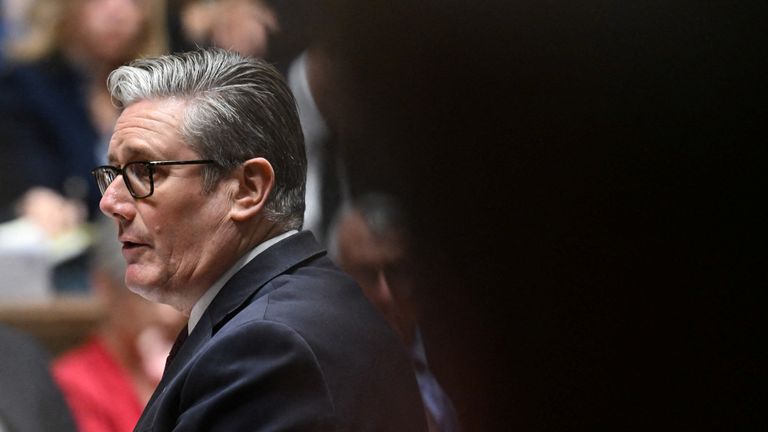
Image:Sir Keir Starmer is facing increasing pressure. Pic: Reuters
Documents coming ‘shortly’
Speaking to journalists earlier, Downing Street said the government would publish the documents “shortly”.
Sky News understands the government is working with police to ensure any document released does not undermine the police investigation into Mandelson.
Officials are believed to be in the early stages of assessing the documents, of which there are thousands.
The scandal surrounding Lord Mandelson has left Sir Keir under severe pressure, with some in Labour wanting him to resign.
Mandelson will bring PM down ‘unless he acts’
Labour MPs are urging Sir Keir to reveal whether he saw a report by an influential party peer that warned of Lord Mandelson’s links to Epstein.
Labour grandee Lord Glasman told Sky News last September that he had flagged to Number 10 about the pair’s relationship but was met with a “discreet suggestion to basically shut up”.
In an interview with Sky News’ Sophy Ridge, Lord Glasman suggested he was asked to report to Number 10 about the pair’s relationship and he did – but suggested no action was taken.
“They asked me to send a report and I sent a report,” he said.
“I did say when I got back, I would think again about this publicly.
“Then I did get a discreet suggestion to basically shut up about that, and I did.”
McSweeney under pressure
Even more focus has been placed on the prime minister’s chief of staff, Morgan McSweeney, who was a close political ally of Lord Mandelson.
Labour backbencher MP Simon Opher called for a “clear out at Number 10”.
“If my chief of staff had done this, I think he would be looking for another job,” Mr Opher told the BBC.
Veteran Labour MP Clive Efford and Southport MP Patrick Hurley have also said Mr McSweeney should leave Number 10.
PM’s future
Former cabinet minister and Labour grandee Harriet Harman told the Electoral Dysfunction podcast previously that the prime minister needed a “real reset”.
Sir Keir could lose his premiership if he does not do the right thing, Ms Harman added.
However, so far no big names on the current frontline of Labour politics have turned their fire on the prime minister and his staff.
Sir Keir on Thursday apologised for believing Lord Mandelson’s “lies” about his closeness to paedophile financier Epstein.
The prime minister made Lord Mandelson the UK’s ambassador to the US in 2024.
Captivate
This content is provided by Captivate, which may be using cookies and other technologies.
To show you this content, we need your permission to use cookies.
You can use the buttons below to amend your preferences to enable Captivate cookies or to allow those cookies just once.
You can change your settings at any time via the Privacy Options.
Unfortunately we have been unable to verify if you have consented to Captivate cookies.
To view this content you can use the button below to allow Captivate cookies for this session only.
The new-look Detroit Lions have been a force to be reckoned with, but this season, they are in what has recently become unfamiliar territory.
After making the playoffs in each of the previous two seasons, the Lions missed out on the playoffs after being one of the favorites to win it all in the preseason.
In 2023, they were this close to making the Super Bowl for the first time. Last season, they lost in their first playoff game as the No. 1 seed.
Amon-Ra St. Brown of the Detroit Lions and running back Jahmyr Gibbs look on prior to an NFL football game against the Green Bay Packers at Lambeau Field on Sept. 7, 2025, in Green Bay, Wisconsin. (Todd Rosenberg/Getty Images)
“I really think we have all the pieces, and that’s why this year hurt the way that it did, because you know we have this high elite level of talent,” star edge rusher Aidan Hutchinson told Fox News Digital on Radio Row. “I really just think it was a football thing, and it was a lack of complimentary football in critical moments. I think different phases were letting the team down. That’s defense included, too. It sucks that you have to sit there and say it, but I think that’s kind of what happened. Because we have the pieces.”
“I think we just slipped up here and there. Details kind of slipped up, we had a lot of people injured, but I wouldn’t make that as an excuse because we did the same thing last year. Just need to clean up some stuff,” running back Jahmyr Gibbs added. “Everybody’s in the league for a reason. Every team’s good. Every team’s got players getting paid. So, I mean, anybody can beat anybody any given Sunday, Thursday, Monday, whatever it is. We just happened to get beat more than we’re used to. So it is what it is.”
Part of the reason the Lions did not go to that Super Bowl two years ago, many would argue, is Dan Campbell’s aggressiveness on fourth down. But don’t expect anyone on the Lions to ever disagree with their coach’s mentality.
“We love it,” Amon-Ra St. Brown said. “We’re rocking with it, we feel like we have a good offense, players everywhere that can go make plays on fourth down. We feel like we can get it on every fourth down. Dan’s instilled that in us since we’ve been there… and we feel like we can get it every time.”
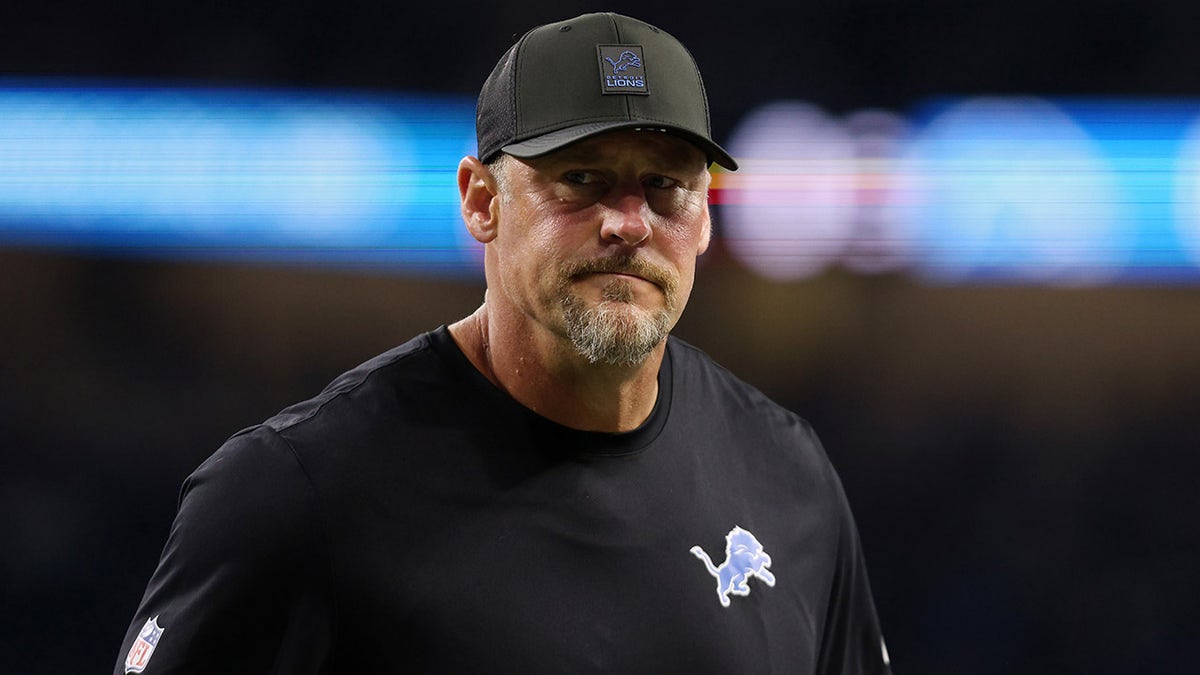
Head coach Dan Campbell looks on prior to the game against the Cleveland Browns at Ford Field on Sept. 28, 2025 in Detroit, Michigan. (Mike Mulholland/Getty Images)
Gibbs’ answer was much simpler.
“We want more points,” he said.
One thing that the Lions undoubtedly do, though, is lean on one another. Hutchinson and Gibbs partnered with Rocket Mortgage on Radio Row to spread the word on being a good neighbor, and likened home living to the locker room.
“Be dependable. Always depend on that one person that’s gonna be, then no matter what, to help you. Like, you need your packages picked up. They gonna help you,” Gibbs said.
Detroit Lions running back Jahmyr Gibbs (0) celebrates his touchdown against the Tampa Bay Buccaneers during the second half of an NFL football game, Monday, Oct. 20, 2025, in Detroit.(AP Photo/Ryan Sun)
“It’s really what Rocket is all about,” added Hutchinson. “And their culture, they preach being a good neighbor and being kind and spreading kindness. The biggest thing is dependability when I think of teammates and neighbors. “I think the severity of the situation changes in-game, a little bit higher pressure, but it’s a similar flair of dependability.”
When asked if anything is missing to get over the hump, Penei Sewell echoed Hutchinson’s teammates about having the right pieces.
“Nothing comes to mind,” Sewell admitted.
“But I’ll tell you what,” Hutchinson added, “once we all come back for OTAs, we all know what’s at stake. We all know how much has been put into this team and the talent that we have. So it’s going to be continuing to sharpen iron, compete in practice, compete in games, and really become the best version of ourselves.”
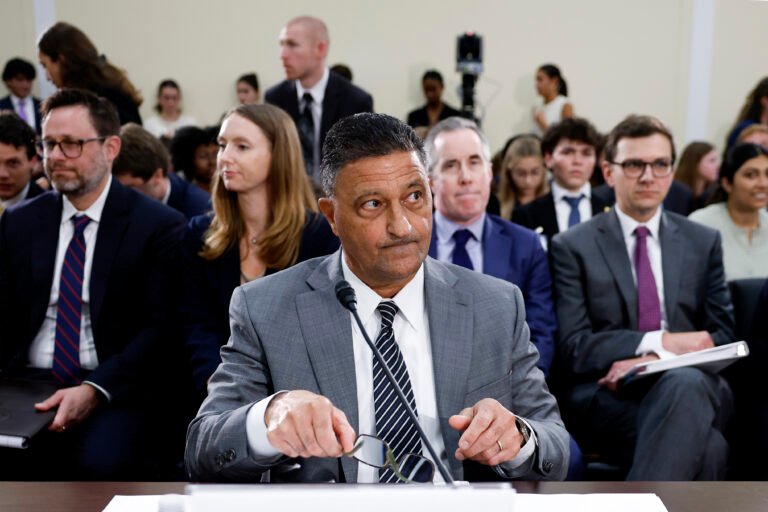
The Department of Homeland Security’s watchdog office has launched an audit of the agency’s privacy practices amid allegations that DHS and its components have used facial recognition tools and other technologies to collect data broadly and violate civil liberties.
The audit, according to a Feb. 5 letter from DHS Inspector General Joseph Cuffari and published by Virginia Democratic Sens. Mark Warner and Tim Kaine, started the previous day, and is titled “DHS’ Security of Biometric Data and Personally Identifiable Information (PII).”
“The objective of the audit is to determine how DHS and its components collect or obtain PII and biometric data related to immigration enforcement efforts and the extent to which that data is managed, shared, and secured in accordance with law, regulation, and Departmental policy,” Cuffari wrote.
Cuffari’s letter does not specify the audit’s scope or which agencies, technologies, programs or policies would be scrutinized.
In response to questions from CyberScoop, the DHS IG office indicated that the probe will initially focus on the activities of two department sub-components: Immigrations and Customs Enforcement and the Office of Biometric Identity Management.
“We will begin with OBIM, ICE and could include other components of the Department,” a spokesperson for DHS IG said in an email in response to questions about the audit’s scope.
ICE has become the most visible part of the Trump administration’s broader effort to expand data collection on Americans. The agency – along with Customs and Border Protection officers, who are sometimes mistaken for ICE agents – has played a leading role, helping build a large facial recognition database that DHS can use to identify not only people targeted in immigration raids, but also protestors and legal observers.
The Office of Biometric Identity Management is responsible for overseeing these biometric databases—managing, storing, and analyzing information on Americans such as photos, fingerprints, iris scans, license plate numbers and other identifying data.
Cuffari told the senators that the probe “will address a number of the questions you provided” in their own Jan. 29 letter urging the IG office to investigate “immigration procurement activities” at the department for constitutional and privacy law violations against Americans.
In that letter, Kaine and Warner highlight several concerns across multiple component agencies, including the mass collection and storage of facial recognition and license plate data, expanding the types and amount of biometric data that can be collected by the U.S. Citizenship and Immigration Services and the hiring of 30 “social media surveillance contractors” to build profiles of individuals for immigration enforcement.
DHS’ “proven ambivalence toward observing and upholding constitutionally-guaranteed freedoms of Americans and noncitizens, including freedom of speech and equal protection under the law, leaves us with little confidence that these new and powerful tools are being used responsibly,” the senators wrote.
The Senators urged the Inspector General’s office to brief them with a detailed accounting of how the Trump administration has altered DHS data privacy practices and “the manner and methods by which DHS stores and uses data that contains personally identifying information.”
They also asked investigators to examine how DHS and ICE ensure their actions comply with the Constitution; how biometric and other personal data is used to detain people; whether the agencies have information-sharing agreements with social media companies; and what data they obtain from third-party data brokers.
Dhaka, Bangladesh – Ziaul Haque Tanin had planned his February around the T20 World Cup.
The former first-class cricketer turned sports-goods entrepreneur from Thakurgaon, in northwestern Bangladesh, had lined up a trip combining business, family visits and cricket fandom.
Recommended Stories
list of 4 itemsend of list
Tanin had secured a premium hospitality ticket at the famed Eden Gardens cricket stadium in Kolkata, where Bangladesh would take on Italy on February 9.
Those plans were scrapped after Bangladesh said it would not send its men’s team to India for the tournament, citing security concerns.
The Bangladesh Cricket Board had asked the International Cricket Council (ICC) to move Bangladesh’s matches from India to Sri Lanka, a request the governing body rejected. Bangladesh stood firm in their stance, resulting in their ouster from the tournament and Scotland’s inclusion at their expense.
The decision has drawn Bangladesh’s most popular sport into a wider political dispute, dividing opinion between supporters of the government’s stance and those fearing long-term ramifications on the game.
How cricket became a casualty of politics
Tensions sharpened after January 3, when Bangladesh fast bowler Mustafizur Rahman was dropped from the Indian Premier League, a move that Bangladeshi officials said highlighted the impact of extremist pressure on Indian cricket authorities.
In Dhaka, the episode amplified wider resentment towards India, rooted in trade disputes and anger over New Delhi hosting fugitive former Prime Minister Sheikh Hasina since her ousting in August 2024.
In that charged atmosphere, cricket – Bangladesh’s most emotional public arena – became a proxy for questions of security and national dignity, with debate dominating social media, television talk shows and conversations in Mirpur, the heart of the country’s cricket culture.
About a year and a half after Bangladesh’s July 2024 mass uprising, signs of a thaw appeared in relations with India.
Indian External Affairs Minister S Jaishankar visited Dhaka for the funeral of former Prime Minister Khaleda Zia, while Prime Minister Narendra Modi sent a conciliatory letter to Tarique Rahman, Khaleda’s son, followed by a brief meeting between Jaishankar and Rahman.
Indian High Commission contacts with Jamaat-e-Islami further fuelled speculation that New Delhi was recalibrating its Bangladesh policy ahead of elections.
That cautious optimism, however, was abruptly undercut by actions of the Board of Control for Cricket in India (BCCI), pulling cricket into the centre of a renewed political standoff.
Mustafizur Rahman, left, playing for Delhi Capitals in the 2025 IPL [File: Abhijit Addya/Reuters]
Security first, cricket second
Many supporters say the government had little room to manoeuvre.
Shamim Chowdhury, head of research at Dhaka-based sports channel T Sports, said the issue had hurt Bangladesh’s sentiments and questioned the role of the ICC. “The ICC’s double standards have been exposed,” he told Al Jazeera.
Abu Zarr Ansar Ahmed, a sports journalist in Dhaka, said the security concern goes beyond players and includes staff, journalists and supporters. With national elections approaching, he warned that even a single incident involving Bangladeshi nationals in India could trigger widespread anger at home. “From that perspective, Bangladesh made the right decision,” he said.
Others accept the security logic but are concerned about the long-term cost to cricket. Khairul Islam, a Dhaka-based university lecturer, said the threat level should have been assessed more carefully and suggested a third-country venue as an alternative.
On the streets, support appears strong. At a tea stall in Dhaka’s Tejgaon area, vendor Billal Hossain backed the boycott, citing violence against Muslims in India and border tensions. “If something happened to our players, it would be disastrous,” he said.
Of 14 people interviewed by Al Jazeera across Dhaka, seven supported the government’s decision, three opposed it – all identifying as supporters of Hasina’s party, the Awami League – while four declined to state party affiliations but still backed the boycott. Overall, support outweighs opposition, with dissent largely driven by concerns over cricketing consequences rather than security.
Players regret missed opportunity
The protagonist of the story, Bangladesh’s cricket team, have stayed largely silent, wary of being drawn into a diplomatic dispute, though privately many are anxious.
Two national team players, speaking to Al Jazeera on the condition of anonymity, said the squad had prepared intensively and felt confident after a strong run in T20 cricket. In 2025, Bangladesh won 15 of 30 matches – their best calendar-year record in the shortest format of the game.
“We felt ready,” one player said.
Both relayed the team’s eagerness to play in the T20 World Cup – in India or elsewhere – and had hoped for a compromise on venue. Missing the tournament, they said, means more than the loss of lost match fees – it limits their exposure to quality opposition, franchise opportunities and career growth.
“It’s not just money,” one player said. “It’s the chance to grow.”
Neither player criticised the government or the board publicly, saying that with India central to the dispute, speaking out felt risky.
However, Bangladesh’s absence from the T20 World Cup has left national cricketers facing an unexpected break. To make use of this vacant period, the Bangladesh Cricket Board (BCB) has offered them a swiftly-organised local T20 tournament.
The three-team event, titled “Odommo Bangladesh T20 Cup”, will offer 25 million taka ($200,000) in total tournament prize money and player fees.
Bangladesh last played India at the 2025 Asia Cup in a match staged in Dubai [Satish Kumar/Reuters]
‘The sadness of not playing is bigger’
Not all cricket figures back the hardline stance.
Former Bangladesh batter Anamul Haque Bijoy urged keeping sport above politics, saying that a World Cup is the pinnacle of a cricketer’s career and a dream not many can realise.
“Sports should be above everything,” he said.
Others challenged the critics directly.
Behind the scenes, criticism has been sharper. Former BCB director Ahmed Sajjadul Alam said the decision reflected government interference, warning of financial losses and damage to Bangladesh’s standing within the ICC.
Another former director, Syed Ashraful Haque, who helped secure Bangladesh’s Test status, said the country’s influence in world cricket had weakened and argued the issue could have been resolved through dialogue.
Former captain Mohammad Ashraful took a pragmatic view, noting that government approval is mandatory for tours. While acknowledging the disappointment – especially for younger players – he said financial losses could be managed, but “the sadness of not playing is bigger”.
Pakistan’s backing and what comes next
The dispute has taken on a regional dimension after the Pakistan Cricket Board backed Bangladesh and urged the ICC to reconsider venue arrangements. While some in Dhaka see this as a challenge to India’s dominance, officials reject the idea of a new alliance.
Former BCB director Alam dismissed talk of a Bangladesh-Pakistan axis, calling Pakistan a longstanding cricketing friend. BCB officials also avoided any suggestion of formal alignment.
The BCB says the matter is closed and it will not pursue arbitration. “We have accepted the ICC’s decision,” said Amjad Hossain, a BCB director.
Attention has now shifted to managing the fallout. Suggestions of extra tournaments to offset player losses remain unconfirmed, with the board saying benefits are being handled internally.
The government’s youth and sports adviser, Asif Nazrul, said the decision not to travel was taken at cabinet level after the ICC refused to revise the schedule.
For fans like Tanin, the cost is personal – cancelled plans, unused visas and an idle World Cup ticket – reflecting a wider national sense of loss as cricket once again collides with politics.
Pakistan’s decision not to take part in its match against India at the T20 World Cup has sent shockwaves through world cricket, with its impact also being felt in Bangladesh.
Multiple senior sources at the BCB said the move could reduce the board’s potential earnings from the ICC. However, a top BCB official, speaking on condition of anonymity, said there was little the board could do at this stage. He added that the crisis could still be resolved through dialogue at any time.
Referring to Pakistan’s boycott, he said Pakistan has always been a good friend of Bangladesh in cricket and has maintained a consistently friendly relationship.
Diplomacy in the dark
Questions have emerged over how diplomatic communication was handled. An official at Bangladesh’s Ministry of Foreign Affairs, speaking on condition of anonymity, said the government was not formally engaged in the process, as the BCB communicated directly with the ICC.
Neither the BCB nor the Ministry of Youth and Sports issued any directive to involve the Foreign Ministry, leaving officials largely reliant on media reports.
Political and diplomatic analyst and former Bangladeshi ambassador Humayun Kabir said the situation has grown more opaque due to recklessness on both sides. He argued that groups in both Bangladesh and India actively work to derail normalisation efforts, using multiple flashpoints – with cricket now possibly added to that list.
Once a unifying force, cricket in Bangladesh is now caught in politics. Supporters see sovereignty, critics see a setback for a promising generation, and players see a lost stage.
Whether this strengthens Bangladesh’s position or weakens its standing in world cricket remains unclear – but the cost is already being felt far beyond the boundary rope.
A Nigerian court has reportedly ordered the UK to pay £420m to the families of 21 striking miners killed by security forces during British colonial rule.
The judge, Justice Anthony Onovo of the Enugu High Court, found the former colonial administration liable over the 1949 incident and said Britain should formally apologise.
The UK was not represented in court, according to local reports, and the government has declined to comment.
The miners, who were protesting over harsh working conditions and had occupied the facility, were shot by colonial police at the Iva Valley Coal Mine in southeastern Enugu state.
Fifty-one others were seriously injured in the shooting, News Agency of Nigeria reported.
“These defenceless coal miners were asking for improved work conditions, they were not embarking on any violent action against the authorities, but yet were shot and killed,” the judge said.
Campaigners have been pursuing damages for decades and Mr Onovo said a £20m payment to each family would be “effective remedy and compensation for the violations of the right to life”.
He also ruled that the Nigerian government had failed in its duty to seek redress for the victims.
The incident is widely seen in Nigeria as one of the events that led to agitations for independence in Africa’s most populous nation. The country broke free from Britain 11 years later in 1960.
A lawyer on the case, Yemi Akinseye-George, said Thursday’s ruling gave “historical accountability and justice for colonial-era violations, affirming that the right to life transcends time, borders, and changes in sovereignty”.