Bangladesh’s Tariq Rahman government has banned Indians from paying dues. Budget Airline SpiceJet has been stopped from using its airspace. Due to non-availability of airspace, some flights from Kolkata to Guwahati and Imphal are now having to take longer routes. This may impact flight times and operational costs
What did SpiceJet spokesperson say? A SpiceJet spokesperson said on Thursday (February 19) that the airline is in regular communication with the concerned authorities on operational and procedural issues, including navigation charges. Calling it a general issue related to the industry, he said that work is being done constructively towards an early solution and scheduled flight services are continuing as per the rules.
How much does Bangladesh owe and since when? He said that all scheduled flights are being operated as per the rules. Let us tell you that at present there is no direct impact on the passengers. However, due to closure of airspace, some flights are having to take alternative routes. Sources say that this step has been taken due to non-payment of dues. However, clear information regarding the nature and amount of the dues could not be immediately obtained. SpiceJet says that the airline is in touch with the concerned authorities.
SpiceJet shares fell by about 1 percent According to flight tracking data, some SpiceJet flights are adopting alternative and longer routes avoiding Bangladeshi airspace. Meanwhile, SpiceJet shares fell by about 1 percent during afternoon trading on BSE. The company had also recently recorded a loss of Rs 269.27 crore in the December 2025 quarter, which was attributed to rising costs and one-time expenses.
Ravie LakshmananFeb 19, 2026Cyber Espionage / Data Security
Cybersecurity researchers have disclosed details of a new campaign dubbed CRESCENTHARVEST, likely targeting supporters of Iran’s ongoing protests to conduct information theft and long-term espionage.
The Acronis Threat Research Unit (TRU) said it observed the activity after January 9, with the attacks designed to deliver a malicious payload that serves as a remote access trojan (RAT) and information stealer to execute commands, log keystrokes, and exfiltrate sensitive data. It’s currently not known if any of the attacks were successful.
“The campaign exploits recent geopolitical developments to lure victims into opening malicious .LNK files disguised as protest-related images or videos,” researchers Subhajeet Singha, Eliad Kimhy, and Darrel Virtusio said in a report published this week.
“These files are bundled with authentic media and a Farsi-language report providing updates from ‘the rebellious cities of Iran.’ This pro- protest framing appears to be intended to increase credibility and to attract Farsi-speaking Iranians seeking protest-related information.”
CRESCENTHARVEST, although unattributed, is believed to be the work of an Iran-aligned threat group. The discovery makes it the second such campaign identified as going after specific individuals in the aftermath of the nationwide protests in Iran that began towards the end of 2025.
Last month, French cybersecurity company HarfangLab detailed a threat cluster dubbed RedKitten that targeted non-governmental organizations and individuals involved in documenting recent human rights abuses in Iran with an aim to infect them with a custom backdoor known as SloppyMIO.
According to Acronis, the exact initial access vector used to distribute the malware is not known. However, it’s suspected that the threat actors are relying on spear-phishing or “protracted social engineering efforts” in which the operators build rapport with the victims over time before sending the malicious payloads.
“The use of Farsi language content for social engineering and the distributed files depicting the protests in heroic terms suggest an intent to attract Farsi-speaking individuals of Iranian origin, who are in support of the ongoing protests,” the Swiss-based security company noted.
The starting point of the attack chain is a malicious RAR archive that claims to contain information related to the Iranian protests, including various images and videos, along with two Windows shortcut (LNK) files that masquerade as an image or a video file by using the double extension trick (*.jpg.lnk or *.mp4.lnk).
The deceptive file, once launched, contains PowerShell code to retrieve another ZIP archive, while simultaneously opening a harmless image or video, tricking the victim into thinking that they have interacted with a benign file.
Present within the ZIP archive is a legitimate Google-signed binary (“software_reporter_tool.exe”) shipped as part of Chrome’s cleanup utility and several DLL files, including two rogue libraries that are sideloaded by the executable to realize the threat actor’s objectives –
urtcbased140d_d.dll, a C++ implant that extracts and decrypts Chrome’s app-bound encryption keys through COM interfaces. It shares overlaps with an open-source project known as ChromElevator.
version.dll (aka CRESCENTHARVEST), a remote access tool that lists installed antivirus products and security tools, enumerates local user accounts on the device, loads DLLs, harvests system metadata, browser credentials, Telegram desktop account data, and keystrokes.
CRESCENTHARVEST employs Windows Win HTTP APIs to communicate with its command-and-control (C2) server (“servicelog-information[.]com”), allowing it to blend in with regular traffic. Some of the supported commands are listed below –
Anti, to run anti-analysis checks
His, to steal browser history
Dir, to list directories
Cwd, to get the current working directory
Cd, to change directory
GetUser, to get user information
ps, to run PowerShell commands (not working)
KeyLog, to activate keylogger
Tel_s, to steal Telegram session data
Cook, to steal browser cookies
Info, to steal system information
F_log, to steal browser credentials
Upload, to upload files
shell, to run shell commands
“The CRESCENTHARVEST campaign represents the latest chapter in a decade-long pattern of suspected nation-state cyber espionage operations targeting journalists, activists, researchers, and diaspora communities globally,” Acronis said. “Much of what we observed in CRESCENTHARVEST reflects well-established tradecraft: LNK-based initial access, DLL side-loading through signed binaries, credential harvesting and social engineering aligned to current events.”
In early November, a social media post by United States President Donald Trump set off alarm bells across Nigeria. The US “Department of War”, he said, was preparing to go into the West African country “guns-a-blazing” over what he claimed was the killing of Christians in Nigeria.
Nigeria’s government under President Bola Ahmed Tinubu swiftly hit back, rejecting the claims, saying that while the country faced a challenging security situation due to armed groups and banditry, it was untrue that Christians were specifically being targeted, as Muslim communities and traditional believers had also come under attack.
Recommended Stories
list of 3 itemsend of list
But the Trump administration was not appeased. It had placed Nigeria on its “Countries of Particular Concern” (CPC) watchlist for religious freedom, and soon made threats of sanctions, cuts to financial aid, and punitive measures against Abuja for “failing” to protect Christians.
As Nigerians worried about a potential bombing campaign against their nation, the Tinubu government — though still denying accusations of a “Christian genocide” — quietly pivoted. Instead of aggressive rhetoric, it said it would welcome US assistance in dealing with security challenges that have long proved a thorn in the side of successive Nigerian governments.
Weeks later, on the night of December 25, the US launched what Trump described as “powerful and deadly” strikes in northwest Nigeria but the US military’s Africa Command (AFRICOM) made clear the attacks were carried out “at the request of Nigerian authorities”.
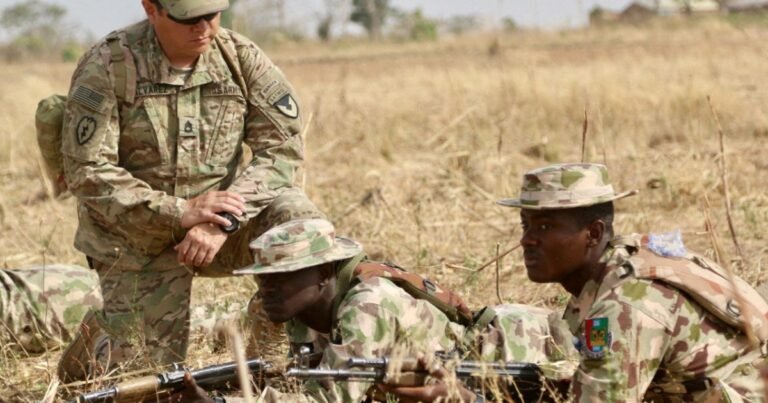
That cooperation between the US and Nigeria only appears to have grown, culminating this week in 100 US military personnel arriving in the country to help train Nigerian soldiers in the fight against armed groups.
Nigeria’s Ministry of Defence said US forces will assist with “technical support” and “intelligence sharing”, and despite not playing a direct combat role, will help target and defeat “terrorist organisations”.
To many, the developments come as a surprise – as in a little over three months, Nigeria appears to have overturned Trump’s “Christian slaughter” claim to instead win US military support for Abuja’s own military goals against armed groups.
“There’s been a strong shift,” said Ryan Cummings, the director of analysis at Signal Risk, an Africa-focused risk management firm. The narrative has “transitioned completely from a slap on the wrist to one where there seems to be a holding of hands in tackling this issue together”.
Although a notable shift, it is not fully surprising to many analysts, who see Nigeria’s cooperation as a strategic move to de-escalate tensions.
“It is neither unexpected nor hypocritical,” said Cheta Nwanze, the CEO of Nigerian risk advisory SBM Intelligence, who noted that Nigeria’s longstanding security partnerships since 1999 have favoured Western military doctrines.
What has shifted, he said, is the “US posture”: Washington now feels more entitled to get involved in a country where it sees strategic interests.
Nigeria’s National Security Adviser Nuhu Ribadu and US Under Secretary of State for Political Affairs Allison Hooker deliver a speech during the inauguration of the Nigeria-US Joint Working Group to boost counterterrorism cooperation at the Office of the National Security Adviser in Abuja, Nigeria, on January 22, 2026 [Marvellous Durowaiye/Reuters]
Lobbyists and working groups
Kabir Adamu, the director of Beacon Security and Intelligence in Abuja, feels the Tinubu administration has been “successful in de-escalating the Trump threat and in establishing a joint working group between the two countries”. But the “challenge”, the risk analyst said, is that Abuja has not been transparent enough about the process.
“At what cost did [the government] do this?” he asked. “It has so far failed to be transparent in letting Nigerians know what agreement it entered with the US government that led to a de-escalation of the situation.”
In January, the US and Nigeria convened a joint working group to address Nigeria’s designation as a CPC and how the country can work to reduce violence against vulnerable groups. But outside of that, details of what transpired between the first Trump threats and the first US strikes are scant.
However, Cummings of Signal Risk points to one deal, in particular, that he believes helped turn the tide: on December 17, the Nigerian government, through a legal intermediary, hired the DCI Group, Washington, DC-based lobbyists, for a reported sum of $9m.
According to the terms of the contract published online, DCI would “assist the Nigerian government through Aster Legal in communicating its actions to protect Nigerian Christian communities and maintaining U.S support in countering West African jihadist groups and other destabilizing elements”.
In hiring DCI, Nigeria has decided to “fight fire with fire”, Cummings said, comparing Abuja’s approach with what South Africa has done in the face of similar false accusations by Trump’s government that a “white genocide” is taking place there.
In both Nigeria and South Africa, the claims were first spread by local minority lobby groups aided by Republicans and evangelicals in the US, Cummings said. These groups fed selectively framed or exaggerated accounts into the Trump administration.
Nigeria hired a lobby group “to basically persuade the Trump administration that what is happening in Nigeria and what has been told to the Trump administration by certain lobby groups was not an accurate reflection of the status quo,” Cummings said.
“And that seemingly has been pivotal in changing the stance of the US government towards Nigeria,” he said.
Trump’s Africa positions are strongly shaped by a conservative evangelical base in the US, Cummings added, displaying concern for Christians globally and sympathy for white minorities portrayed as supposed victims of Black governments.
In the sense of playing to his core constituency, Trump’s concerns for these groups are genuine, Cummings said, but in other ways, they are instrumental: Trump uses issues like “Christian persecution” or “white genocide” to pressure other countries on broader foreign‑policy alignment.
People read newspapers reporting on US air strikes against Islamic State fighters in Nigeria, in Lagos, on December 26, 2025 [Sodiq Adelakun/Reuters]
‘Calculated trade-off’
Pressuring states for geopolitical gains plays out not just in Africa but outside the continent as well, both Nwanze and Adamu pointed out, citing the US’s recent abduction of Nicolas Maduro, the then-president of Venezuela, which, like Nigeria, holds significant oil reserves.
“Nigeria holds tens of billions of barrels of oil reserves and is Africa’s largest producer. The US National Security Strategy prioritises securing strategic resources through unilateral action”, so to some extent, the US’s recent moves regarding Nigeria are about “asserting control over global energy flows”, Nwanze said.
“The counterterrorism framing is genuine but convenient because it provides cover for interventions that also serve resource security objectives,” he explained.
Also citing the example of Venezuela, Adamu said that witnessing the US’s abduction of Maduro also likely “made the Nigerian government more disposed to US cooperation”.
Adamu described Nigeria’s decision to allow the US to intervene as “a calculated trade-off” – one that provides security benefits through US troops and intelligence sharing; and stronger diplomatic ties with a powerful country — while also maintaining Nigeria-led oversight of US operations.
From Tinubu’s side, cooperation with the US is an “operational necessity”, Nwanze said. “Nigeria’s security forces are overstretched, and US intelligence and air power offer tactical advantages against militant groups.”
However, Cummings cautioned that while US support may improve Nigeria’s tactical counterterrorism capacity, it “treats the symptoms” and not the socioeconomic conditions at the root of the violence.
“There hasn’t been enough focus on how America can actually assist the Nigerian government in addressing the causes of these insurgencies, which very much lies in basic economics – creating employment opportunities, ensuring governance and access to public services in these areas are good, and ensuring that you as a country or as a government can make a better deal for local communities than the jihadists can,” he said.
Risk of escalation by armed groups
In fact, a US military presence in Nigeria may actually empower the armed groups, the analysts noted.
“There is a real risk of escalation,” Nwanze said, noting that recent security data compiled by his firm has shown “an uptick in attacks” since the US’s CPC designation.
He said armed groups like Islamic State Sahel Province (ISSP) and the al-Qaeda-linked Jama’at Nusrat al-Islam wal-Muslimin (JNIM) “have consistently exploited narratives of foreign intervention to recruit and radicalise”.
“The December strikes [on Nigeria by the US] provide propaganda material, allowing them to frame local grievances as part of a global war against Western forces,” he added.
“There is also the risk that militant groups will rebrand themselves as resisting foreign occupation, gaining propaganda advantages that outweigh tactical losses.”
Adamu said a US presence could motivate armed groups to intensify attacks, especially symbolically. But more than that, “due to the controversy and difference in support between Nigerians for the US presence, it can lead to a further polarisation of Nigeria along religious and ethnic divides”.
There are “domestic perception risks” for Abuja, he said, noting that previous Nigerian governments had faced public criticism when allowing US presence in Nigeria, and many now feel Tinubu is “handing the country over to US imperialism”.
The domestic “optics” are a concern, Nwanze agreed. “The perception of compromised sovereignty feeds nationalist resentment and deepens distrust in government,” he said.
For Cummings, Nigeria was in a tough spot in the face of US aggression, and “on balance, it was a smarter decision by the Tinubu government [to have] greater alignment with the United States”.
The analyst argues that Nigeria is historically more pro‑West, with economic, political, social and diaspora ties to the US. He says in the absence of alternative partners – like BRICS or other South-South alliances – Abuja’s cooperation and seeming alignment with the Trump administration was the best way to de-escalate this crisis.
But other analysts like Nwanze are concerned that by choosing to concede to Trump the right to violate Nigerian sovereignty — even with Nigerian oversight — the Tinubu government had left the country exposed to further crises.
“Adding a US military footprint, however limited, risks deepening instability by broadening the conflict’s ideological scope,” he warned. “The [armed] groups were already motivated; now they have a more compelling story to tell.”
Emmanuel Macron has hit back at US criticism of Europe’s efforts to regulate AI, vowing to protect children from “digital abuse” during France’s presidency of the G7.
Speaking at the AI Impact summit in Delhi, the French president called for tougher safeguards after global outrage over Elon Musk’s Grok chatbot being used to generate tens of thousands of sexualised images of children, and amid mounting concern about the concentration of AI power in a handful of companies.
His remarks were echoed by António Guterres, the UN secretary general, who told delegates – including several US tech billionaires – that “no child should be a test subject for unregulated AI”.
“The future of AI cannot be decided by a few countries or left to the whims of a few billionaires,” Guterres said. “AI must belong to everyone”.
Bill Gates had been scheduled to speak but withdrew at the last minute amid renewed scrutiny of his past links to the convicted child sex offender Jeffrey Epstein.
On Wednesday, the White House’s senior AI adviser, Sriram Krishnan, renewed the Trump administration’s criticism of AI regulation, singling out the EU’s AI Act.
He told delegates he would continue to “rant” against legislation that was not “conducive to an entrepreneur who wants to build innovative technology”.
But Macron told the intergovernmental summit: “Opposite to what some misinformed friends have been saying, Europe is not blindly focused on regulation. Europe is a space for innovation and investment, but it is a safe space, and safe spaces win in the long run.”
Research published this month by Unicef and Interpol across 11 countries found at least 1.2 million children reported having their images manipulated into sexually explicit deepfakes in the past year. In some countries, one in 25 children – the equivalent of one child in every classroom – had been affected.
“There is no reason our children should be exposed online to what is legally forbidden in the real world,” Macron said. “Our platforms, governments and regulators should be working together to make the internet and social media a safe space. This is why, in France, we are embarking on a process to ban social networks for children under 15 years old.”
Among the tech executives attending was Sam Altman, the chief executive of OpenAI, which is facing a legal challenge from the family of Adam Raine, a 16-year-old who took his own life after discussing suicide with ChatGPT.
Dario Amodei, the co-chief executive of Anthropic, said he was “concerned about the autonomous behaviour of AI models, their potential for misuse by individuals and governments and their potential for economic displacement”.
India’s prime minister, Narendra Modi, said it was “imperative that AI is child safe and family-guided”, likening the emergence of AI to the discovery of fire and calling it a “profound transformation in human history”.
India is seeking to position itself as the world’s third AI power behind the US and China, with Google this week announcing a $15bn investment in datacentres and subsea cables linking India to the US and other countries.
Modi said there must be “established levels of authenticity for content within the digital world … people must know what is authentic, and what has been generated by AI”.
The interventions come amid growing public concern about the societal risks of AI, as the most advanced models remain largely controlled by about four US companies and a handful of Chinese rivals.
Modi set out an alternative vision, leveraging India’s 1.4 billion population as a huge growth market for tech firms.
He said: “We must prevent an AI monopoly. Many nations consider AI to be a strategic asset, and therefore it is developed confidentially and its availability is carefully managed.
“However, our nation India holds a different perspective. We believe that technology, like a I will only truly benefit the world when it is shared and when open source code becomes available.”
His comments appeared to be directed at the US, where leading AI models are not open-source and cannot be used or adapted without permission. By contrast, China’s leading systems, such as DeepSeek and Qwen, are broadly open-source.
For this week’s Savings Guide, we have a special edition with Mark Chicken, a chartered financial planner at The Private Office, looking at how you can save your child from university debt…
For parents with young children, university can feel a very long way off.
But with graduates in England facing up to 40 years of repayments, it’s never too early to get ahead on setting your kids up for university.
The average graduate now leaves university with a debt of £51,645, including tuition fees and maintenance loans, according to investment platform Lightyear.
Students starting courses today fall under the new Plan 5 system. They repay 9% of earnings above £25,000, and repayments can continue for up to 40 years before any remaining balance is written off.
That means children starting school now could still be repaying student debt in their sixties.
So, as parents, if you are in a position to put money aside for your child, could you meaningfully reduce the long-term cost?
First, let’s look at how the new student loans work
Student loans don’t work like traditional bank loans.
A graduate earning £45,000 today would repay around £1,800 a year under the rules. Over time, those payments can add up significantly, particularly given the length of the repayment period.
Should parents save in cash or invest?
Parents can save up to £9,000 a year into a Junior ISA in the child’s name, which can be held either in cash or invested. Known as a JISA, it’s a tax-free savings or investment account for children under the age of 18.
Top cash JISAs are paying up to 3.85%. For cautious savers, that can feel reassuring, particularly given the ups and downs investment markets can experience.
Over long periods, however, investing in a diversified global equity portfolio has historically delivered stronger returns than cash, albeit with more short-term volatility along the way.
“As a firm, when modelling over longer timeframes, we tend to use cautious nominal assumptions such as: Cash growing at around 1% per year and investments growing at around 5% per year,” Chicken explained.
“In practice, long-term returns from global stock markets have historically been higher than 5% per year, but we prefer to work on cautious assumptions when planning.
“Actual returns can vary significantly from year to year. The figures above are simply used to illustrate the long-term impact of compounding.”
While today’s cash JISA rates are attractive, interest rates can change over time, and many people fall into the trap of leaving their cash to languish in poor paying accounts, rarely switching.
Using those assumptions (1% cash and 5% investments), the difference over 18 years can be considerable.
Take this example…
To build a pot of at least £51,645 over 18 years:
Saving in cash might require contributions of around £220 a month
Investing might require closer to £150 a month
That’s a difference of £70 a month, or more than £15,000 in total contributions over 18 years
“As you can see from the above example, long-term investment growth has the power to do a lot of the heavy lifting. It still requires regular saving, but the effect of compounding means a meaningful portion of the final pot can come from investment returns rather than direct contributions,” Chicken said.
“Ultimately, cash plays an important role in protecting capital in the short-term. But over longer-term periods, it has often struggled to keep pace with inflation.”
Image:Pic: iStock
How can you manage risk as university approaches?
The example above shows how, over the long term, a diversified global equity portfolio can offer the potential for stronger growth, albeit with periods where values fall along the way, Chicken said.
When university is many years away, those short-term ups and downs tend to matter less. But as the point at which the money is needed approaches, market falls become more relevant.
For that reason, it may be sensible to choose to reduce investment risk gradually in the final few years before university, for example, by moving part of the pot into cash, to lessen the risk of a market downturn just before fees are due.
One of the main advantages of using a JISA is that investment growth is free from income tax and capital gains tax. Over 18 years, that tax efficiency can make a meaningful difference.
The trade-off is loss of control. At age 18, the money legally becomes the child’s. Parents ultimately have no control over how it is used and spent.
An alternative is to invest in a parent’s own name in, for example, an ISA or even a general investment account. These accounts legally remain the parents’ assets, but they can be notionally earmarked for a child’s future.
“The benefit of this route is flexibility. Parents keep full control over how and when money is distributed. If a child decides not to go to university, the pot could instead contribute towards a house deposit or other milestone,” Chicken said.
The drawback is that unless the money is in an ISA, the parents will pay tax at their usual rate – be that income tax or capital gains tax.
In this case, if you have one parent who pays a higher tax rate than the other, it could make sense to put the funds into their name to minimise the tax due, though you should seek advice when considering how to do this.
Who wants to make their baby a millionaire?
For those lucky enough to have more to save for their child, it’s amazing how much can be gifted at age 18.
If parents or grandparents were to save £9,000 a year into a JISA, assuming growth of 5% a year, by age 18 that child could have a tax-free lump sum of nearly £266,000, Chicken said.
If the child then transferred their JISA funds into an adult ISA at 18 and left it until retirement, it could grow to almost £1.8m if left untouched until age 57.
If you want to give your child a huge boost to their retirement, contributing to a pension can be a good alternative, though the funds cannot be accessed until age 57 (assuming no change to current legislation).
Even if the child has no income, pension contributions still qualify for basic rate tax relief on total contributions of up to £3,600 a year.
So this can be affordable for many families as a maximum gross contribution of £3,600 each year until age 18 costs £2,880 net annually (£51,840 over 18 years), with the government adding £720 in tax relief each year (£12,960 in total).
Assuming 5% growth until age 57, and even with no further contributions after 18, the pension could still reach £737,000.
“There are lots of options for parents who can afford to put something away regularly for their children – and starting early can make it easier to ease at least some of their future financial burdens,” Chicken added.
The new shadow treasurer, Tim Wilson, says he does support the Reserve Bank’s twin objectives after his call for a more targeted focus on taming inflation was decried as a strategy to drive up interest rates and unemployment.
Just two days into the new role, Wilson signalled to the Nine papers that the opposition would review the legislated mandate that requires the bank to maintain equal focus on two goals: keeping inflation within its 2% to 3% target band and achieving full employment.
Wilson suggested the RBA’s “core purpose” should be to lower inflation, after an unexpected jump in prices growth prompted Michele Bullock’s board to hike rates for the first time in two years earlier this month.
The comments were immediately seized upon by the treasurer, Jim Chalmers, and the Australian Council of Trade Unions secretary, Sally McManus, who said Wilson’s approach would mean higher interest rates and unemployment.
“The dual mandate has been a mainstay of Australian economic policy since it was formalised by John Howard and Peter Costello and has been supported by both sides of politics and the independent Reserve Bank,” Chalmers said.
“This radical departure from that bipartisanship is an early sign of Tim Wilson’s extreme ideology on the economy that would see more people out of work if ever he got his hands on the levers.”
McManus said Wilson’s “disgraceful” suggestion echoed the view of sections of big business, which wanted a large pool of unemployed workers in order to suppress wages.
In an interview with Guardian Australia, Wilson said he “certainly support(s) the dual mandate”.
But the Goldstein MP argued the bank was failing to deliver on that mandate, insisting it was not putting enough emphasis on curtailing inflation.
The headline monthly inflation rate was 3.8% in the year to December, up from a low of 1.9% in June of last year.
“They have got it wrong, and I think they’ve got it wrong in multiple periods where we’ve ended up in a situation where we’ve got inflation that has been led to be out of control. And you know, Australia, to be blunt, doesn’t have an unemployment problem presently,” Wilson said.
“They’ve clearly misread inflation, so they’re clearly not putting enough emphasis on inflation. And they basically had to admit publicly that they thought inflation was under control.”
Wilson was open to some form of review of the RBA’s mandate but is not proposing to remove the employment objective.
“The dual mandate is about balance, and the objective isn’t to crash the private economy, but that is what Australians are now living through higher inflation, lower annual wage growth and rising prices,” he said.
The unemployment rate remained steady at 4.1% in January, according to Australian Bureau of Statistics figures published on Thursday.
The new opposition leader, Angus Taylor, did not respond directly when asked if the bank’s dual mandate should be scrapped but backed Wilson’s argument that inflation was too high.
“I absolutely support Tim Wilson’s opinion that inflation is too high in this country and everything reasonable should be done to make sure that we get that inflation down and we get interest rates down, we restore our standard of living, and we give Australians hope again,” Taylor said.
“That’s what Tim wants to see, and he has made a strong point that there needs to be a very strong focus from the Reserve Bank and, more importantly, the government, that has been letting Australians down on getting inflation down.”
In a separate intervention on Thursday, Wilson told The Australian that the 47% top marginal tax rate – which applies to incomes above $190,000 – was “punitive” and a disincentive to work, leaving the door open to changes as part of a wider vision to lower income taxes.
Wilson called for a “robust conservation” about the tax settings, which he said should be geared towards encouraging Australians to “take risks” such as setting up small businesses.
“If you tax something, you are going to discourage it. If you lift the tax or reduce the tax, or provide tax relief, you will incentivise that behaviour,” he said.
For the happiness of his daughter, father became mother, reached school disguised as a woman, this video will make you emotional!
A single father set a unique example of never letting his daughter feel alone. This father attended the Mother’s Day school function, where children’s mothers attend, wearing a dress and wig so that his daughter does not miss her mother. When the daughter saw her father in this form, her smile and then emotional hug touched everyone’s heart. This moment proves that a family is not just about traditional roles, but about togetherness and love. The father prioritized his daughter’s happiness and peace of mind, regardless of his ego. This beautiful video went viral on social media and reminded people that even those who give the most love need to be heard about how special they are. Video Credit:Instagram-@socialjantaa
To add News18 as your favorite news source on Google click here Do it.
The 10-year jail sentence handed to a British couple in Iran is “totally unjustifiable”, Yvette Cooper has said.
Lindsay and Craig Foreman were arrested in January 2025 while travelling through the country on an around-the-world motorcycle journey and detained on charges of espionage. The couple from East Sussex, who are being held in Tehran’s Evin prison, deny the allegations.
“This sentence is completely appalling and totally unjustifiable,” said Cooper, the foreign secretary. “We will pursue this case relentlessly with the Iranian government until we see Craig and Lindsay Foreman safely returned to the UK and reunited with their family.
“In the meantime, their welfare is our priority and we will continue to provide consular assistance to them and their families.”
Lindsay Foreman said she came to the country on a “global initiative to focus on the good”. Speaking to the BBC before the sentencing, she said: “If anything, my desire to find what connects us is even greater.”
Joe Bennett, Lindsay Foreman’s son, told ITV News they had been informed of the sentence last week and his family was “deeply concerned” for the pair’s welfare and the “lack of transparency” in their judicial process.
“My parents have now been sentenced to 10 years following a trial that lasted just three hours and in which they were not allowed to present a defence,” he said.
“They have consistently denied the allegations. We have seen no evidence to support the charge of espionage.”
He added: “We were previously told that once sentencing occurred, further action would follow. We now hope the UK government will act decisively and use every available avenue to secure their release.”
In January, Bennett was joined by Anoosheh Ashoori – a British-Iranian who was imprisoned in the country for five years – and Richard Ratcliffe, who fought a public campaign that involved two hunger strikes to have his wife, Nazanin Zaghari-Ratcliffe, freed from Iran, at the steps of No 10 to deliver a 70,000-signature petition calling on the government to do more to free them.
The couple is due to appear before a court in Tehran in the coming days.
Craig Foreman said the infrequent meetings with his wife were what sustained him.“I know her prison is just 70 metres away, and I get to see her once a month,” he said.
“For me and for Lindsay, seeing each other is the only thing that’s keeping us going right now. I love my wife dearly. She’s the love of my life.”
1. Santa got beaten by his mother. When Banta saw him crying, he asked, “What happened, why are you crying?” Santa- “Brother was on the phone, he did not agree to mummy’s request to keep him, that’s why he killed me!” Banta- “This is what you did wrong, see brother, if mother asks you to keep the mobile, then keep it because along with heaven, mother has slippers on her feet!”
2. Woman- “How will I lose weight?” Doctor: “Move your neck left and right!” Woman- “When?” Doctor- “When someone asks for food!”
3. Pappu went to the doctor. Doctor- “Yes brother, tell me, what is the problem?” Pappu- “First promise that you will not laugh!” Doctor- “Yes promise…” Pappu pulled up his pants and showed his legs and said, “See, my legs are as thin as sugarcane.” The doctor started laughing loudly.
4. On the first day after marriage, the husband was worried about how to talk to his newly-wed wife. He gathered a lot of courage and thought of a topic to talk about and asked – “What is your name?” Wife- “Is it a cover, didn’t it read in the card?”
5. Teacher- “Why do they make the patient unconscious before operation in the hospital?” Student- “If the patient is not made unconscious and learns to operate, then who will question the doctor!”
6. Judge- “Why do you want to get a divorce?” Husband- “I am not happy with this.” Begum- “Judge sir, the whole locality is happy, only this man has so many tantrums.”
7. Wife- “Do you love me?” Husband- “Yes, very much!” Wife: “Then let’s prove it!” Husband- “I lie well too, I have just proved that.”
8. Chintu- “Papa, please get me the musical instrument.” Papa- “No, you will trouble everyone.” Chintu- “I will not, for sure, I will play only when everyone goes to sleep!”
9. A cute child went to the neighboring house and said to aunty – “Aunty, please give me a bowl of sugar, mummy has said.” Aunty- “Okay son, I will give it now, what else did your mother say?” Child: “Mummy said that if the witch next door does not give, then ask for it from the witch in front!”
10. English- “What is this?” Confectioner- “This is curd!” English- “What is curd?” Confectioner- “Milk sleeps at night and morning becomes tight!”
Access Denied
You don’t have permission to access “http://hindi.gadgets360.com/mobiles/vivo-v70-5g-series-launched-with-50-megapixel-camera-and-6500mah-battery-know-price-features-news-11065469” on this server.