The U.S. Federal Bureau of Investigation (FBI) has warned of an increase in ATM jackpotting incidents across the country, leading to losses of more than $20 million in 2025.
The agency said 1,900 ATM jackpotting incidents have been reported since 2020, out of which 700 took place last year. In December 2025, the U.S. Department of Justice (DoJ) said about $40.73 million has been collectively lost to jackpotting attacks since 2021.
“Threat actors exploit physical and software vulnerabilities in ATMs and deploy malware to dispense cash without a legitimate transaction,” the FBI said in a Thursday bulletin.
The jackpotting attacks involve the use of specialized malware, such as Ploutus, to infect ATMs and force them to dispense cash. In most cases, cybercriminals have been observed gaining unauthorized access to the machines by opening an ATM face with widely available generic keys.
There are at least two different ways by which the malware is deployed: Removing the ATM’s hard drive, followed by either connecting it to their computer, copying it to the hard drive, attaching it back to the ATM, and rebooting the ATM, or replacing it entirely with a foreign hard drive preloaded with the malware and rebooting it.
Regardless of the method used, the end result is the same. The malware is designed to interact directly with the ATM hardware, thereby getting around any security controls present in the original ATM software.
Because the malware does not require a connection to an actual bank card or customer account to dispense cash, it can be used against ATMs of different manufacturers with little to no code changes, as the underlying Windows operating system is exploited during the attack.
Ploutus was first observed in Mexico in 2013. Once installed, it grants threat actors complete control over an ATM, enabling them to trigger cash-outs that the FBI said can occur in minutes and are harder to detect until after the money is withdrawn.
“Ploutus malware exploits the eXtensions for Financial Services (XFS), the layer of software that instructs an ATM what to physically do,” the FBI explained.
“When a legitimate transaction occurs, the ATM application sends instructions through XFS for bank authorization. If a threat actor can issue their own commands to XFS, they can bypass bank authorization entirely and instruct the ATM to dispense cash on demand.”
The agency has outlined a long list of recommendations that organizations can adopt to mitigate jackpotting risks. This includes tightening physical security by installing threat sensors, setting up security cameras, and changing standard locks on ATM devices.
Other measures involve auditing ATM devices, changing default credentials, configuring an automatic shutdown mode once indicators of compromise are detected, enforcing device allowlisting to prevent connection of unauthorized devices, and maintaining logs.
Good morning. Some days there isn’t an immediately obvious theme for what tomorrow’s newsletter should be about. Yesterday was not one of those days. As Thames Valley police confirmed early on Thursday that a “man in his 60s from Norfolk” had been arrested on suspicion of misconduct in public office, it quickly became clear who the 1,000th First Edition would feature.
The man taken into custody was Andrew Mountbatten-Windsor – formerly Prince Andrew, Duke of York – arrested at Wood Farm on the Sandringham estate, on his 66th birthday. He is the first senior royal in modern history to be arrested. By the evening, Andrew was seen leaving Aylsham police station, slouched in the back of a vehicle, having been released under investigation.
For today’s newsletter, I spoke to the Guardian’s home affairs editor, Rajeev Syal, to unpack what we know of yesterday’s events, what being suspected of misconduct in public office actually means and what could happen next. But first, the headlines.
Five big stories
Civil service | Keir Starmer has appointed Antonia Romeo as cabinet secretary, the UK’s most senior civil servant, the first woman to hold the post in its 110-year history.
Iran | Donald Trump changed his mind on supporting the Chagos Islands deal because the UK will not permit its airbases to be used for a pre-emptive US strike on Iran, the Guardian has been told.
Iran | A British couple have been sentenced to 10 years in jail by an Iranian court on charges of espionage – an outcome foreign secretary Yvette Cooper called “completely appalling and totally unjustifiable”.
Education | Children in England with special needs will receive individual support and therapy directly from their schools as part of the government’s overhaul of England’s special education provision.
In depth: ‘All we knew during the day was that Andrew was in a police station somewhere’
Police officers outside Wood Farm where Andrew Mountbatten-Windsor was arrested in Sandringham, Norfolk. Photograph: Tolga Akmen/EPA
Rajeev tells me it is “significant that he has been arrested at all”, adding that such a move might have been less likely while Andrew remained a working royal. Mountbatten-Windsor has consistently denied any wrongdoing.
A lifetime of privilege and scandal
Once second in line to the throne, Andrew might have hoped to be remembered chiefly as a Falklands veteran and, later, the UK’s special representative for international trade and investment. But his long association with the convicted sex offender Jeffrey Epstein has steadily eclipsed all else in his life – even his 1980s tabloid reputation as “Randy Andy” and “His Royal Heart-throb”.
He stepped back from public duties after that disastrous BBC Newsnight interview in 2019, in which he claimed he could not have exploited Virginia Giuffre as she had alleged because he was at Pizza Express in Woking, he was medically unable to sweat, and that he had “no recollection” of meeting her. He later settled Giuffre’s civil claim in the US for a reported £12m, without admission of liability, while expressing regret for his association with Epstein. Virginia Giuffre took her own life in 2025, after writing a harrowing memoir detailing her alleged abuse, having been trafficked by Epstein.
In 2022 and 2025 he was progressively stripped of military roles, patronages and, ultimately, his titles. Buckingham Palace eventually confirmed he would be known simply as Andrew Mountbatten-Windsor and by late 2025 he had left Royal Lodge and withdrawn from public life.
The monarchy sought distance, but the story did not fade away.
What is misconduct in public office?
Suspicion of misconduct in public office, Rajeev tells me, is a charge “usually used against police officers and prison officers, but it has occasionally been wheeled out against other public figures, including politicians”. In theory it can lead to life imprisonment but, Rajeev says, “in reality, if there is a successful prosecution, sentences tend to be much shorter.”
As I wrote in a recent First Edition looking at how the fallout from the Epstein files led to the disgrace of Peter Mandelson, misconduct in public office is a common-law offence that applies when a public official is alleged to have acted in their position in a way that seriously abuses the public’s trust. But it is also a law that has been heavily criticised and is in the process of reform.
“The Law Commission found it wasn’t being applied effectively to people who committed serious offences. So even as it stands, it’s rarely used successfully in serious cases involving corruption or abuse of position,” Rajeev explains. “The replacement legislation is now before parliament and has reached committee stage, but it is still months away from completion.”
The Epstein files connection
The immediate trigger for the police investigation appears to be the latest tranche of documents released by the US Department of Justice relating to Epstein’s crimes. British police have set up a new national group to deal with allegations involving Epstein and his associates. The allegation under investigation is not sexual assault – allegations Andrew has always denied – but whether, while holding a public office as trade envoy, he improperly shared sensitive information.
“The documents highlighted so far include material relating to Afghanistan – for example, information about mineral deposits, gold and oil that had been identified as commercially valuable – which was allegedly shared with Epstein,” Rajeev says.
“There were also details about the Treasury’s view of the Icelandic financial crash that were said to have been forwarded on to a banker friend of Andrew’s,” he adds. “Those are the sorts of documents that have been pointed to as potentially relevant and could be examined by the police in considering whether to bring a charge. Whether that is what the police are actually focusing on, we don’t yet know.”
“All we knew during the day was that Andrew was in a police station somewhere. He will have been questioned. He is entitled to legal representation”.
Thames Valley police later confirmed: “The arrested man has now been released under investigation. We can also confirm that our searches in Norfolk have now concluded.”
Andrew Mountbatten-Windsor leaves Aylsham police station. Photograph: Phil Noble/Reuters
Why can this be reported?
Police have not formally named the arrested man, in line with national guidance. But the media can identify a suspect where there is clear, independently verifiable information and overwhelming public interest – and where reporting does not prejudice active proceedings.
Oliver Wright, one of the Thames Valley’s assistant chief constables, said after the arrest: “It is important that we protect the integrity and objectivity of our investigation as we work with our partners to investigate this alleged offence. We understand the significant public interest in this case, and we will provide updates at the appropriate time.”
King Charles, Andrew’s older brother, also acknowledged the arrest in a public statement, saying: “Let me state clearly: the law must take its course. As this process continues, it would not be right for me to comment further on this matter”.
“The police have been careful in their statement to stress that the case is active and that care must be taken in reporting allegations,” Rajeev says. There is also a potential blurring of lines which could complicate matters. Andrew, Rajeev says, might “attempt to argue that, as a private citizen now, he shouldn’t be exposed in the same way he would have been as a senior royal.”
However, Rajeev reminds me, “the alleged conduct relates to when he was a public figure and a member of the royal family acting in an official capacity”.
What could happen now?
Several paths are possible. Police have released him without charge while inquiries continue. They could take no further action or at some point submit a file to the Crown Prosecution Service for charging consideration. Given the profile of the suspect and the complexity of the allegations, this process may take months.
Rajeev notes says that the arrest itself may spark new lines of inquiry. “Once someone has been arrested, the police have access to much more material. They can examine files, computer records, phones. That potentially broadens the scope of what they are able to look at. Who knows where that might lead?”
For King Charles, who has already stripped his brother of titles and patronages, the legal process now unfolds beyond palace control. , yesterday’s arrest will be seen as a further step in a long campaign for accountability.
In a statement on Thursday, Giuffre’s family said their “broken hearts have been lifted with the news that no one is above the law – not even royalty …. He was never a prince. For survivors everywhere, Virginia did this for you.”
“In theory, it could go to a jury trial. Whether it would, depends on the seriousness of the allegations and any eventual charge. But that’s a long way down the road,” Rajeev says.
“We know the law itself has been criticised as weak,” he says. “The fact the government has acknowledged the offence is difficult to use successfully against public figures does indicate there are legal hurdles in prosecuting this kind of case. You can draw your own conclusions as to whether, in this case, it’s going to be successfully applied.”
What else we’ve been reading
A mamuthone and an issohadore wait for the parade to start. Photograph: Christian Sinibaldi
I loved today’s picture essay on Sardinia’s ancient masked rite of mamuthones and issohadores. Poppy Noor, newsletters team
In Japan’s top football leaguethe concept of the draw is being banished and replaced with penalty shoot-outs, in a move which will give football traditionalists the heebie-jeebies. Martin
I was tickled at Marta’s belief she can keep her scent ‘unique’ by using store-bought bottled perfume – and felt sorry for her friend Elsa who she seems to be terrorising over it, in you be the judge. Poppy
Those of a certain age may get a huge frisson of nostalgia reading this piece by Ryan Loftus about London’s oldest Scalextric club. Martin
I also thoroughly enjoyed our top tenBaftas moments — after being sucked in by the astonishing mid-motion photo we used of John Hurt for the main image. Poppy
Thank you
Photograph: Linda Nylind/The Guardian
I mentioned earlier in the newsletter that today marks the 1,000th First Edition. I wanted to give a shout out to all the unsung heroes behind the scenes who work on the production and making sure it reaches your inbox every day, and all of the front-of-house writers we’ve had over the last four years – especially Archie, Nimo, Aamna, Karen, Phoebe, Esther and Rupert.
Most of all, I’d like to thank you, the readers, for sticking with us. If you want to support First Edition and the rest of the Guardian’s journalism, do please consider donating here.
Here’s to 1,000 more newsletters to come.
Sport
Great Britain’s men’s curlers celebrate after seeing off Switzerland in a tense match in Cortina Photograph: Andrew Milligan/PA
Winter Olympics | Britain’s men’s curling team secured a place in Saturday’s final against Canada after beating the undefeated Swiss team 8-5.
Football | For Nottingham Forest, an evening in Istanbul they will not forget in a hurry: a 3-0 victory over Fenerbahce in the Europa League. Celtic, though, crashed to a damaging 4-1 defeat at home to Stuttgart in the same competition.
Rugby union | Gregor Townsend expects Blair Kinghorn and Duhan van der Merwe to be fuelled by “huge determination” against Wales after they were restored to Scotland’s starting XV for Saturday’s Six Nations meeting in Cardiff.
Something for the weekend
Our critics’ roundup of the best things to watch, read, play and listen to right now
Film Queen at Sea | ★★★★★ Recently divorced academic Amanda (Juliette Binoche) has taken a sabbatical to be closer to her elderly mother, Leslie (Anna Calder-Marshall) – who has dementia – and her stepfather, Martin (Tom Courtenay). One morning, she catches the pair having sex, a mask of incomprehension on her mother’s face. She accuses Martin of rape – the GP has already advised that Leslie can no longer give meaningful consent. Yet Martin has done his own research on the internet and claims that marital sex can comfort dementia patients. This lacerating movie from US film-maker Lance Hammer moves from one agonisingly difficult and ambiguous situation to the next, with angry, complex, brilliant late-career performances from Courtenay and Calder-Marshall. Peter Bradshaw
TV Gisèle Pelicot: The Newsnight Interview | ★★★★☆ Interviewer Victoria Derbyshire has a steely warmth that meshes well with the innate dignity of Gisèle Pelicot, while they walk unflinchingly through her story. On 2 November 2020, the police called Pelicot and her husband, Dominique, to the station. They had found on his laptop thousands of videos and photographs of his wife unconscious and being raped by strangers. Sitting in the interview, perfectly calm, effortlessly poised, even when occasionally moved to tears, Mme Pelicot cuts an extraordinary figure. You can only gaze in admiration at her strength and grace. But questions lurk. How many people out there are reading or watching or listening not in abject horror but in thrall? How many men are thinking: “I wish, I wish …”? Lucy Mangan
Music Mitski: Nothing’s About to Happen to Me | ★★★★★ On her thought-provoking, lol-inducing eighth album, the US musician is never far from expressing a longing to disappear. On opener In a Lake, she extols moving to the city from a small town, not in search of excitement, but obscurity. On Rules, she’ll “get a new haircut … be somebody else”. All this is set to beautifully crafted music that splits the difference between alt-rock, country-infused acoustic lamentation and grander ambition. One thing the world isn’t suffering from in 2026 is a drought of self-examining millennial singer-songwriters, publicly picking at their neuroses. But Mitski is better at this stuff than her peers: stronger with melodies and more skilled at creating atmospheres that seep out of the headphones and into your bones. Alexis Petridis
Theatre Dreamscape, Omnibus theatre, London | ★★★★★ Tyisha Miller was 19 when she was shot dead by police officers while she lay unconscious in her car in California, in 1998, joining the long, appalling, litany of Black victims of police violence. In writer-director Rickerby Hinds’ award-winning production, she is named Myeisha Mills, still dead after an officer shoots 12 bullets into her body, but simultaneously alive or rising from the dreamscape of the title to tell us about herself. The two-hander is told entirely through beatboxing, spoken word, hip-hop and dance, and Jada Evelyn Ramsey gives an extraordinary performance filled with beauty as Myeisha. Josiah Alpher is just as charismatic as he beatboxes, raps and narrates the parts of other characters. It is a dazzling, disturbing experience. Arifa Akbar
The front pages
Friday’s front page of the Guardian
“King says ‘law must take its course’ after Andrew arrest” is the lead of this morning’s Guardian. The Times has “the arrest of Andrew”, the Telegraph has “Andrew arrested”. “King: my brother must face the law” leads the i paper, while the Mirror has “King: Law must take its course”.
“Now he’s sweating” is the splash of the Sun. “Taxi for Andy” leads the Star, while the Mail goes with “downfall”. The FT, meanwhile, leads on “Trump sets 10-day window to decide on Iran strikes as US builds up forces”.
Today in Focus
Campaigners take part in a rally outside the Houses of Parliament in London Photograph: Wiktor Szymanowicz/Future Publishing/Getty Images
‘They’re not listening!’: the government’s gamble on special education reform
Ben Jennings Illustration: Ben Jennings/The Guardian
The Upside
A bit of good news to remind you that the world’s not all bad
Cesar Vasquez, 18, stands in the fields where his mother and sisters once harvested crops. His work advocating for immigration rights is deeply connected to his family’s immigrant journey. Feb. 6, 2026. Zaydee Sanchez/The Guardian Photograph: Zaydee Sanchez/The Guardian
He often visits families after arrests. “There have been so many occasions where I walked through the door, and a kid was expecting their father or mother,” he said. “And it was just me.”
“It’s common for children of immigrants to fill out legal forms,” he added. “But in fourth grade, I had to learn what a warrant looked like and what rights I had.”
Sign up here for a weekly roundup of The Upside, sent to you every Sunday
Bored at work?
And finally, the Guardian’s puzzles are here to keep you entertained throughout the day. Until tomorrow.
NORAD says aircraft did not enter sovereign airspace and were not considered a threat.
Published On 20 Feb 202620 Feb 2026
Share
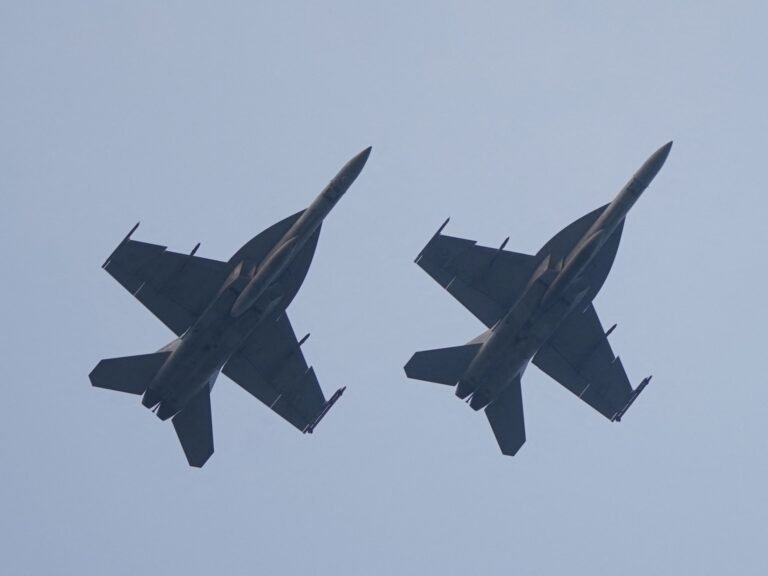
The United States has dispatched fighter jets after multiple Russian military aircraft were observed operating in international airspace near Alaska, according to the North American Aerospace Defense Command (NORAD).
Two Russian Tu-95s, two Su-35s and one A-50 were “detected and tracked” operating in Alaska’s Air Defense Identification Zone (ADIZ), NORAD said in a statement on Friday, adding that it responded by sending two F-16s, two F-35s, one E-3 and four KC-135s.
Recommended Stories
list of 3 itemsend of list
It said the Russian aircraft did not enter US or Canadian sovereign airspace, and that they were escorted until they departed Alaska’s ADIZ.
While Russia’s Ministry of Defence has not issued a statement, NORAD said that Russian aircraft are regularly observed in Alaska’s ADIZ and that this type of activity is “not seen as a threat”.
Countries including the US, China, India and Japan have unilaterally declared ADIZs that require foreign military aircraft to identify themselves upon entering a specific zone of airspace.
Unlike sovereign airspace, ADIZs are not recognised in international law or overseen by any international body.
In July 2024, the US and Canada intercepted two Chinese and two Russian bombers operating in Alaska’s ADIZ.
This was the first time that Russian and Chinese bombers are known to have flown together over the North Pacific, marking a further expansion of the countries’ military cooperation and raising concerns among the US and its allies about regional stability.
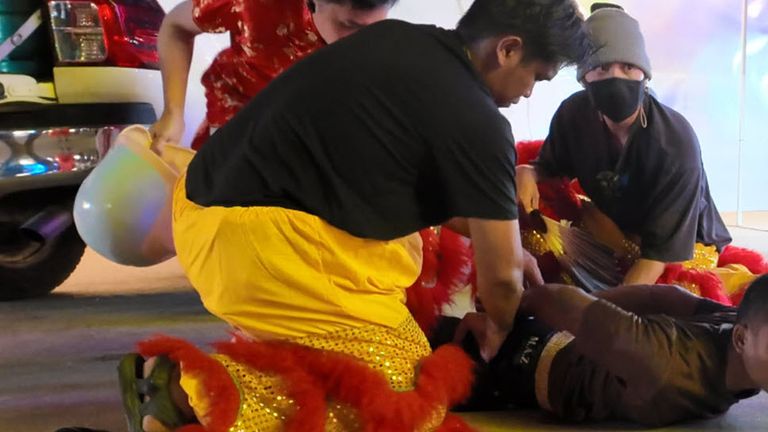
Thai police went undercover in a traditional lion costume in order to get close enough to a serial burglar to pounce on them and arrest them.
Footage released by the Bangkok police department shows officers dressed in a red-and-gold lion costume dancing towards the suspect as he walked through a Lunar New Year fair on Wednesday.
The officer wearing the lion’s papier-mache head then leaps at the suspect and quickly pins him to the ground at the temple in Nonthaburi, a province covering part of the Bangkok conurbation.
Image:Thai police disguised as lion dancers catch the suspect. Pic: The Metropolitan Police Bureau/AP
Police said the suspect, a 33-year-old man, is accused of breaking into the home of a local police commander in Bangkok three times earlier this month.
He is suspected of making off with valuables worth around 2 million baht (£47,700).
Police said they had attempted to arrest the man several times, but he had spotted the officers sent after him and run off.
They later identified him by tracing stolen amulets he had sold and learned he frequently visited temples in Nonthaburi.
Lion dancers are often part of the Lunar New Year, and the custom allowed the officers to go undercover for the operation.
It is no longer possible to interpret the Yemeni landscape solely through the lens of politics. The developments witnessed in the southern Yemeni governorates under government control in recent months clearly indicate that security and military affairs have become the decisive factor in determining the course of power on the ground. Any governmental or political arrangements will be unsustainable unless the issue of security control and the unification of military command are resolved.
Nor can the escalating Saudi–Emirati rift between two allies who have militarily, politically and economically shaped southern Yemen in recent years be overlooked, given its direct impact on the balance of power and stability.
Over the past years, a complex security structure has taken shape across the southern governorates, comprising official units and others that emerged during the war. Some of these units are linked to state institutions, while others were established with Emirati support, such as the Southern Transitional Council’s forces, which number in the tens of thousands, or through local arrangements shaped by the circumstances of the conflict.
Although recent months have seen moves to restructure this landscape following the defeat of the Southern Transitional Council (STC), which declared its dissolution in Hadhramaut and al-Mahra on January 3, 2026, security control remains uneven from one governorate to another. Furthermore, the STC’s security and military formations have not disappeared entirely; some have been redeployed, while the fate of others remains unknown.
In Aden, the temporary capital, security agencies operate within a complex structure. Some units formerly affiliated with the STC have seen their personnel and weapons disappear, while others have been renamed or redeployed. However, longstanding networks of influence remain, and the transfer of leadership or redeployment of camps reflects attempts to rebalance power rather than a definitive resolution of the situation.
The same applies, to varying degrees, to Lahij, Abyan, Dhale, Shabwah and Hadhramaut, where the state’s ability to assert effective authority varies, as does the level of coordination between official security forces and the formations that emerged during the war.
The most sensitive issue at this stage is the integration of military and security formations into the Ministries of Defence and Interior. The state seeks to end parallel security authority, but the process faces complex challenges, including differing sources of funding for some units, varying political loyalties, fears among some commanders of losing local influence, and considerations related to the composition of these forces. As a result, integration appears gradual, relying more on redeployment and restructuring than on decisive measures that could risk triggering confrontation.
The government now based in Aden, southern Yemen, finds itself facing a delicate equation: it must impose its security authority without plunging the country into renewed internal conflict.
The transition from multiple armed groups to a state monopoly on the use of force requires political consensus, regional support and international backing. Any hasty move could reignite internal clashes, particularly given existing political and regional sensitivities, as well as fears that the Saudi–Emirati dispute could once again trigger confrontation on the ground.
For this reason, government efforts are focused first on establishing a stable security environment.
This trajectory cannot be understood without considering the regional dimension. Saudi Arabia views Yemen as a direct strategic depth for its national security and seeks the emergence of a stable state along its southern border.
The dispute between Riyadh and Abu Dhabi, particularly after Yemen requested the withdrawal of Emirati forces from its territory, has become a significant factor shaping the course of the crisis, especially amid Saudi accusations that Abu Dhabi continues to support the STC and consolidate its influence on the ground.
Yemen today is part of a broader regional landscape, intertwined with Red Sea dynamics and maritime routes, competition for influence in the Horn of Africa, and tensions stretching from Sudan to Somalia to the Gulf. For this reason, international actors — particularly the United States — are keen to keep the situation in Yemen under control, fearing that a security collapse could trigger intra-Gulf conflict, threaten international shipping, create space for a new wave of armed groups, or allow the Houthis to exploit the situation.
In the next phase, the government is likely to continue efforts to consolidate security control in Aden and other southern governorates, including Hadhramaut, which borders Saudi Arabia, while gradually integrating military units and maintaining political balances to prevent renewed conflict.
The success of these efforts will determine whether the country is moving towards gradual stability or another round of reshaping power centres. Given this reality, the central question remains: who truly possesses the ability to impose security on the ground, particularly as some actors continue to push the Southern Transitional Council towards escalation that could reignite the conflict?
The views expressed in this article are the author’s own and do not necessarily reflect Al Jazeera’s editorial stance.
Romantic dance of husband and wife on the song ‘Tenu Shararat Sikhawa’ went viral, public went crazy seeing their love!
Viral Video: These days, a romantic dance video of husband and wife is going viral on social media, in which both are seen dancing in a very beautiful style on the famous song Tenu Shararat Sikhawa. People are liking the couple’s amazing chemistry, synchronized movements and emotion-filled expressions in the video. The love between the two is clearly visible in every step, due to which the viewers are watching this video again and again and also sharing it extensively. In the comments, users are praising the couple and calling it a “perfect example of real love”. Such romantic dance videos quickly win people’s hearts on social media, because a wonderful combination of emotions, music and entertainment is seen in them. This is the reason why this video is trending rapidly on the internet.
To add News18 as your favorite news source on Google click here Do it.
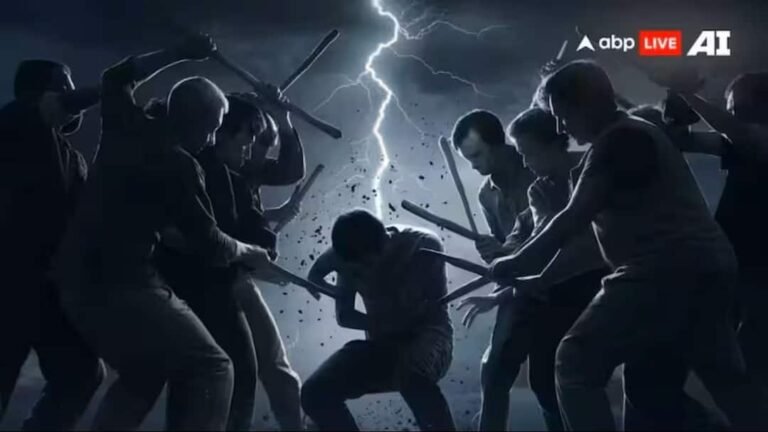
A case of brutal beating of a young man has come to light in Kharghar area of Navi Mumbai. It is being told that some youths surrounded him in the middle of the road and beat him badly with kicks and punches. During the fight, the accused also threatened him that if he went to the police station, they would kill him. After this incident, there is an atmosphere of fear and anger in the area.
Injured youth lives on rent
According to the information, the injured youth is a resident of outside state and lives on rent in Sector-19 of Kharghar. The incident took place on a sector road, where the accused stopped him and attacked him.
Eyewitnesses say that initially there was an altercation and the matter soon turned into a fight. The attackers threw the young man on the ground and kicked and punched him several times.
People kept watching, no one came forward
Many people were present nearby at the time of the incident, but no one had the courage to intervene. It is being told that the attackers were very aggressive and were openly threatening to kill, due to which people got scared. For this reason no one came forward. Local people say that such incidents have happened in the area before and this has created an atmosphere of fear.
Police started investigation
In this matter, Kharghar Police says that investigation has been started as soon as information about the incident was received. Efforts are being made to identify the accused and action will be taken soon.
The police have also appealed to the people that if anyone has information related to this case, then come forward. After this incident, there is an atmosphere of panic in Kharghar area. Local citizens have demanded that strict action should be taken against the culprits so that such incidents do not happen again.
LS Lowry was convinced his paintings would be worthless after his death, he confided in a previously unheard interview.
Although the artist had enjoyed some success in his final years, Lowry could never have imagined he would become one of Britain’s best-loved artists or that his paintings would sell for millions of pounds.
Going to the Match, his 1953 painting of crowds of spectators streaming into a football stadium, sold for £7.8m in 2022.
Half a century after his death, he is now being portrayed by Sir Ian McKellen in a BBC documentary, LS Lowry: The Unheard Tapes, which draws on a trove of previously unheard audio recordings.
Described as “the last words of a great artist” who was an intensely private man, McKellen will lip-sync his dialogue.
In the tapes, the artist is heard to say: “Some day, you may be walking down some street and look into a junk shop window. You’ll see a picture upside down, marked cheap, 30 shillings. And it’ll be mine.”
Going to the Match sold for £7.8m in 2022. Photograph: Karim Sahib/AFP/Getty
From 1972, over a period of four years, Lowry gave his longest, most revealing interview to a young fan, Angela Barratt. She died in 2022 and the tapes remained hidden in her Manchester home. They have never been broadcast until now.
Lowry bared his soul to her. He confided that his family and friends had teased him about his paintings. “I made no money,” he said. “People laughed heartily at them … All my friends used to joke about it: ‘How’s the art trade?’; ‘Are you making your fortune out of it?’; ‘Don’t be such a fool, why don’t you give it up?’”
Lowry had enrolled at the age of 17 for evening art classes. On selling his first painting, he said: “It was in 1921. And I got the sum of £5 for it. I was 34 … My family got the shock of their lives when I sold it. They couldn’t believe it was possible I could sell anything.”
Asked whether his mother liked his paintings, Lowry replied: “No, I don’t think so. And me father [who worked as a clerk for an estate agent] used to have hysterics if I sold a picture. He couldn’t understand it.”
Lowry became disheartened: “I was often very, very fed up. I said what’s the point of doing this, many a time.”
LS Lowry (played by Ian McKellen) bared his soul to Angela Barratt, a young fan (played by Annabel Smith). Photograph: BBC/Wall to Wall Media/Connor Harris/PA
Yet Lowry is loved by the public for his unique depictions of working-class urban life, mill scenes and industrial landscapes in the north of England, peopled with his distinctive matchstick men.
When his family faced financial difficulties, they moved to Pendlebury in Salford, then an area blighted by pollution, noise and poverty: “I didn’t like it at all for a long time, and I couldn’t get used to it. And then I got fascinated by it. I began to think after a time, has anybody ever painted this scene? And I found they hadn’t.”
Asked whether he preferred an “industrial” view to “places which are beautiful”, he replied: “I don’t like the south of England, if that’s what you mean. It’s harmless. No guts in it … Dull … Horrible place.”
Lowry worked as a rent collector for the same Manchester property company for 42 years. He feared that if people knew about his day job they would assume that he only painted in his spare time and was therefore an amateur. He really wanted to be taken seriously.
One of his friends says in the documentary that they only found out about his job after he died. “Somebody told us, and in all honesty, we didn’t believe it. We thought that they were mistaken. It was a little hurtful that one felt that one was very close to this man, and he kept a secret.”
When Barratt paid tribute to him for putting the “industrial scene on the map [with] these wonderful paintings”, Lowry replied modestly: “That’s very nice of you. Thank you for that.”
He added: “I feel about my painting, I did as well as I could.”
On the day of retirement, students gave an emotional farewell to their beloved teacher, the entire classroom was filled with tears!
On the day of retirement, the atmosphere of the school became very emotional when the students bid a heartfelt farewell to their beloved teacher. As the teacher addressed the class for the last time, many students’ eyes became moist. Some hugged him, others expressed their feelings with words of thanks. This teacher, who taught the values of life along with studies for years, had made a special place in the hearts of the children. This moment of farewell became not just a formal event, but a true glimpse of the unbreakable relationship between Guru and disciple. The video of this emotional scene is becoming increasingly viral on social media and people are calling it a beautiful example of a teacher’s influence and respect. Video Credit:Instagram- @tv1indialive
To add News18 as your favorite news source on Google click here Do it.
Iron rails shrink in cold weather and expand in summer. In such a situation, if space is not left for expansion, the tracks may bend, which may increase the risk of accidents.
Unknown Fact: Even today in India, a large number of people travel by train, and there are many questions related to this which come to people’s mind, but their answers are often not found. For example, you may have seen many times that the train stops at the outer signal before reaching the station, while some platforms even appear empty. In such a situation, it is natural that questions arise in the mind as to why this happens.
Have you ever observed the tracks carefully while traveling in a train, crossing a railway gate or standing at a station? If you have paid attention, you must have seen that a track is made by joining tracks at some distance. This happens because it is not possible to make the entire length of track in a single piece, so the track is prepared by joining several parts.
You must have also noticed that where two tracks join, a small gap is left between them. Now the question arises that why is this distance maintained?
If you think that this gap left between the tracks happens just like that, then it is not so at all. It would also be wrong to assume that this distance is kept just to fill the empty space. Actually, this gap is kept very thoughtfully and keeping in mind the safety of the passengers. Iron rails shrink in cold weather and expand in summer. In such a situation, if space is not left for expansion, the tracks may bend, which may increase the risk of accidents. Now you must have understood how important this space left between the tracks is.