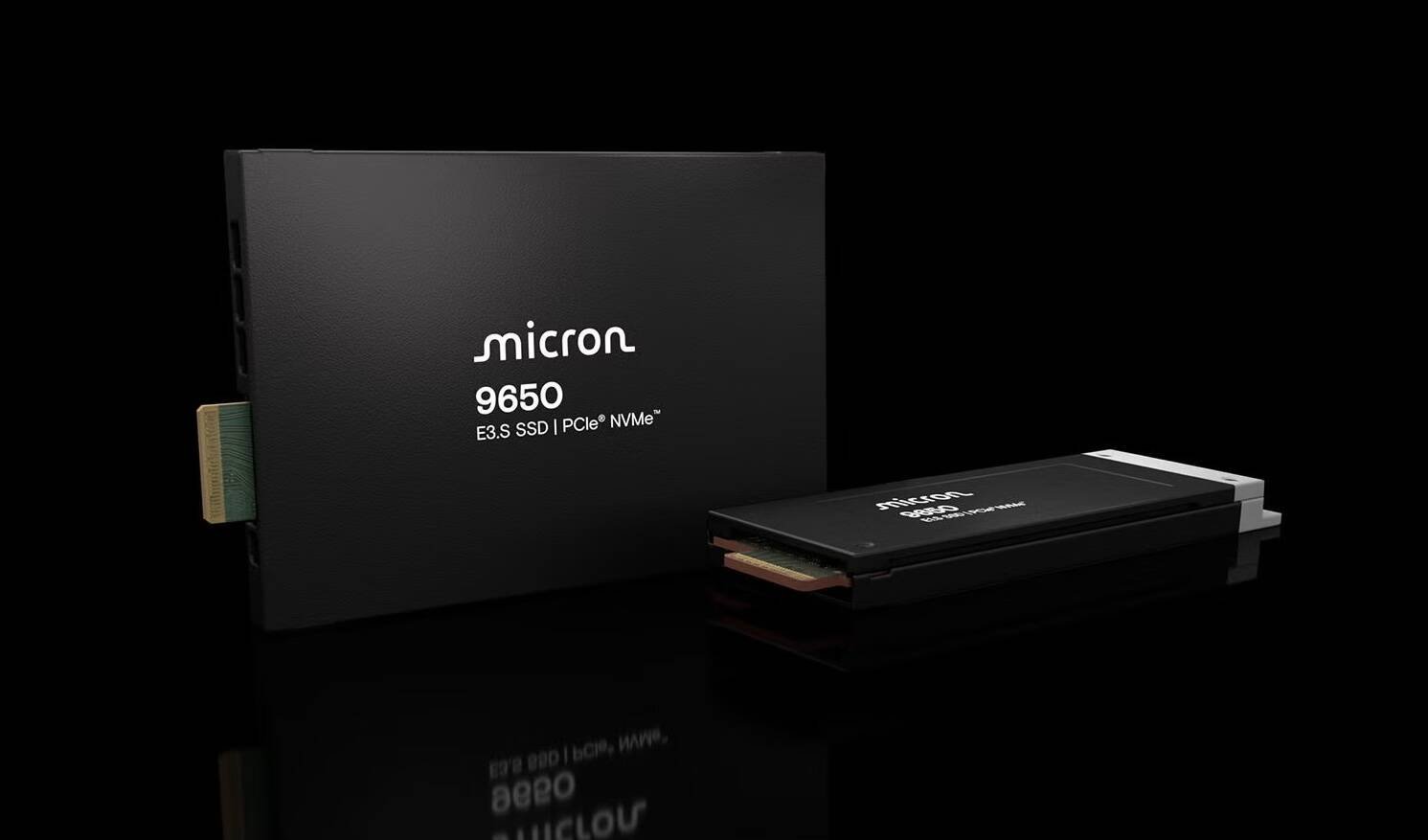
It’s time for a new generation of faster flash storage, but not on your laptop or desktop. Micron’s first PCIe 6.0 SSDs have entered mass production and promise eye-watering transfer rates of up to 28 GB/s. However, unless you’re building flash storage arrays for AI, you won’t have a use for them.
At 18 watts, Micron’s 9650 is designed squarely with datacenter duty in mind with both air and liquid-cooled E1.S and E3.S form factors and capacities ranging from 7.68 to 30.72 TB in the works (most end-user drives are in the 1 to 4 TB range). High-speed storage has become a key bottleneck in AI datacenters where it’s used to offload things like key-value caches — essentially the model’s short-term memory — for better interactivity over extended sessions.
The SSDs arrive ahead of the first PCIe 6.0 compatible CPUs from Intel, AMD, and Nvidia, which are expected to arrive later this year. Even if you could get your hands on Micron’s fastest flash today, there’s nothing to plug them into.
As SSDs go, the 9650 is certainly fast, achieving sequential read rates roughly double those of last gen. This isn’t too surprising as PCIe 6.0 doubles the effective bandwidth per lane over 5.0. For sequential writes, performance doesn’t scale quite as neatly with Micron claiming a still-respectable 14 GB/s. Meanwhile, for random writes and reads, Micron says its latest storage offering is between 22 and 67 percent faster at 900,000 to 5.5 million IOPS, respectively.
Having said that, it’s worth remembering that these drives are rarely deployed on their own and are usually configured in arrays designed to maximize streaming or random access data patterns, while also maintaining redundancy.
Compared to PCIe 5.0 NVMe, Micron says that the 9650’s higher bandwidth doesn’t come with the same power and thermal constraints. The company boasts that its new drive delivers twice the performance for the same power envelope. However, this is only true for streaming reads. Write efficiency, measured in bits per watt, is only up between 20 and 40 percent.
As nice as an SSD capable of hitting 28 GB/s appears — that’s a decent fraction of memory bandwidth on consumer platforms (100 GB/s) — it’s going to be a while before PCIe 6.0 drives make their way into consumer desktops and notebooks.
Part of the problem is there aren’t really any PCIe 6.0-compatible CPUs on the market. Sure, they’re coming to the datacenter later this year, but aren’t expected to arrive on Intel’s consumer-focused Nova Lake generation and there’s no word yet on PCIe 6.0 for AMD’s next Ryzen refresh. Even if AMD did ship PCIe 6.0 support on its next desktop processors, at current memory pricing, the drive could end up costing more than the CPU.
Beyond storage, the benefits of PCIe 6.0 aren’t there just yet for consumer platforms. A single PCIe 4.0 x1 lane is sufficient for 10 GbE networking, while many consumer GPUs are now shedding lanes. Many new GPUs are now wired up for x4 or x8 PCIe 4.0 or PCIe 5.0 connectivity since they don’t really benefit from the additional bandwidth a full x16 slot would deliver. ®