
Social networking giant Meta has revealed details of four previously unknown custom chips powering its AI services.
The company signalled its intention to roll out more custom inferencing chips in 2024, and in a post about its custom silicon, reveals it built its latest chips “in close partnership with Broadcom.”
The post names the four previously unknown chips as models 300, 400, 450, and 500 in the Meta Training Inference Accelerator (MTIA) series, and says some are already running in production and others will appear this year or next. Broadcom has said Meta will install “multiple gigawatts” of its chips in 2027 and beyond.
Meta described the four chips as follows:
- MTIA 300: A communications chip optimized for ranking and recommendation (R&R) workloads, comprised of one compute chiplet, two network chiplets, and several HBM stacks. Each compute chiplet is composed of a grid of processing elements (PEs), with some redundant PEs to improve yield. Each PE includes a pair of RISC-V vector cores. The chip is in production.
- MTIA 400: An evolution of the MTIA 300 that can support generative AI models and R&R workloads. Meta says it is the first of its chips with “raw performance competitive with leading commercial products,” that employs two compute chiplets. The company says a rack with 72 MTIA 400 devices, connected via a switched backplane, forms a single scale-up domain, and that now that testing has concluded it is “on the path to deploying it in our data centers.”
- MTIA 450: Built with specific optimizations for GenAI inference, by doubling the HBM bandwidth of the MTIA 400 to levels that Meta says means its performance is “much higher than that of existing leading commercial products.” Scheduled for mass deployment in early 2027.
- MTIA 500: An efficient GenAI inference chip that increases HBM bandwidth by an additional 50 percent over the MTIA 450. Uses a 2×2 configuration of smaller compute chiplets surrounded by several HBM stacks and two network chiplets, along with an SoC chiplet that provides PCIe connectivity to the host CPU and scale-out NICs. Meta plans mass deployment in 2027.
Meta also posted specs for the chips.
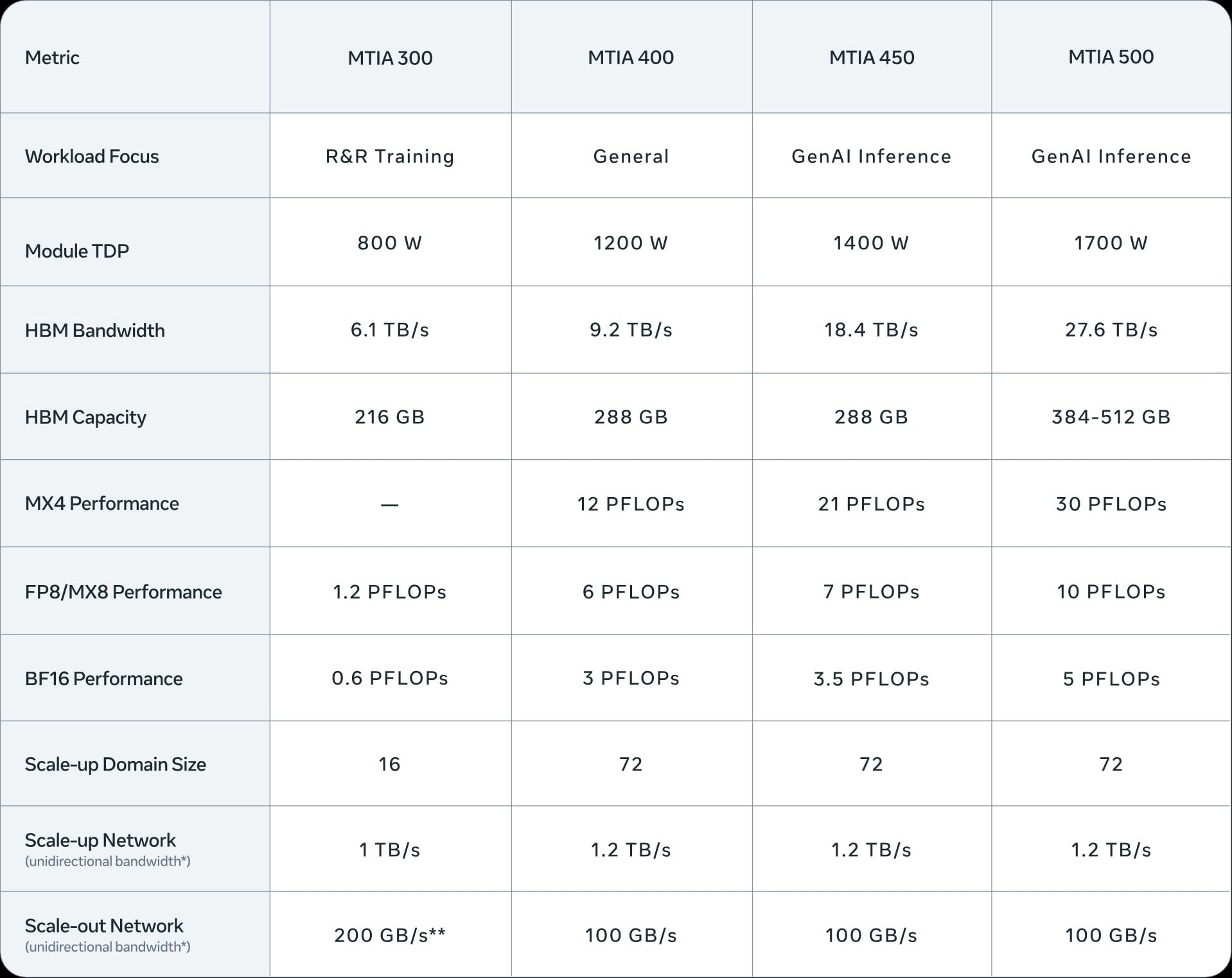
Meta’s specs for its custom silicon – Click to enlarge
Expect more of this sort of thing from Meta, because its post says the company now has the capacity to ship a new chip “roughly every six months.”
“We achieve high velocity through a reusable and modular design across all levels: chiplets, chassis, racks, and network infrastructure,” its post states, before revealing the MTIA 400, 450, and 500 “all utilize the same chassis, rack, and network infrastructure.”
Nice chips, shame about the slop
While Meta has refined the art of creating and deploying chips, it’s doing a lousy job of flagging misleading AI-generated content according to the company’s own Oversight Board which on Tuesday called for Zuck to implement new rules covering content posted during conflicts.
The Board considered a faked video purportedly depicting scenes in Israel during the 2025 12-day war with Iran. Despite independent fact-checkers labelling the content fake, and six users reporting the content to Meta, the company did not label it as “a ‘High Risk’ AI”.
The Board said it is “concerning” that “Meta did not identify on its own initiative the clear engagement abuse signals from the page” and said the company’s mechanisms for flagging fake videos “are neither robust nor comprehensive enough to contend with the scale and velocity of AI-generated content, particularly during a crisis or conflict where there is heightened engagement on the platform.”
In its report, the Board said Meta “should ensure that fact-checkers are adequately resourced and have guidance on prioritizing content from conflicts” and that its content-checking policies “should have allowed Meta to ensure more effective support for third-party fact-checkers during the crisis.” A reminder: Meta last year announced the end of its third-party fact-checking program and adopted user-led reporting instead.
That scheme mirrored the way X moderates content under Elon Musk, leading some to suggest Mark Zuckerberg hoped to win approval from the Trump administration, which has supported its Big Tech friends with threats to act against nations that impose Digital Services Taxes on American companies.
Meta just found a way to nullify those taxes, at least in Europe, by announcing it will charge advertisers a fee equivalent to the rate of local digital taxes.
The company calls its extra charge a “location fee” and explained them with the example of an advertiser who delivers $100 worth of ads to Italy, where a three percent tax is in force, and will therefore receive a bill for $103 – $100 for ads and a $3 location fee.
Meta will apply the fees in six nations: Austria, France, Italy, Spain, Türkiye, and the UK. ®