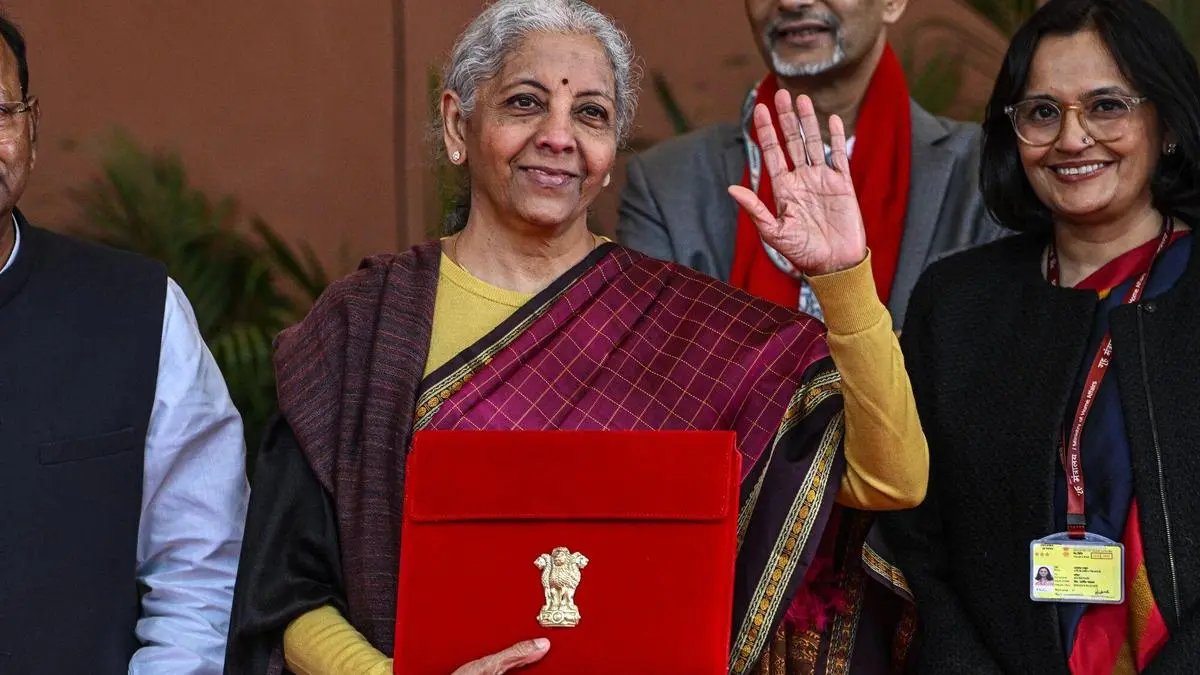

Nirmala Sitharaman, India’s finance minister | Photo Credit: PRAKASH SINGH
Markets reversed early gains and slipped sharply into negative territory by afternoon on Sunday, February 1, as post-Budget optimism evaporated amid selling pressure across broader indices. The Sensex fell 1,483.53 points or 1.80 per cent to 80,786.25, while the Nifty declined 539.60 points or 2.13 per cent to 24,781.05 as of 12.30 pm IST.
Market breadth remained negative with 2,294 stocks declining against 1,602 advancing on the BSE, while 200 remained unchanged out of 4,096 stocks traded. A total of 178 stocks hit 52-week lows compared to just 65 touching 52-week highs, with 126 stocks locked in lower circuit and 175 in upper circuit.
Broader indices witnessed steeper losses, with the Nifty Midcap 100 down 1,754.00 points or 3.00 per cent at 56,639.95 and the Nifty Smallcap 100 falling 578.30 points or 3.43 per cent to 16,300.80. The Nifty Next 50 dropped 1,764.90 points or 2.60 per cent to 66,074.95, while sectoral indices including Nifty Financial Services, down 566.70 points or 2.07 per cent at 26,739.20, and Nifty Bank, lower by 1,035.00 points or 1.74 per cent at 58,439.15, also traded under pressure.
Only four stocks managed to stay in positive territory on the Nifty50. Max Healthcare led gainers, rising 2.62 per cent to ₹981.90, followed by Sun Pharma up 0.72 per cent at ₹1,606.80, Kotak Mahindra Bank gaining 0.59 per cent to ₹410.40 and Dr Reddy’s Laboratories higher by 0.44 per cent at ₹1,223.40.
Bharat Electronics emerged as the top loser, plunging 9.13 per cent to ₹408.00, followed by Hindalco down 6.06 per cent at ₹904.25, State Bank of India falling 5.13 per cent to ₹1,021.90, Jio Financial Services declining 4.17 per cent to ₹243.90 and HCL Technologies dropping 3.93 per cent to ₹1,628.90.
Sonam Srivastava, Founder and Fund Manager at Wright Research PMS, said “Union Budget 2026 is being read by markets as a continuation budget rather than a disruptive one, which in itself is a positive at this stage of the cycle.” She added that “the budget compresses macro risk premia rather than triggering an immediate earnings re-rating, which is healthy for medium-term equity returns.”
Published on February 1, 2026