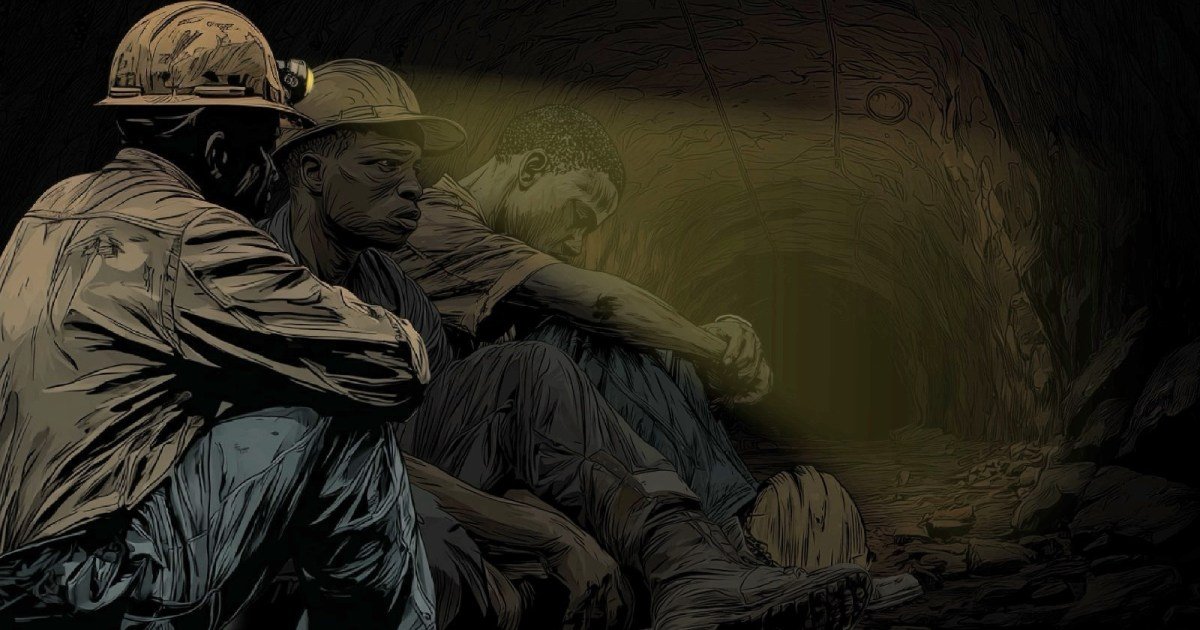
Below ground, men were gathering at the hollowed-out area at a depth of about 1,300 metres in Shaft 11.
Patrick had made his way there in November, having heard there might be food, as the men around him in Shaft 10 tried to survive on salt and toothpaste mixed with water collected at the bottom of the rock face. On his way to the passage, he had seen a body hanging from the shadowed mass of steel girders above him. The man had fallen from the upper levels while trying to escape.
As he half-crawled, half-staggered along the passage, he felt he heard his children telling him: “You’re not going to die here. This is not going to be your grave.”
But now in Shaft 11, panic was growing. The rescues were too slow. Not enough food or water was coming down. Patrick was finding it hard to cling to hope. The miners were growing weaker and had only the stagnant water oozing out of the rock to sustain themselves. Over two days, seven people had died.
Below the men, the shaft stretched even deeper into blackness filled with water to an unknown depth.
One day, a miner looked at Patrick with frightened eyes: “You know what?” he gasped. “I’m going to throw myself down this shaft.”
Patrick pleaded with him.
“No, man, you can’t do that,” Patrick told him. “It’s not our time to die here. We must believe in God. Our graves are not going to be this deep. We will go out. We’ve got families outside.”
The man didn’t jump, but his despair affected Patrick deeply. He still believed in his own survival, but the atmosphere among the men starving and dying in Shaft 11 was too much to bear.
On December 22, he decided to return to Shaft 10 and climb the girders. It was dangerous, but he had to do something to survive.
He had barely entered the passageway that led back to Shaft 10 when, somewhere in the darkness, he heard a voice.
“Do you want to buy some meat? Some pork?” the voice asked. “There are people selling it if you want some.”
He then saw men cooking over a fire.
Patrick returned to Shaft 11, reporting to the leaders that people were eating some kind of meat. They found the man who had approached Patrick, and he showed them the meat. It was human flesh. Then they found the man who had sold it to him. He admitted he’d taken it from the bodies of people who had fallen and died while trying to climb out.
The leaders were horrified. “You are not supposed to eat human flesh,” they said.
“We are hungry. What can we do? We are not killing these people. These people, they are falling, and we find them hanging,” the men told them.
Patrick was surprised that the men were not punished, but neither could he condemn them. It was the only way they had found to survive. But the horror of it spurred him on. He returned to Shaft 10 and began to climb.
On December 25, Christmas Day, he was almost blinded by the sunlight as he climbed out of the shaft. He’d climbed for more than 1km (0.6 miles) over three days, cutting his arms on sharp protruding steel, and come across nine bodies hanging from the girders.
He saw a flash of blue out of the corner of his eye and a glint of steel. A policeman grabbed him, forced his hands behind his back and handcuffed him. He was dimly aware of a small crowd watching and the hubbub of their angry voices as the police shoved him into a white van.
Mandla and Johannes watched as their friend Patrick was handcuffed and led away. Four miners had come up early that morning. After giving her mother her medication, Zinzi went to Shaft 10 to see if there was any news about her brother. There was nothing to celebrate this Christmas, she thought.
But there were still sounds coming from inside the shaft, and men were climbing up. Four more miners surfaced over the course of the morning. There was no sign of Zinzi’s brother, Ayanda.
‘We have to get you to your families’
In late December, police removed the anchoring rocks for the rope pulley at Shaft 11.
Against a backdrop of court actions as rights groups pushed for the government to rescue the miners, Johannes, Mandla and others pleaded with the police at the shaft entrance.
“Let us not bury them alive,” Johannes urged. “Let us help them to resurface. Then the law must take its course. Arrest them, do whatever you want to do, but save those lives.”
With no supplies going down since Christmas, on January 9, the community rebuilt the pulley system, and two handwritten notes were brought up.
“Mothers and fathers, we come in peace. People around us are dying by the hour, and currently, 109 people have died,” read the first.
The second began: “Greetings parents please be aware there are a lot of decompose bodies here also know even today there will be bodies to be retrieved, know the food you have sent can’t feed all the people who are here.”
The next day, Judge Ronel Tolmay of the High Court in Pretoria ordered the government to rescue the men.
But on January 13, Mine Rescue Services refused to descend, believing the men underground could be heavily armed or a kingpin and his cohorts were holding miners against their will.
Mandla and another community leader volunteered to go down in the red rescue cage to confirm there were no weapons, that it was safe for the rescue to proceed and to organise the men underground.
It took 25 minutes to descend through the darkness to the trapped miners. Mandla could smell the corpses before he reached the starving and sick men and dozens of wrapped bodies. He felt sorrow as he told the survivors, “I did try to fight with our government and told them that they are killing you, but they didn’t listen to us.”
“But we’re here to save your bones at least. We have to get you to your families.”
Only six men could properly fit in the cage, but Mandla helped more get in, as many as 12.
Over the next three days, Zinzi watched the cage come up and go down. Each time the cage surfaced, she felt hope surge through her, thinking that she would find her brother in it alive.
On January 16, 2025, when the last cage surfaced, Zinzi, who had stayed strong for her family, collapsed mentally.
Eighty-six bodies were retrieved from the mine while 246 miners were brought up alive. Zinzi’s brother, Ayanda, was not among them, nor was Nthatisi’s boyfriend, Bahlekase.
After the rescue, seven more people died in the hospital, bringing the death toll to 93.
MACUA, which represents the Stilfontein community’s interests, blamed the government and police for the deaths. They have requested that parliament instigate an inquiry, which has been referred to the Portfolio Committee on Mineral and Petroleum Resources. No investigation has begun. MACUA questions why there has not been an Independent Police Investigative Directorate (IPID) inquiry and notes the silence from most government bodies.
“The operation, which was approved at cabinet level, must ultimately be held to account and pay reparations,” Christopher Rutledge, executive director at MACUA, told Al Jazeera.
The South African Human Rights Commission investigated the events at Stilfontein in September 2025. They concluded that depriving the miners of essential supplies violated their human rights. They held another inquiry in February this year and are expected to present their findings in May.
The police have not released the names of the deceased, although 38 people were identified. At least 30 individuals among the unclaimed bodies were given funerals.
About 1,800 miners surfaced and were arrested at Stilfontein, about 1,500 of whom were deported, while 27 foreign children were handed over to the Department of Social Development. The youngest was 14 years old.
Al Jazeera reached out to the South African Police Service, the president’s office, and the Department of Mineral Resources and Energy with questions, but did not receive a response.
The township of Khuma, meanwhile, is largely quiet, the dusty streets almost deserted.
The nearby shafts have been sealed, and the police presence has returned to routine local patrols.
In February, protests erupted briefly. Roads were barricaded with logs, stones and burning tyres while the residents manning them demanded jobs and better service delivery.
The economy of the township has collapsed with no money in circulation. Many people stay at home, waiting, uncertain about what is next for them. Some gather to talk about their situation at the local taverns. There is little else to do.