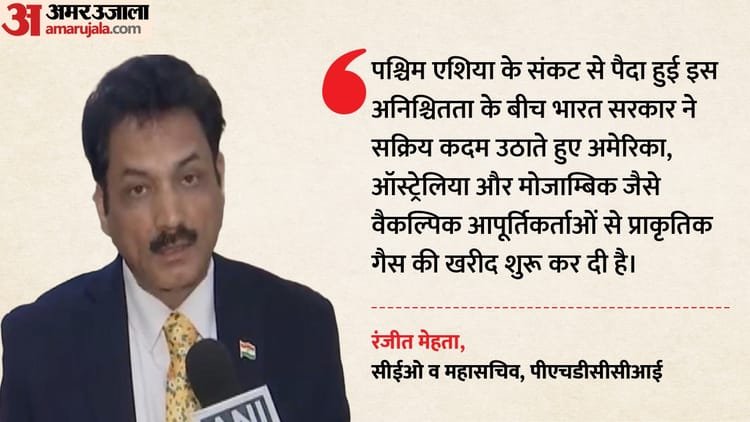
The ongoing war in West Asia has severely disrupted the global energy supply chain, which is directly impacting many key sectors of India, especially gas-dependent industries and port-based trade. Expressing concern over this crisis, Ranjit Mehta, CEO and General Secretary of PHD Chamber of Commerce and Industry (PHDCCI), has made it clear that this war is directly affecting India’s energy security. According to Mehta, ‘There is an atmosphere of chaos at the ports and many businesses dependent on gas supply are facing huge challenges as the gas supply has been affected.’
Purchase of gas from new markets, but ‘import bill’ will increase
Amidst the uncertainty created by the crisis in West Asia, the Indian government has taken proactive steps and started purchasing natural gas from alternative suppliers like America, Australia and Mozambique. Mehta estimated that it may take about two to three weeks for the new options to start supplying and the situation to stabilize. He pointed out that the price per MMBTU (million metric British thermal units) of gas imported from the US or other sources will definitely be higher than in the Middle East. This will result in a direct increase in India’s import bill, but the country cannot ignore its energy needs.
Increase in production and logistics costs
Due to this geopolitical crisis, there has been a huge surge in the global crude oil market. Mehta said that the prices which were earlier at the level of $60-$65, have now crossed the mark of $90 per barrel and at one time it had reached close to $117 per barrel. He warned that crude rising above $90 is a matter of concern not only for India but for the entire global economy. Rising energy prices directly increase the costs of production, transportation and logistics. This is impacting a wide range of import-export activities, including pharmaceutical trade, making shipping expensive and ultimately creating inflationary pressure in the economy.
Concerns of fertilizer sector before Kharif season
This interruption in gas supply has also raised alarm bells for the fertilizer industry, because natural gas is the main raw material in this sector. Mehta said that in view of the upcoming Kharif season, there is a need to keep a close watch on the production and availability of fertilizer, although he is confident that the government will manage the situation successfully.
shift towards renewable energy
Amid these current short-term challenges, this crisis strongly underlines the need to reduce India’s dependence on imported fossil fuels. Mehta stressed that to become completely energy secure in the long term, India will have to move towards renewable energy. The government has already prepared a roadmap to achieve about 500 GW of renewable energy capacity by 2030, which coupled with diversification of energy sources in the future, will help in making India’s energy security impenetrable.