Good morning.
The Rev Jesse Jackson, the civil rights campaigner who was prominent for more than 50 years and who ran a strong campaign for the Democratic presidential nomination in 1988, has died. He was 84.
“Our father was a servant leader – not only to our family, but to the oppressed, the voiceless and the overlooked around the world,” the Jackson family said in a statement. “We shared him with the world, and in return, the world became part of our extended family. His unwavering belief in justice, equality and love uplifted millions, and we ask you to honor his memory by continuing the fight for the values he lived by.”
-
What was Jesse Jackson’s role in the civil rights movement? Once close to Martin Luther King Jr, Jackson was a fixture of Democratic politics since the 1960s. In an interview with the Guardian in May 2020, Jackson said: “I was a trailblazer, I was a pathfinder. I had to deal with doubt and cynicism and fears about a Black person running [for president]. There were Black scholars writing papers about why I was wasting my time. Even Blacks said a Black couldn’t win.”
FBI won’t share Alex Pretti shooting evidence, Minnesota authorities say
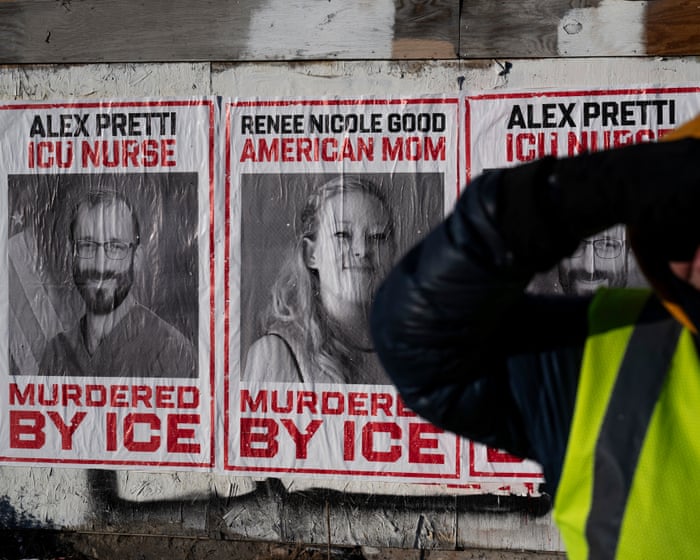
Minnesota law enforcement authorities have said the FBI is refusing to share any evidence on its investigation into the death of Alex Pretti, the man killed by federal immigration authorities in late January.
Pretti was shot on 24 January by Customs and Border Protection (CBP) officials in Minneapolis just two weeks after an immigration official shot and killed Renee Good and 10 days after the shooting of Julio Cesar Sosa-Celis.
Yesterday, Minnesota’s bureau of criminal apprehension (BCA), a state-level criminal investigative law enforcement agency, said the FBI had formally notified it that information or evidence relating to Pretti’s shooting would not be shared.
‘Deliberate targeting of vital body parts’: X-rays taken after Iran protests expose extent of catastrophic injuries
More than 75 sets of medical images – primarily X-rays and CT scans – have been shared with the Guardian from one hospital in a major city in Iran, taken over the course of a single evening during the regime’s January crackdown on protesters. The plain, grayscale images tell a story of the deadly violence inflicted on protesters and onlookers by Iran’s Revolutionary Guards.
They provide further evidence of events described by doctors and protesters across Iran, where authorities switched from more traditional “crowd control” to opening fire with high-calibre assault rifles and shotguns.
-
Is there a pattern to the injuries? The records present a pattern of people being shot in the face, chest and genitals – a trend also seen in the 2022 “Women, life, freedom” protests. Collectively, they help to illustrate the scale of bloodshed, showing dozens of life-threatening injuries appearing at a single hospital in a midsize city within a few hours.
In other news …
-
At least three people are dead and three more hospitalized after a mass shooting at an ice rink in Pawtucket, Rhode Island, which took place during a high school hockey match.
-
Chinese tourists are increasingly shunning Japan, with the country falling out of the top 10 destinations for those Chinese residents travelling abroad to celebrate the lunar new year.
-
It took her five Olympics, but 41-year old Elana Meyers Taylor won gold in the monobob yesterday, capping a long and brilliant career.
-
Austrian prosecutors have filed terrorism-related charges against a 21-year-old whom they say planned to attack one of Taylor Swift’s concerts in Vienna in 2024.
Stat of the day: Kyiv’s forces made fastest battlefield gains since 2023, analysis finds
Ukraine recaptured 201 sq km (78 sq miles) from Russia between Wednesday and Sunday last week, taking advantage of a Starlink shutdown for Russian forces, according to an Agence France-Presse analysis of data from the Institute for the Study of War (ISW). The recaptured area is almost equivalent to the Russian gains for the entire month of December and is the most land retaken by Kyiv’s forces in such a short period since a June 2023 counteroffensive.
Culture pick: How to Get to Heaven from Belfast review – if you see nothing else this year, watch this
When old school friends reunite at a funeral, they suspect foul play. Cue this frenetic, witty caper from the writer of Derry Girls, Lisa McGee – complete with a sensational performance from Saoirse-Monica Jackson. McGee’s new offering has all of the verve, acuity and havoc – dancing on top of the immaculate plotting – that you find in her masterwork. How to Get to Heaven from Belfast is on Netflix now.
Don’t miss this: ‘I felt betrayed, naked’ – did a prize-winning novelist steal a woman’s life story?
His novel was praised for giving a voice to the victims of Algeria’s brutal civil war, and in 2024 it won the Goncourt literary prize. Now one woman has accused Kamel Daoud, a celebrated Algerian writer living in France, of having stolen her story – and the ensuing legal battle has become about much more than literary ethics.
Climate check: Claims that AI can help fix climate dismissed as greenwashing
Tech companies are conflating traditional artificial intelligence with generative AI when claiming the energy-hungry technology could help avert climate breakdown, according to a report. Most claims that AI can help avert climate breakdown refer to machine learning, not the chatbots and image generation tools driving the sector’s explosive growth of gas-guzzling datacentres, the analysis of 154 statements found.
Last Thing: ‘I love you 26 times’ – how lyrics written by a three-year-old became tear-inducing viral hits
When Stephen Spencer first began setting his toddler daughter’s surreal stories to music, he had 36 followers. He now has more than 250,000 and his songs have been listened to an astonishing 23m times on Instagram and 5m times on TikTok. There have been demands to turn these minute-long mini-masterpieces into full-length versions for an album.
Sign up
Sign up for the US morning briefing
First Thing is delivered to thousands of inboxes every weekday. If you’re not already signed up, subscribe now.
Get in touch
If you have any questions or comments about any of our newsletters please email newsletters@theguardian.com.