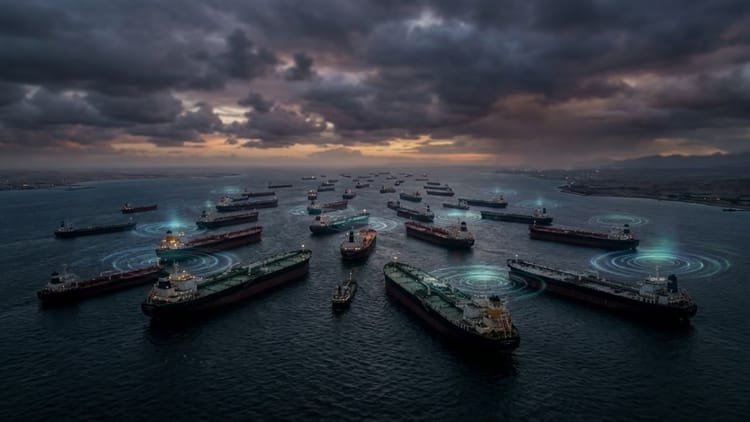
One of the world’s most important maritime trade routes – the Strait of Hormuz – has suddenly become a mysterious ‘blind spot’. Amid the US and Israel’s ongoing war with Iran, the region is witnessing heavy electronic signal jamming. The situation is such that the navigation systems of ships have stopped working and the world’s crude oil supply chain has completely collapsed.
After all, what is happening on this important sea route and what effect is it having on the global economy? Let us understand.
Question: What strange incident is happening with merchant ships near the Strait of Hormuz?
answer: According to tracking data compiled by Bloomberg, at least a dozen clusters of ships have appeared near Hormuz, some of which include up to 200 ships. These ships are seen forming strange shapes on the tracking platforms; For example, a circular cluster of ships has been seen near Abu Dhabi, while an inverted ‘Z’ shape has been formed off the coast of Ruwais in the United Arab Emirates (UAE). There is also a cluster of ships in the Gulf of Oman, perhaps waiting for tensions to ease or for clear loading dates to arrive.
Question: What is the real reason for these strange tracking data and ‘signal jamming’?
answer: In times of geopolitical tension and war, armies often resort to ‘electronic warfare’. For this reason, navigation systems of ships are being disrupted through electronic jamming. According to Starboard Maritime Intelligence analyst Mark Douglas, the situation has become so ‘impenetrable’ that it is almost impossible to pinpoint the exact location of any ship through tracking data. No ship can rely on GPS for navigation. Due to jamming, the speed of ships is also being recorded incorrectly; For example, the ‘Esprouda’ product tanker with a maximum speed of 16 knots was seen moving at an impossible speed of 102.2 knots (about 190 km/h).
Question: What impact has this interruption had on the global energy market (crude oil)?
answer: The effective closure of this vital route has caused massive disruption in the global energy market. Oil producers in the Persian Gulf are running out of storage capacity, due to which they are having to stop their production. Due to this supply crisis, the price of Brent crude futures initially jumped to near $ 120 per barrel. However, contracts fell sharply on Tuesday after US President Donald Trump hinted at an early end to the war.
Question: How serious is the situation and what is America’s stance on it?
answer: The jamming began as soon as the war began and has affected more than 1,100 ships in the Persian Gulf, according to maritime-intelligence firm Windward. There has been a huge decline in traffic; On 26 February, 120 ships had crossed from Hormuz, which reduced to only five on 4 March. To deal with this crisis, US President Trump has expressed the possibility of providing American insurance and naval escort to ships to resume maritime traffic. Trump also told CBS that he is also thinking about ‘taking over’ it, although no clear action plan has come forward yet.
The ongoing navigation and security crisis in Hormuz has increased the concerns of shipowners and businessmen manifold, as insurance premiums related to the risk of war are continuously skyrocketing. Unless electronic ‘signal jamming’ is stopped and safe navigation of ships is ensured, global energy supplies and oil prices will remain under significant pressure from uncertainty.