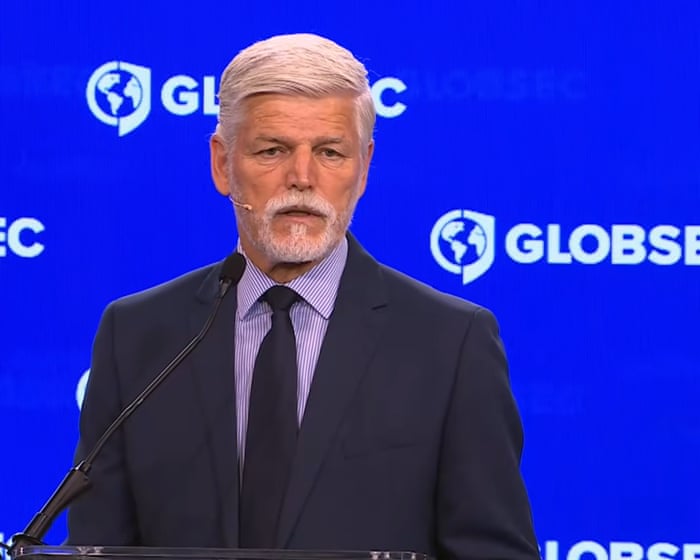
‘Peace in Europe no longer default,’ Czechia’s Pavel says
In a stark warning, Pavel – a retired Nato general – warns that “peace in Europe can no longer be treated as the default state of affairs.”
“It must once again be actively protected, defended and maintained. The lesson of this moment is not that Europe is alone it is that Europe needs to be strong enough to stand on its own when needed.”
He warns that Europe needs to pull all the levers to get itself into the best position, as “history will simply not wait for Europe to become ready.”
“We must act swiftly,” he says.
Key events
-
Nato allies should spend more to support Ukraine, Nato and Sweden’s leaders say
-
Swedish PM defends Ukraine from criticism over stray drones, warns against Russian disinformation
-
Nato’s response to any attack would be ‘devastating,’ Rutte says
-
Nato’s Rutte speaks alongside Swedish PM ahead of Nato meeting
-
‘If Russia were to invade, I’m confident we would live up to our obligations,’ former US defence secretary Esper says
-
Russia doubles down on repeatedly denied claims alleging Baltics were looking to enable Ukrainian drone attacks
-
Lithuania continues search for drone that prompted air alert yesterday
-
Latvia confirms drone incursion in its airspace
-
Ukraine is ‘military power with huge production capabilities’ that must not be allowed to fall in Russian hands, former Estonian president says
-
Ukraine ramping up security measures in regions bordering Belarus
-
Ukraine must be precise when using drones to avoid helping Russian provocations, Poland’s defence minister says
-
Latvia declares possible drone alert for southeastern part of country
-
Russia claims Ukraine is seeking escalation after Zelenskyy warns of possible expansion of war by Russia
-
Europe needs to learn from Ukraine, move ‘much faster’ to respond to challenges, Pavel says
-
‘Peace in Europe no longer default,’ Czechia’s Pavel says
-
‘If Ukraine is forced into bad peace, we will all live with consequences for decades,’ Pavel warns
-
EU and Nato should align priorities to help Europe step up its defence, Pavel says
-
‘No time to lose’ as capabilities, not spending, are key for Europe’s ability to defend itself, Pavel says
-
‘Many assumptions for old security architecture are no longer valid,’ Czech president warns
-
Morning opening: Dobré ráno from Prague
Nato allies should spend more to support Ukraine, Nato and Sweden’s leaders say
Rutte and Kristersson also say that not all Nato countries equally contribute to help fund Ukraine’s defence.
Rutte says the spending “is not evenly distributed within Nato,” with “a limited” group of countries leading the effort – Sweden, Canada, Germany, the Netherlands, Denmark – but many others are “not spending enough when it comes to the support for Ukraine.”
Kristersson says Sweden is the third largest donor and it “it would be far better if more countries competed with our size of support.
He says:
“We need to be long term and firm in our support. So I really would like more countries that speak so extremely well about Ukraine to also put the money where the mouth is.”
Swedish PM defends Ukraine from criticism over stray drones, warns against Russian disinformation
Sweden’s Kristersson jumps in to Ukraine’s defence, too.
He says:
“It’s my firm belief that the Ukrainians are very… I mean, they certainly don’t want their drones to end up on friendly territory, for obvious reasons.
Sometimes it’s a matter of jamming, sometimes it’s a matter of other disturbances, and obviously they do not want them to happen, because it could create damage, it could create fear, of course.
But I think you should also realise that there is Russian willingness to give the impression that other countries are kind of doing things that are not legitimate, and that’s why … we should really not be open for the Russian narrative on this, but … help the Ukrainians as much as we can to direct, to help them direct their attacks in the right directions.”
Rutte joins him to once again declare the various Russian theories about the three Baltic states allegedly allowing Ukraine to launch drones from their territory (11:22) as “totally ridiculous.”
Rutte gets asked about the latest drone incident in Latvia.
He largely repeats his talking point from yesterday, saying that if gets confirmed that it’s another stray drone from Ukraine, these drones “are there because of the full-scale Russian attack against Ukraine, Ukraine having to defend itself.”
He says that Nato is “always prepared for every eventuality,” and it has shown with its response to a stray drone over Estonia that it’s prepared for any scenario.
We next go to the Q&A, and Rutte gets exactly what he gets every single time when he appears at a press conference: a question on Trump.
The question focuses on his past comments that he had an agreement with Trump on “no surprise” announcements, and whether that arrangements is obviously looking somewhat shaky given the recent US announcement on troop withdrawals or delayed rotations affecting Germany and Poland.
As often, Rutte doesn’t really answer the question, deflects and talks about the work Europe is doing to increase its defence spending and military posture instead.
He argues that Europe’s overreliance on the US is “not healthy,” and Europeans need to “take more care of their own defence.”
When he eventually gets to the basic premise of the question, he says:
“The rotational forces involved in the announcements do not have an impact on Nato’s defence plans.”
He says the US’s decision to pivot away from Europe and towards Asia is only being done “step by step in a way where it will not, of course, lower the overall deterrence in defence of Nato.”
Nato’s response to any attack would be ‘devastating,’ Rutte says
Rutte begins with general niceties about Sweden as the latest country to join the alliance, praising its contribution to Nato, and plans to increase defence spending.
He commends Sweden on its work to stop Russia’s shadow fleet.
He then delivers his usual warning, clearly aimed at Russia:
“Let there be no mistake: our ability and our resolve to defend every ally are absolute. Were anyone to be so foolish as to attack, the response would be devastating.”
Nato’s Rutte speaks alongside Swedish PM ahead of Nato meeting
I will bring you more lines from Esper and Rasmussen soon, but let’s go to Sweden now where the current Nato secretary-general, Mark Rutte, is speaking alongside the Swedish prime minister, Ulf Kristersson ahead of a Nato ministerial later today.
‘If Russia were to invade, I’m confident we would live up to our obligations,’ former US defence secretary Esper says
Back to Prague, former US defence secretary Mark Esper sought to reassure the audience that Europe can still trust the US as a partner in Nato, despite recent confusion over the presence of US troops on the continent.
Speaking to former Danish PM and Nato secretary general, Anders Fogh Rasmussen, he said:
“Yes, Europe can trust the United States. … The alliance has gone through these ups and downs in the past, and I think at the end of the day, if the consensus in Washington DC, from both Democrats and Republicans, most on both sides, is that Nato is critical to American security; it’s certainly critical to stability and security in Europe.
And when push comes to shove, if Russia were to invade, I’m confident that we would live up to our obligations.”
But he said that Trump was “spot on” calling Europe out on defence spending, stressing this point has been repeatedly made by numerous US administrations.
Rasmussen partially agreed, saying that:
“For too long Europe has been too dependent on cheap energy from Russia, cheap goods from China, and cheap security from the United States. That model doesn’t work any longer.”
Russia doubles down on repeatedly denied claims alleging Baltics were looking to enable Ukrainian drone attacks
Meanwhile, Russia has doubled down on its (repeatedly denied) suggestions that Latvia and other Baltic states could soon be used by Ukraine as a “launchpad” for attacks on Russia, raising fears about a potential escalation in the region.
In a lengthy statement on its Telegram channel, the Russian ministry of foreign affairs said – quoting its foreign intelligence serving, but without offering any evidence – its claims that the Ukrainian military is preparing to carry out strikes on Russia from the territories of Estonia, Latvia and Lithuania.
It criticised Latvia’s “naive” leaders for allegedly “consenting” to the operation – again, a claim repeatedly denied by Latvia’s top leadership, including both the president and the prime minister, and Ukraine (Europe Live, Tuesday).
As part of the message, the Russian MFA even named the five Latvian military bases it alleged were hosting the Ukrainian drones.
“Nato membership will not shield accomplices of terrorists from just retribution,” it said, repeating the threats first made in the UN security council meeting earlier this week, which prompted clear condemnation from the US and the EU.
Nato’s secretary general Mark Rutte said yesterday that Russia’s claims were “totally ridiculous, and Russia knows it” (Europe Live, Wednesday).
Worth remembering that the (now repeated) drone incursions into Latvian airspace have caused some real political damage in the country, prompting a government crisis leading to the collapse of Evika Siliņa’s administration last week.
Lithuania continues search for drone that prompted air alert yesterday
Meanwhile, Lithuania is still looking for a military drone that prompted a national air threat alert yesterday, with the country’s leaders led to bunkers and the general public told to take shelter.
The drone disappeared from the Lithuanian radars near Vilnius, with a major search operation now under way trying to figure out what happened to it.
The operation had to be paused last night because of darkness, but has resumed this morning, with the authorities now looking closer to the Lithuanian border with Belarus.
“Until the object is found, no one can say for sure, but all parameters recorded by radars […] point to a drone,” Vilmantas Vitkauskas, head of the National Crisis Management Centre, said, quoted by LRT.
Latvia confirms drone incursion in its airspace
Oh-oh.
Further to the earlier air alert, Latvia has just confirmed “there is at least one unmanned aerial vehicle in Latvia’s airspace.”
There is still no detail on what sort of drone or whose drone it is.
We will surely hear more about it during the day.
Ukraine is ‘military power with huge production capabilities’ that must not be allowed to fall in Russian hands, former Estonian president says
Back in Prague, former Estonian president Kersti Kaljulaid offered a clear take on the question facing the EU as it is moving to consider whether Ukraine should be admitted as a member of the bloc.
“I just wanted to say [it] should be about simplification. It’s very difficult to discuss [if] Ukraine [should] join European Union, and then we discuss how will its agriculture fit the common agricultural policy.
[But] this is not the question. Question is: Ukraine is a military power with huge military production capability. Whose hands must it be in? In Russian hands, [or] western hands? End of story. This is our question. This is our objective.
Have Ukrainians with us, because imagine they started, like in Soviet Union times, to build all these things for Russia, not for us.
And that gives you your answer. It’s very simple.”
Ukraine ramping up security measures in regions bordering Belarus
Following Zelenskyy’s warnings yesterday, Ukraine is ramping up security measures in its regions bordering Belarus, AFP reported, after weeks of warning of a possible fresh attack from Russia’s chief regional ally.
Kyiv has sounded the alarm that Russia may use Belarus – a springboard for its 2022 invasion of Ukraine – to stage a new offensive from the north, including towards the capital.
AFP noted that Ukraine’s Security Service (SBU) said its units and the army were “carrying out a comprehensive set of enhanced security measures in the northern regions of our country”.
The measures – including stepped up checks and controls of individuals and properties – “will serve as an effective deterrent to any aggressive actions or operations by the enemy and its ally”, the SBU said in a statement.
Just a reminder that Russia and Belarus are also staging joint nuclear drills this week, involving thousands of troops, planes and strategic missile forces.
Ukraine must be precise when using drones to avoid helping Russian provocations, Poland’s defence minister says
For what it’s worth, Poland’s defence minister Władysław Kosiniak-Kamysz said this morning Ukraine must be very precise when using drones to avoid Russia interfering with their flight path.
“Ukraine must be more precise here, of course, to avoid giving rise to Russian provocations,” Kosiniak-Kamysz told a news conference in the Estonian capital Tallinn, Reuters reported.
“Our territories … should not be violated, they should not be threatened.”
Earlier this week, Ukraine apologised for individual cases when its drones attacking targets in Russia strayed into the Baltic airspace, blaming Moscow’s “electronic warfare.”
But Nato’s secretary general Mark Rutte laid the blame squarely on Russia, saying bluntly yesterday (Europe Live, Wednesday):
“If drones come from Ukraine, they are not there because Ukraine wanted to send a drone to Latvia, Lithuania, or Estonia. They are there because of the reckless, illegal, full-scale attack of Russia, starting in 2022 after, of course, what they did in Crimea in 2014 against Ukraine.”
Latvia declares possible drone alert for southeastern part of country
And just like that, Latvia’s army has just issued a possible drone alert over southeastern part of the country – for the third day in a row.
I will keep an eye on that as there are more questions than answers at this early stage, including the crucial one on where does the it come from and, well, whose is it as we have seen reports of stray Ukrainian drones crossing into the Baltic countries as a result of Russian jamming.