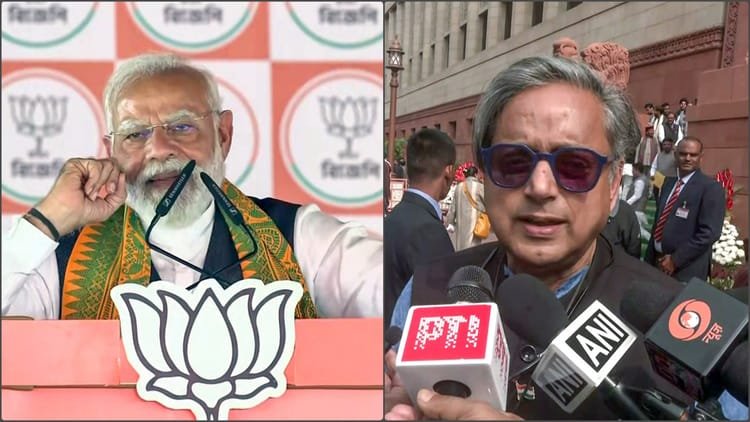
Congress leader Shashi Tharoor has urged Prime Minister Narendra Modi to hold wide consultations with all political parties and states before going ahead with the hasty process of delimitation. Tharoor said that if the process is rushed, it could prove dangerous for the federal structure of the country, as smaller states may feel that their prosperity and human development are being punished by reducing their political voice.
Suggestion of ‘Degressive Proportionality’
Tharoor suggested adopting the principle of ‘degressive proportionality’ in the Lok Sabha to balance population with federal parity. He said this principle is applied in Europe in the structure of the European Parliament, where a balance is created between small and large states. India also needs to find a compromise between strict democratic representation (one person, one vote) and the need to ensure the voice of smaller political units.
example of european model
In line with the European model, this principle states that more populous states will get more seats, but the ratio of representatives to citizens will also increase as the population increases. For example, in the European Parliament, no member state can have fewer than 6 and more than 96 seats. A member from a small country like Malta can represent about 80,000 citizens, while a member from a large country like Germany can represent about 850,000 citizens. Its purpose is to prevent a permanent absolute majority of large countries from bypassing the collective interests of smaller countries.
Need to apply in Indian context
Tharoor stressed the need for debate on the application of this principle in India. He said the focus should not only be on issues like women’s representation, but also the North-South divide created due to delimitation should be addressed. A strict population-based redistricting would increase the seats of northern states like Uttar Pradesh and Bihar, while reducing the political influence of states successful in population control like Kerala and Tamil Nadu.
Possible solutions and concerns
If India adopts the ‘degressive model’, the Parliament can be structured to balance population and federal equality. Like the European Union, a “floor” could be set for smaller states like Goa, Sikkim or the North-East so that they do not become insignificant. Tharoor suggested that instead of a fixed ratio, the ratio of citizens per MP could change depending on the total population of the state. For example, a state with 20 crore people may have 25 lakh citizens per MP, while a state with 3 crore people may have 10 lakh citizens per MP.
He also said that Telangana Chief Minister A. Echoing the suggestions of Revanth Reddy, a state’s contribution to national gross domestic product (GDP) can also be considered. Tharoor warned that it would be dangerous for smaller states to feel that their prosperity and human development were being punished by reducing their political voice.
Rajya Sabha vs Lok Sabha
While the Rajya Sabha exists for federal representation, ‘degressive proportionality’ in the Lok Sabha will provide a “weighted” democratic mandate that acknowledges population but does not penalize states for their developmental successes.
Government steps on reservation and delimitation of women
Meanwhile, the government is circulating among MPs the bill related to women’s reservation law and delimitation. Congress has commented on this, saying that when the intent of a Bill is malicious and its content fraudulent, the extent of the damage it can do to parliamentary democracy is immense. According to the latest information, the number of Lok Sabha seats will be increased from the current 543 to 850 after the delimitation exercise to implement the women’s reservation law before the 2029 parliamentary elections. According to the draft Constitution Amendment Bill, the number of seats in state and union territory assemblies will also be increased to accommodate 33 percent reservation for women.