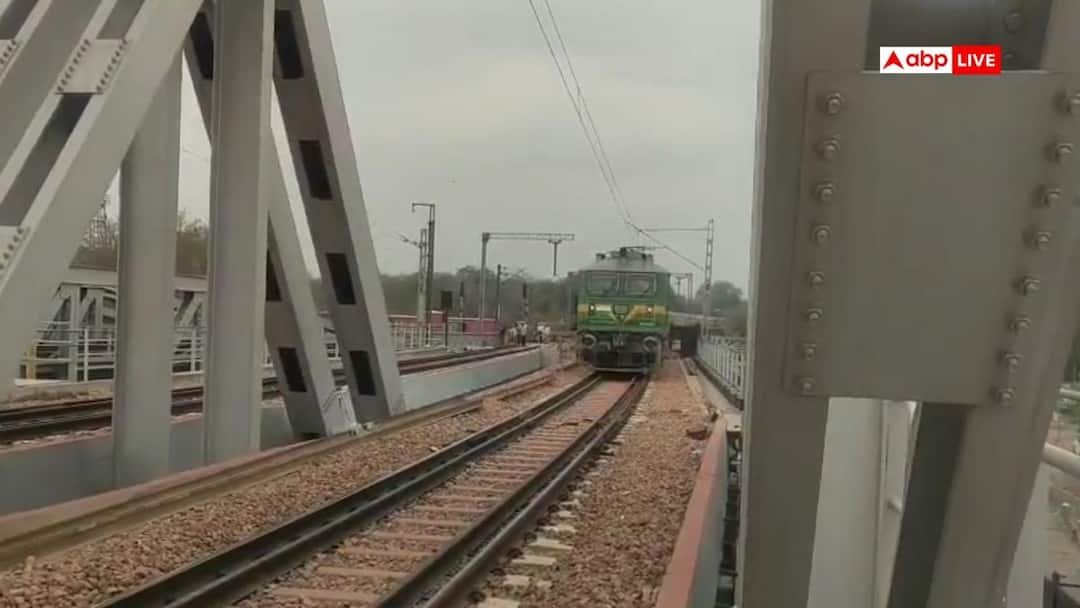
In place of the historical iron bridge built on Yamuna river in Delhi, a modern and high bridge has now been built, which is going to provide great relief in railway operations. With the commissioning of the new bridge, passengers will not only get safe travel but the speed of trains will also be faster than before.
According to Rajesh Kumar Pandey, General Manager of Northern Railway, the new bridge has been built 4.5 meters higher than the old bridge. This is the reason that even if the water level of Yamuna increases, the operation of trains from this bridge will not be affected. Earlier every year there was a danger of disruption of railway service during floods, which has now completely ended.
The limitations of the old bridge became a challenge
The structure of the nearly 150-year-old iron bridge had weakened over time. As the water level rose, the operation of trains had to be stopped for safety reasons. Not only this, considering the condition of the bridge, trains had to pass at a very slow speed, which caused inconvenience to the passengers and also took more time.
History became heritage, now operations are closed
This historic ‘Iron Bridge’ built on Yamuna between Delhi and Shahdara is now out of service. This bridge was once the most important rail link connecting North and East India. Carrying the load of millions of passengers and heavy freight, its capacity became weak, after which the decision was taken to close it.
Amazing example of 19th century engineering
Built in 1866-67 with about 3,500 tons of wrought iron, this bridge was a brilliant example of engineering of that era. On this approximately 1000 feet long bridge, a steam engine train ran for the first time in 1867, due to which Delhi was directly connected to Kolkata. After this, there was a revolutionary change in trade, postal system and military movement.
Two storey structure, multi-use identity
The design of this bridge was also very special. Railway tracks were laid in its upper part, while the lower part was used as a road and footpath. After 1857, this bridge played an important role in the reconstruction and expansion of Delhi and it remained the most reliable means of crossing Yamuna for the common people.
Now the journey will move forward with modernity
The new bridge is not only technically strong but has also been designed keeping the future needs in mind. This will make rail traffic more safe, fast and uninterrupted, which will prove to be a great relief for both passengers and goods transport in the future.