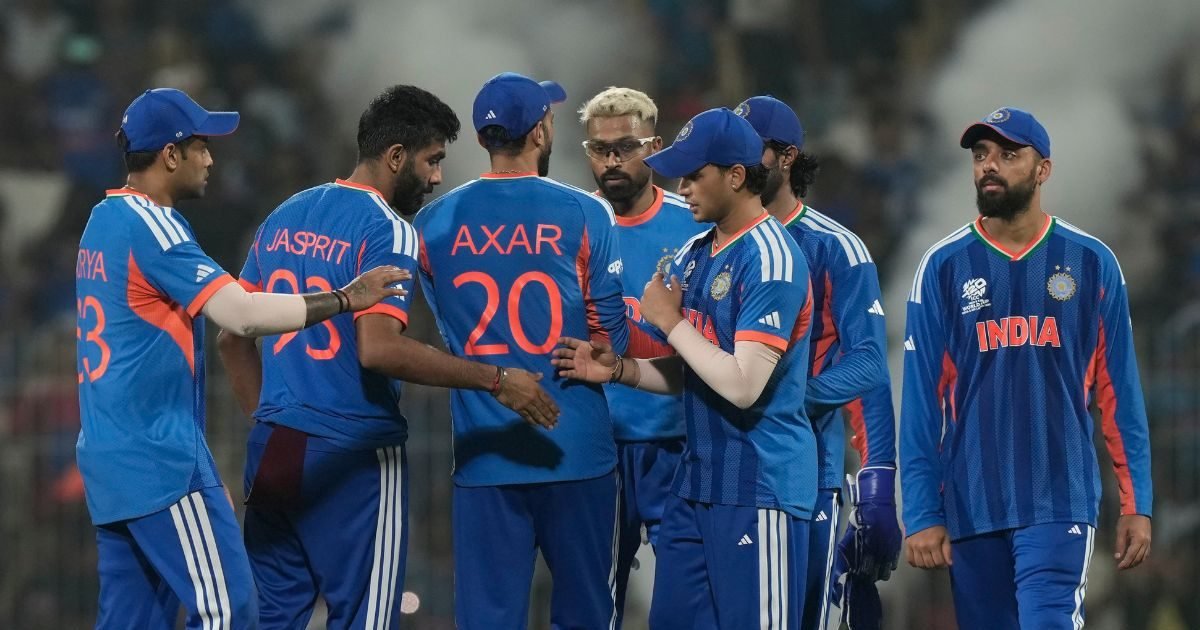
New Delhi. When India won a virtual quarterfinal match against West Indies at the historic Eden Gardens in Kolkata, the stadium erupted in celebration, but this victory was not comforting, but rather a relief. India again did not look at its best. Expectations were high, but the journey was not that easy. Still, the talent is so much that under the leadership of Suryakumar Yadav, Team India reached the semi-finals of the T20 World Cup 2026. Making it to the finals should have been the minimum goal for this team, but a lot of energy and mental strength has been spent just to reach the final four.
This tournament has been full of ups and downs for India. The very beginning almost narrowly avoided the biggest upset in history, when America bowled out India at 77/6. That day, Suryakumar Yadav turned the match by playing a memorable inning of his life and then showed weakness against spin against Namibia. Ishan Kishan made a save against Pakistan, while the bowling remained in question against Netherlands. South Africa gave a huge blow to India in Ahmedabad. There is a possibility that the same match will be seen again in the final on March 8, but the way the Proteas defeated India in the first match of the Super 8 would have given them confidence. In reply, India batted brilliantly against Zimbabwe, but gave away 184 runs and the situation could have been very difficult against West Indies had Sanju Samson not been there. Team India, standing on the threshold of the semi-finals, still faces six major problems, which can emerge at the wrong time and snatch the title.
1. Where has Varun Chakraborty’s edge gone?
From the last T20 World Cup till this tournament, no bowler of any full-member team has taken as many wickets as Varun Chakraborty. After returning to T20I, he took 57 wickets in 28 innings, one wicket every 11.2 balls. But his shine has faded in this World Cup. They were effective against weaker teams in the group stage, but as soon as the Super 8 came, their edge diminished. South Africa targeted him heavily and his economy rate against Zimbabwe and West Indies was above 9.3. He seemed to be struggling with lack of confidence, length was short and control was weak. India, which used to rely on his four overs, is now in a dilemma.
2. Excessive dependence on Jasprit Bumrah
As Varun’s form declines, all the pressure has come on Jasprit Bumrah. His economy in this tournament is 6.3, while in all T20 World Cups together it is 5.63, which is incredible. But the question is, what will happen on the day when Bumrah will not be there? He is not a machine. Opponents can make a strategy to play him, so who is the other reliable option? Apart from this, there are also questions on the use of Bumrah. In Asia Cup 2025, he was bowled for three overs in the powerplay. Now many times he is brought in after the fifth over and he should attack with the new ball along with Arshdeep, so that there is pressure on the opposition in the beginning.
3. Can Indian fielders take catches?
Distributing fielding medals after the match is a different matter, but catching on the field is more important. India has the worst catching record among the Super 8 teams. Pakistan and Sri Lanka are often considered weak fielding teams, but India lagged behind them in this tournament. Being a young team does not mean better fielding, this team is becoming an example of this.
4. Tournaments are not won by individual performance alone
Suryakumar against America, Ishaan against Pakistan, Shivam Dubey against Netherlands, Bumrah against South Africa and Sanju Samson against West Indies. The story of one player standing in every match sounds good, but collective performance is necessary to win the tournament. Top order continuity has been a big problem. Barring Zimbabwe, the top four batsmen could not click together. India needs more stability on grounds like Mumbai and Ahmedabad.
5. Suryakumar Yadav’s ‘SKY’ still far away
Suryakumar’s strike rate fell after his inning of 84* in 49 balls against America. His SR in the next matches were 92, 110, 121, 81 and 112. The total strike rate is 135.9, which is much lower than 168 in IPL 2025. Teams are restricting him against spin. He was seen struggling especially against left arm spinners. His strike rate in the first 10 balls is 118, which is low for a player of his level. Opponents are shutting down his flick shot line, yet, his talent is such that he can turn the match on any given day.
6. Abhishek Sharma’s confidence wavered
1029 runs in 24 matches before the tournament, a strike rate of almost 200 and an average of 45 but only 110 runs in the last 8 matches, an average of 13.75 and four zeroes. The bowlers are now bowling on his stump line, due to which he is not getting space to open his hands. Akil Hussain’s dismissal on a simple ball against West Indies shows lack of confidence. It is not a technical problem, it is mental and mental problem can be cured in a few balls. The half-century against Zimbabwe gave hope, but continuity did not come.
India is in the semi-finals, but not completely sure. If these six problems rear their head again, then the title dream can be shattered. Talent, experience and ability are all present, now what is needed is collective performance, confidence and right strategy.