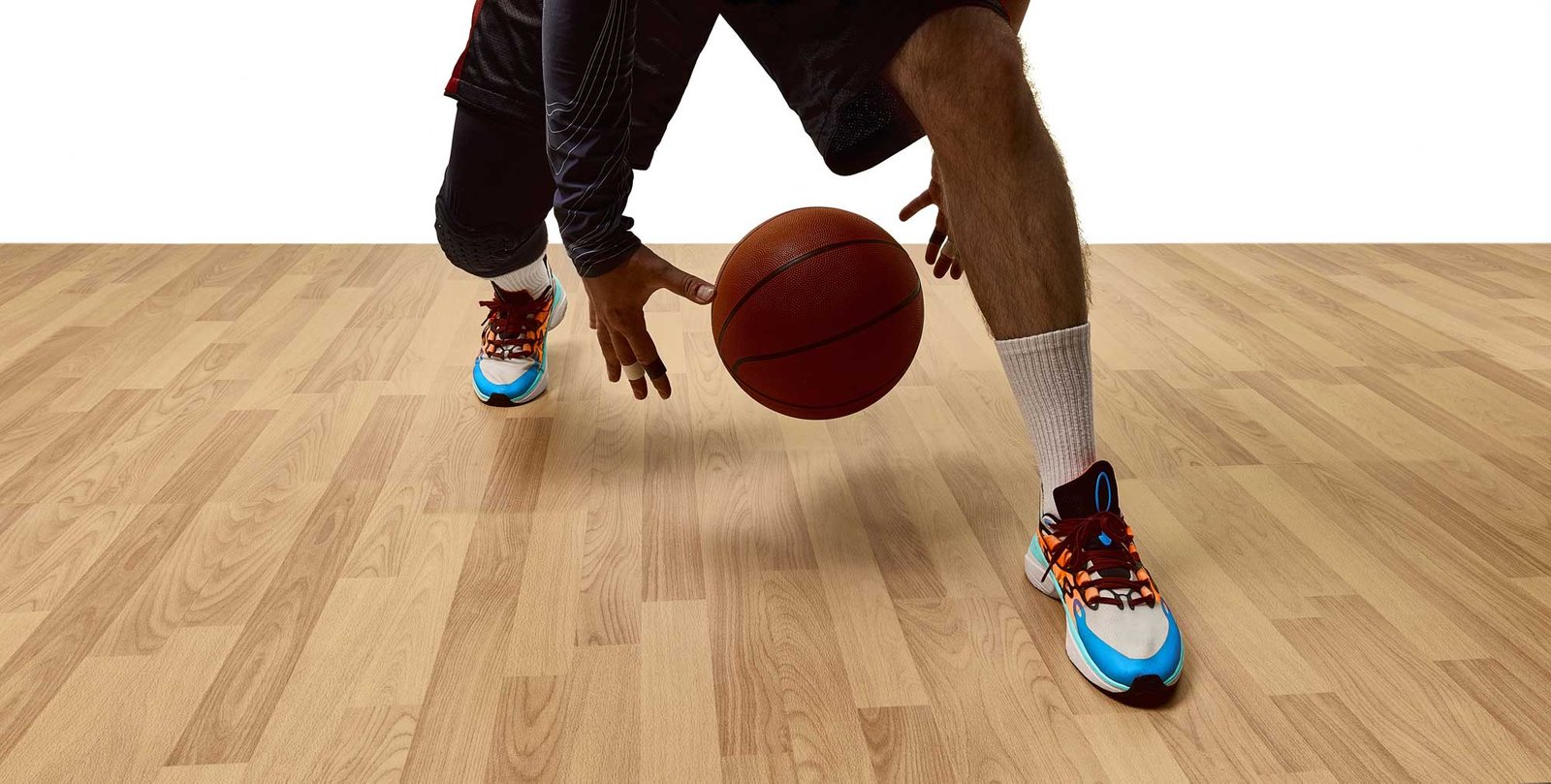
It is a sound evocative of high school: the characteristic squeak of sneakers on a basketball court. UK readers may, however, be familiar with the same sound from their trainers while playing badminton.
Whichever it is, how exactly the sound is produced has been a mystery – until now.
The high-pitched tones have often been attributed to the “stick-slip phenomenon,” which creates the sound from a violin bow moving against the instrument’s string. You can still read the explanation on the Wikipedia page.
But the problem is that the sound tends to show up at high sliding speeds, while it also has a well-defined pitch, the frequency of which is difficult to explain.
A team led by Harvard University postdoctoral researcher Adel Djellouli carried out an experimental analysis of the phenomenon and came up with an alternative to the stick-slip explanation.
They replicated the sneaker-court interface by testing rubber blocks sliding against a special glass plate. Light shone into the glass at an angle and was trapped inside — a phenomenon known as total internal reflection — and only released when the rubber made contact with the plate. The researchers were able to record the contact regions using a high-speed camera.
The results showed that the squeaking sound is produced by wave-like patterns across the rubber surface, contacting and then releasing from the glass, allowing the sliding between the surfaces. The waves move across the interface between the two materials at a speed of nearly 300 kilometers per hour.
The Harvard team also found that including ridges in the rubber akin to the sole of a sneaker produced a dramatic effect. “In flat samples, these pulses are irregular and generate broadband acoustic emissions. Introducing thin surface ridges confines pulse propagation, yielding a consistent repetition frequency matching the first shear mode of the sliding block and squeaking at that frequency,” the paper, published in Nature this week, said.
In an accompanying article, Bart Weber from the University of Amsterdam wrote that “The study not only explains a familiar sound but also reveals how much complexity can hide in the seemingly simple act of sliding.”
The researchers also observed tiny triboelectric discharges, brief flashes of light that appear capable of triggering the surface waves.
Aside from explaining a curious effect from high school days, the researchers point to further work that could help enhance or reduce the effect, Weber said. ®