
Fujitsu’s 144-core Monaka CPU will be built using 3D-chip stacking tech from Broadcom, the merchant silicon slinger revealed on Thursday.
Fujitsu is an old hand at CPU design. Its Arm-based A64FX catapulted the original Fugaku supercomputer to the number one spot on the Top500 in 2020.
Monaka is a very different animal. Gone is the on-package HBM, replaced instead by an SRAM-heavy architecture similar in principle to AMD’s Genoa-X CPUs.
That platform used AMD’s 3D V-Cache tech to stack 64 MB SRAM chiplets on top of the CPU’s compute dies. In its top-specced config, the CPU boasted more than a gigabyte of L3 cache.
Fujitsu is going for something similar with Monaka, although the chip is aimed at a broader datacenter market. The chip’s four 2nm compute dies, each with 36 Armv9 cores, will ride atop an equal number of SRAM chiplets fabbed on a 5nm process node. Those stacks will be interconnected via a central I/O and memory die with 12 channels of DDR5 and PCIe 6.0 connectivity, via a silicon interposer.
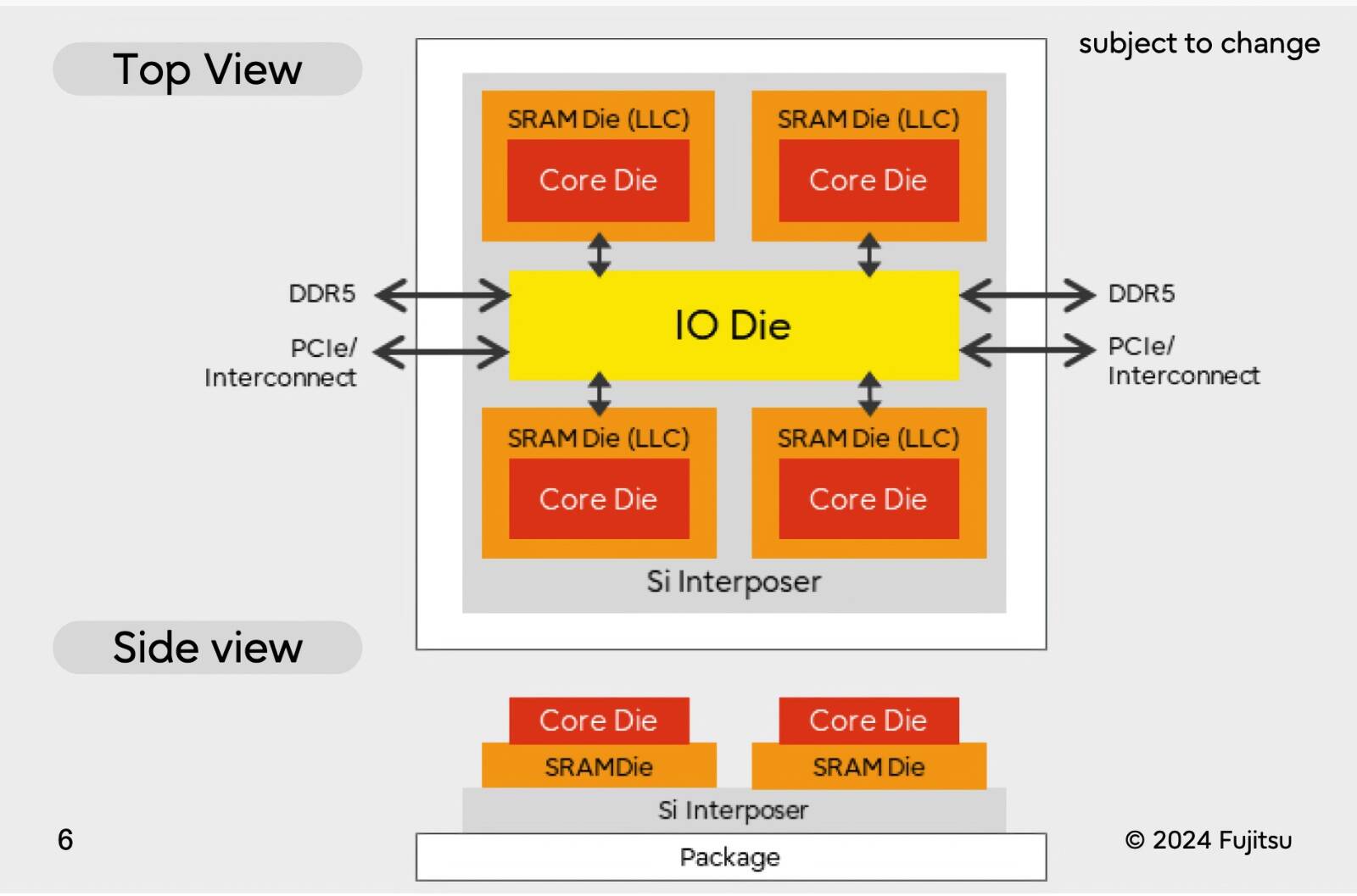
Fujitsu’s Monaka CPU looks a heck of a lot like an Arm take on AMD’s cache-stacked X-chips. – Click to enlarge
Until recently, only AMD and Intel have had the technology required to build a SoC of this nature. With the introduction of its 3.5D XDSiP in 2024, Broadcom sought to change that.
XDSiP stands for Extreme Dimension System in Package, and it’s Broadcom’s attempt at a standardized platform for building multi-die processors in the same vein as AMD’s MI300X or Intel’s Ponte Vecchio.
We explored this tech in closer detail last year, but one of its standout features is its use of face-to-face hybrid bonding, which significantly benefits die-to-die bandwidth.
Fujitsu is among the first chip designers to embrace the tech publicly. Broadcom’s chip customers are notoriously secretive about what IP blocks they do and don’t license for their designs. For example, it’s well known at this point that Google works closely with Broadcom on TPU design, but it isn’t always clear where Google’s contributions stop and Broadcom’s begin. It’s unusual that Fujitsu is disclosing its work with Broadcom.
A little over a year after revealing the tech, Broadcom says it’s begun shipping the first 2nm compute SoC built using the tech.
“We’ve been working on this for almost five years as a technology,” Harish Bharadwaj, VP of Broadcom’s ASIC product division, told El Reg. “We actually shipped the samples this week for Fujitsu, and, in due course, multiple of our other customers have adopted this technology for their next generation.”
Having said that, it’ll be a minute before we see Monaka in the wild. Fujitsu’s roadmap doesn’t have the chip launching until sometime in 2027.
Fujitsu may be one of the first to embrace 3.5D XDSiP tech, but Bharadwaj says the Monaka is only one of roughly half a dozen designs in development. While Monaka is a CPU platform, roughly 80 percent of Broadcom’s XDSiP design wins are for XPUs with HBM on board, Bharadwaj said.
When it was announced in 2024, the platform supported designs with up to 12 HBM stacks. We’re told designs with more than 12 stacks are now in development, suggesting we could see some truly massive chips in the not too distant future. ®