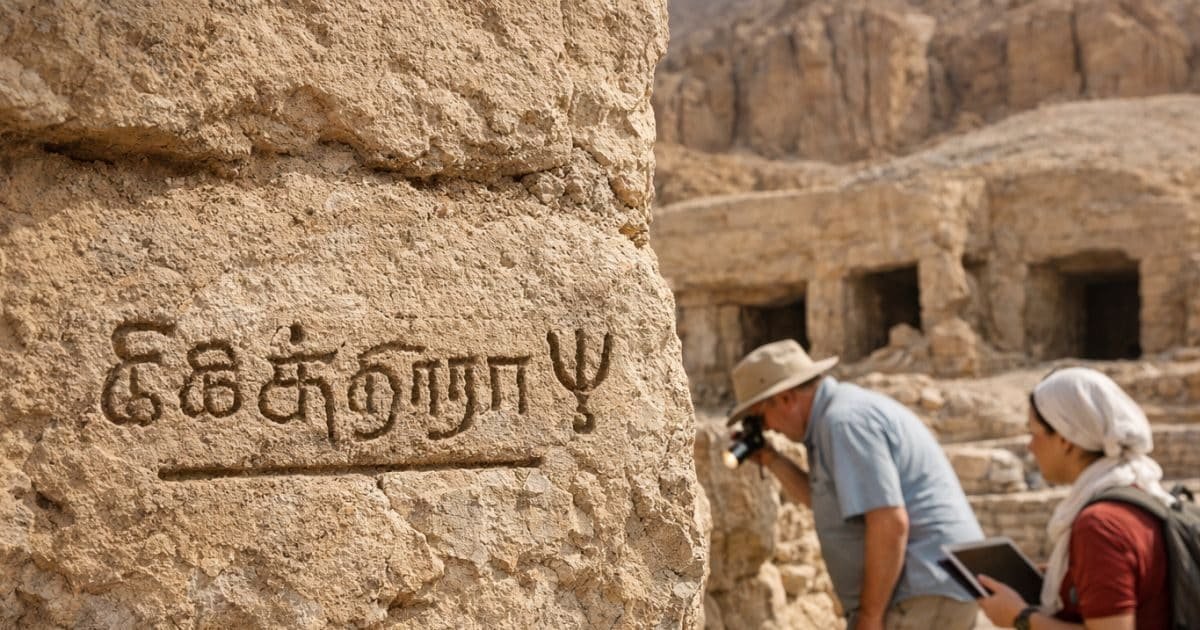
New Delhi: Till now we have read about the trade relations between India and Egypt in history books, but a recent discovery has made it even more exciting. Researchers from Switzerland and France have discovered 2,000-year-old Tamil-Brahmi inscriptions on tombs located in Egypt’s famous ‘Valley of Kings’. This discovery proves that in ancient times, Indian traders not only visited the ports of Egypt, but they also had a keen interest in the tourist places and culture there.
Who was ‘Sigai Korran’? who carved his name on stones
Swiss scholar Ingo Strauch and French researcher Charlotte Schmidt have discovered and decoded these inscriptions. They found that about 2,000 years ago a Tamil merchant had visited the tombs of Egyptian kings (Pharaohs). He had scratched his name ‘Cikai Korran’ at eight different places in five of the six tombs. In Tamil, ‘Sigai’ means crown or braid and ‘Corran’ means leader or king.
According to a report published in Times of India, ‘Sigai Korran- Vara Kant’ was found written at one place, which means ‘He came and he saw’. Researchers believe that this merchant probably also understood the Greek language, because he carved his name there, imitating the style of Greek inscriptions.
There was interest not only in business but also in tourism.
Professor Ingo Strauch of the University of Lausanne said that till now we had found evidence of the presence of Tamil traders only in the coastal ports of Egypt. But the finding of these inscriptions in interior areas like Valley of Kings shows that Tamil traders stayed there for a long time. They not only came to sell and buy goods, but also traveled for miles on foot to see the architecture and history of the place.
Traces of North India also found: Confluence of Sanskrit and Prakrit
Researchers have discovered a total of 30 inscriptions in the Valley of the Kings, out of which 20 are in Tamil. The rest of the inscriptions are in Sanskrit, Prakrit and Gandhari-Kharoshthi languages. This makes it clear that at that time, not only South India, but also traders from Gujarat, Maharashtra and North-West India used to travel to Egypt during the Roman period. A Sanskrit inscription also mentions an envoy from the ‘Kshaharata’ dynasty of western India, who arrived there during the 1st century AD.
The biggest proof of two-way trade
Senior epigraphist Y. According to Subbarayalu and archaeologist V. Selvakumar, this discovery is strong evidence of ‘two-way trade’. Till now it was believed that only Roman traders came to India, but now it is clear that Indian traders were equally actively reaching out to Rome and the Egyptian empire.