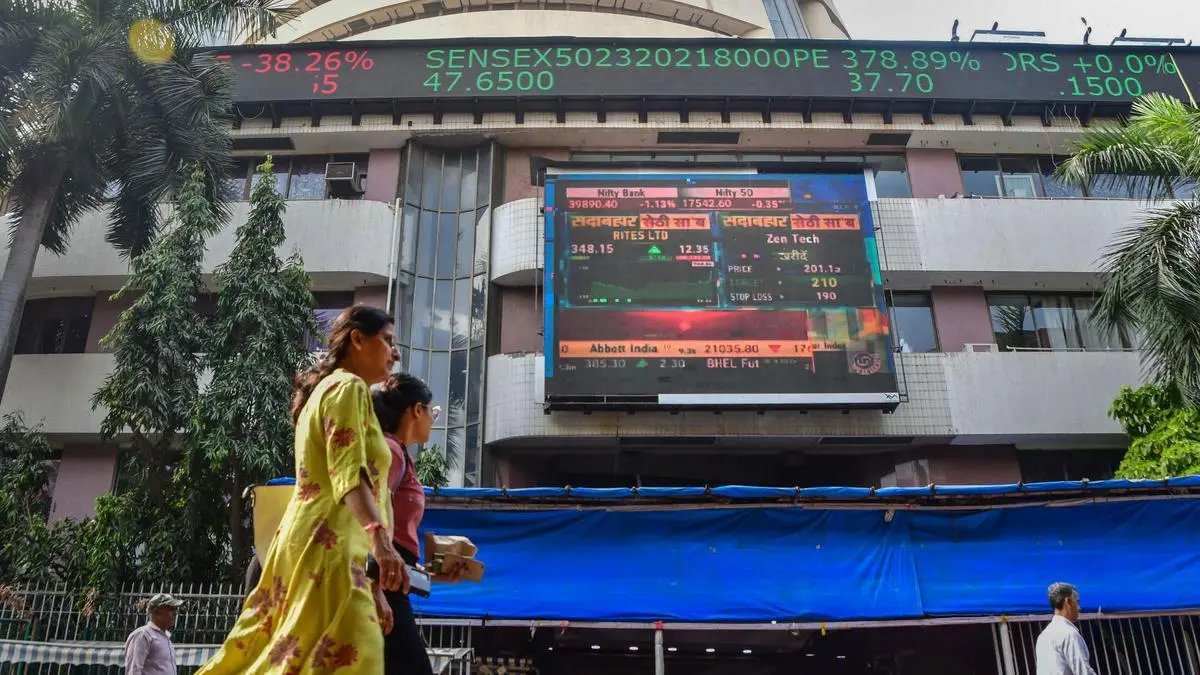

Experts called it a continuation budget, balancing near-term market concerns with structural positives. | Photo Credit: PTI
The Union Budget 2026-27 has drawn mixed reactions from market participants, with experts highlighting the government’s focus on fiscal discipline and infrastructure spending while expressing disappointment over the increased securities transaction tax and the lack of capital gains tax relief.
STT Hike
The budget increased STT on futures from 0.02 per cent to 0.05 per cent and raised STT on options premiums to 0.15 per cent from 0.1 per cent, a move that dominated immediate market sentiment. “The only real negative in the Budget is the increase in STT on derivatives, and that’s what the market is reacting to in the short term,” said Amisha Vora, Chairperson and Managing Director of PL Capital – Prabhudas Lilladher.
Tushar Badjate, Director of Badjate Stock & Shares, said the STT increase “came as an unwelcome move for market participants at a time when equity markets have been under pressure and foreign institutional flows have remained volatile.” He noted that expectations were high for rationalization of capital gains taxation, but “the Budget largely maintained the status quo on taxation.”
Structural Positives
Several experts emphasized the budget’s structural positives despite the near-term negatives. The government maintained capital expenditure at ₹12.2 lakh crore for FY27, representing a 9 per cent increase. “Capital markets play a crucial role in economic growth, currency stability, and capital formation,” Badjate added, calling the absence of targeted incentives for foreign institutional participation “a missed opportunity.”
On fiscal discipline, Anirudh Garg, Partner and Fund Manager at INVasset PMS, said the government’s adherence to “a fiscal deficit path of 4.4 per cent in FY26 and 4.3 per cent in FY27, alongside a gradual reduction in the debt-to-GDP ratio toward the mid-50 per cent range, signals continuity and discipline.”
Foreign Investment
The budget proposed measures to attract foreign investment, including allowing non-resident individuals wider access to invest in listed equities and raising PMS investment limits for NRIs to 24 per cent from 5-10 per cent. “This is a strong positive for capital flows,” Vora said. Manoj Purohit, Partner at BDO India, described the amendment as “much-awaited” and said it would “not only increase inflows but also help stabilize the currency and capital markets.”
Financial Reforms
Financial sector reforms featured prominently. Gayathri Parthasarathy, Partner and Leader – Financial Services at PwC India, highlighted “the strong emphasis on financial sector reforms”, including a proposed high-level committee on banking to “align the sector with India’s next growth phase and help in achieving Viksit Bharat goals.”
Market Innovations
The budget introduced market-making framework and total return swaps on corporate bonds. Mahavir Lunawat, Chairman and Managing Director of Pantomath Capital, called this “a game-changer” that “ensures that investors can buy and sell with much greater ease and lower costs.”
Strategic Investments
Infrastructure and manufacturing received significant attention. Darshan Rathod, COO of MULTYFI, said the rare earth corridors across four states represent “India’s calculated move to capture supply chain fragmentation away from China.” The Bio Pharma Shakti allocation of ₹10,000 crore and Semiconductor Mission 2.0 were described as “strategic investments in sectors where India possesses latent comparative advantages.”
Data Center Boost
N. ArunaGiri, CEO of TrustLine Holdings, said “the tax exemption for foreign investments in data centers is a welcome step and reinforces India’s positioning as a global investment destination.” He added that “safe harbor clarifications and related provisions introduced in the Budget are likely to meaningfully boost investments by Global Capability Centres.”
Stable Outlook
Sonam Srivastava, Founder and Fund Manager at Wright Research PMS, described the budget as “a continuation budget rather than a disruptive one, which in itself is a positive at this stage of the cycle.” She noted that “stable tax policy, predictable capex, and bond market deepening together improve India’s relative attractiveness versus other EMs.”
Published on February 1, 2026